To the Hive Mind -- If anyone can figure this out - I'll buy you a beer at Airventure.
As part of solving any puzzle, it's good to have a view of the forest first - so here's the configuration:
RV-7
IO-360-A1B6 - 9.75" Pulley
Plane Power AL12-EI60B Alternator - 2.75" Pulley
Monkworks MZ30L Standby Generator
Lightspeed Plasma III Ignitions (2)
EarthX ETX680 Primary Battery
TCW IBBS Backup Battery - outputs wired to G3X system(s)
Old fashioned Klixon 7277 breakers, no VPX or similar "systems"
Whelen LED Lighting - "Off"
Avionics, Radios - "Off"
--
No Capacitor filtering on alternator B lead
Standby Generator is "Off"
TCW Backup Battery is "On"
--
Scope probe is connected to the aircraft buss and airframe ground and set to X1 attenuation. AC coupled. DC triggered
----Here we go----
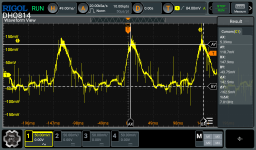
The attached scope shots are from the aircraft electrical buss while running the engine at ~1200RPM.
And another with the Alternator Field turned off; only the battery is supplying the buss:
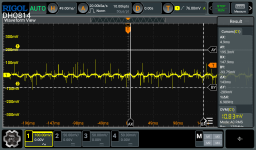
If you look at the first image, you can see the "humps" in the second image superimposed on the waveform.
Turning off the ignitions causes the "humps" to go away. I think I have an understanding of where this signal is coming from (CDI charge/discharge -- 4cyl, 2 firings per 360 degrees - at 1200RPM (20RPS) you would expect to see 40 firing events per second -=> 25mSec, which is about what I can derive from the humps above.)
If turning the ignitions off causes the little humps to go away, and turning the alternator field off causes the bigger swings to go away, what is the *real* cause of the bigger swings? Instinctually, you might say "alternator ripple" -- but look closely at the frequency/period of the signal, that's not "normal" ripple.
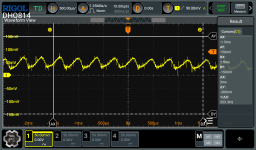
For giggles and grins - here's an image of "normal" ripple from the same alternator (in a different airplane)...note time scale and amplitude difference (ignore the cursors -- just count the dots...)
Enjoy!
As part of solving any puzzle, it's good to have a view of the forest first - so here's the configuration:
RV-7
IO-360-A1B6 - 9.75" Pulley
Plane Power AL12-EI60B Alternator - 2.75" Pulley
Monkworks MZ30L Standby Generator
Lightspeed Plasma III Ignitions (2)
EarthX ETX680 Primary Battery
TCW IBBS Backup Battery - outputs wired to G3X system(s)
Old fashioned Klixon 7277 breakers, no VPX or similar "systems"
Whelen LED Lighting - "Off"
Avionics, Radios - "Off"
--
No Capacitor filtering on alternator B lead
Standby Generator is "Off"
TCW Backup Battery is "On"
--
Scope probe is connected to the aircraft buss and airframe ground and set to X1 attenuation. AC coupled. DC triggered
----Here we go----
The attached scope shots are from the aircraft electrical buss while running the engine at ~1200RPM.
And another with the Alternator Field turned off; only the battery is supplying the buss:
If you look at the first image, you can see the "humps" in the second image superimposed on the waveform.
Turning off the ignitions causes the "humps" to go away. I think I have an understanding of where this signal is coming from (CDI charge/discharge -- 4cyl, 2 firings per 360 degrees - at 1200RPM (20RPS) you would expect to see 40 firing events per second -=> 25mSec, which is about what I can derive from the humps above.)
If turning the ignitions off causes the little humps to go away, and turning the alternator field off causes the bigger swings to go away, what is the *real* cause of the bigger swings? Instinctually, you might say "alternator ripple" -- but look closely at the frequency/period of the signal, that's not "normal" ripple.
For giggles and grins - here's an image of "normal" ripple from the same alternator (in a different airplane)...note time scale and amplitude difference (ignore the cursors -- just count the dots...)
Enjoy!