Van's Air Force

The definitive Van's Aircraft support community! Buying, building or flying an RV? Join our exclusive family of mentors and enthusiasts!

Stick breaks - Now what?

Webb

Well Known Member
Sponsor
There have been several threads recently about loose connections in the control column.

And just as you are having fun, the stick no longer controls the plane in your RV-8. So…..you activate the auto pilot to keep your wings level and maintain altitude. Upon investigation you find the 25 cent bolt that connects the bottom of the stick to the control column is missing due to improper installation (missing washers). Further investigation is the stick end cracked and that’s why the bolt separated and is still in the rod end bearing. Replacing the bolt is not an option.

You have plenty of fuel and the auto pilot is holding the plane level (pitch and roll).

How will you get back on the ground so you can change your underwear?
 
The auto pilot will fly an approach for you. Then you use secondary effects of power to flare. If you have no auto pilot you need to use the secondary effects of rudder to control direction (roll) and power to control pitch.
That’s as long as the aircraft was trimmed when it broke.
You need a nice long runway and plenty of room.
Think Suiox City and DC-10.
 
As above you can trim for pitch and use rudder for roll. On the F1 you can also reach behind and use the rear stick. It’s not actually difficult but this would of course depend on where the malfunction occurred. I practiced with the rear stick a bit. Give it 5 minutes and I think you would be comfortable getting it down.
 
Most certified planes have an emergency checklist dealing with control system failure. The elevator fail checklist from a 172 basically says set power and trim for 65kts, then control pitch with power alone until the landing roundout, at which time you reduce power and crank in aft trim to get something approximating a flare.

Seems like some variation of this would work for most airplanes.
 
I tried it9

I've tried landing with feet and power only, a couple of times. If the situation was real I probably would have died.

May attempt it at a lower power setting sometime. It's kind of a fun exercise.
 
Also consider flaps. They tend to induce a strong nose down pitch moment. You can use them as an elevator that has very slow reaction time.

Set flaps halfway down, trim for 70 knots and a gradual descent. As you near the ground, begin raising the flaps. Voila.. squeaker...I hope. ;-)
 
For Real

This actually happened to a pilot flying a Rocket at Borrego Springs CA. He was practicing akro and the stick broke on a down line. No chance to recover, and he died.
 
In an 8 (and a 4) you would still have roll control with the fwd stick.
If the rear stick is installed you could reach behind the seat and use that stick for pitch control ( it has been done with a 4…. Interconnect push/pull tube between the two sticks came apart because one end wasn’t riveted).
 
Has this ever happened?

I know this is a thought exercise, but I can’t help but ask, has this ever happened to anyone before?

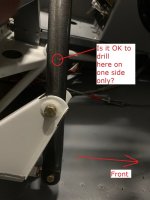
There has been a lot of discussion about drilling a hole at the base of the stick for infinity grip somehow making it susceptible to fracturing, but that seems extremely unlikely to me.

So, the question arises, has any 8 Pilot ever experienced a fracture of the front stick?

Thanks,

Steve Ashby
 
There has been a lot of discussion about drilling a hole at the base of the stick for infinity grip somehow making it susceptible to fracturing, but that seems extremely unlikely to me.

That type of thinking is one of the hidden dangers of the experimental aircraft world.
Lack of knowledge does not justify unbelief.
The majority of RV builders probably have no clue how high the loads can be on the portion of a control stick that typically gets the hole drilled, when the aircraft is in a limit load situation. (in reality, the stick needs to survive to ultimate load without a catastrophic failure. That load is 50% higher than what it would be at six G’s.)
Add to that the variable of hole location, because where the hole is placed, can be a factor in whether it would fail or not.
 
Last edited:
I know this is a thought exercise, but I can’t help but ask, has this ever happened to anyone before?


Thanks,

Steve Ashby

There is a very good podcast in AOPA’s “There I was …” series in which Sean Tucker lost pitch control in the Oracle aerobatic plane. Spoiler alert - after attempting a landing unsuccessfully, he bailed out. A very worthwhile listen …
https://podcasts.apple.com/us/podcast/there-i-was-an-aviation-podcast/id1240482999?i=1000394346295
 
Be prepared

I don’t much care for “what if” speculation but do like teachable moments. Since your scenario pretty much describes his last bailout, zoom in to top of photo for an answer.
 

Attachments

  • 862931B4-ED83-46B1-9D84-043E1FB2E504.jpg
    862931B4-ED83-46B1-9D84-043E1FB2E504.jpg
    203.5 KB · Views: 358
Tucker

The Tucker accident was caused buy an inferior rod end bearing that was mixed in with a group of proper bearings.
Lots of other examples.
In the long ago era when the Beech 18 was a popular corporate airplane there were three pitch control failures due to bolt at elevator not properly installed/safetied. All landed safely. The Beech 18 is one of the easier airplanes to fly with trim only for pitch control.
Lots of other examples including three midget racers. No pitch trim installed. Two landed safely, one crashed fatally.
 
There has been a lot of discussion about drilling a hole at the base of the stick for infinity grip somehow making it susceptible to fracturing, but that seems extremely unlikely to me.
That type of thinking is one of the hidden dangers of the experimental aircraft world.
Lack of knowledge does not justify unbelief.
The majority of RV builders probably have no clue how high the loads can be on the portion of a control stick that typically gets the hole drilled, when the aircraft is in a limit load situation. (in reality, the stick needs to survive to ultimate load without a catastrophic failure. That load is 50% higher than what it would be at six G’s.)
Add to that the variable of hole location, because where the hole is placed, can be a factor in whether it would fail or not.

Nor does it justify belief, but an apparent lack of any real-world examples is a starting point. Then some FEA and some verification (testing) of what it would take to cause the problem should answer it.

I'm with him on the skepticism, though...this has been talked about before, and nobody AFAIK every provided a case of it *actually* happening.
 
I was tooling around years ago in my 6A burning gas, and thought "what if the elevator control broke somewhere?"
So, I let go of the stick, used (manual) trim for pitch control, rudder for turns, and power. Kind of went back to the old two-channel RC days....
Set up for a 500fpm descent, and got myself lined up for the runway on the VASI. When the flaps came out it got sporty, but that would be done up higher if I did it again.
Anyway, I convinced myself that I could get it on the ground, but would likely bend something. And that's okay!
 
Let me be Danny Downer. Total failure of pitch or roll control could be fatal.

With that said the flight control system (push pull rods) is pretty stout. So built, inspect and maintain the flight control system like your life depends on it. It does. Do this it makes thread moot and just mental gymnastics. Fun as this thought experiment is, jammed, locked, disconnected controls is right up there with wing fell off in lethality. Do pay attention to it with no compromise.

I have seen some crazy stuff in GA both certified and EAB, and large jets with Flt control issues that could kill you. Often issues happen after maintenance. Tools left in, fasteners not installed or loose, connected backwards. It is so important air transport cat aircraft have massive redundancy, often 3 independent systems.

This is why we do a CONTROL CHECK. TAKE IT SERIOUSLY. MANY PILOTS HAVE DIED NOT DOING THIS PRE TAKEOFF CHECK. Yes look to see aileron is up on side stick is pushed towards. If Cessna/Piper/Beechcraft/Mooney w/ yoke your thumbs are pointing at up aileron. Take it to full 4 corners. I see pilots casually wiggle the stick. No.
 
Last edited:
Nor does it justify belief, but an apparent lack of any real-world examples is a starting point. Then some FEA and some verification (testing) of what it would take to cause the problem should answer it.

I'm with him on the skepticism, though...this has been talked about before, and nobody AFAIK every provided a case of it *actually* happening.

When the airplane is designed, the loads on the stick are calculated (you can’t really design a stick and other system components, if you don’t know what loads you’re designing for)
Then the components are tested at that load.
If they pass the tests, then that is how the kit is delivered.

I never said that any hole added to a control stick is automatically going to cause a failure, but there is a very real possibility, that if the hole is added in the wrong place that it could if the stick is ever exposed to loads that are totally possible in flight.
One thing I am fully sick of hearing is an argument against any particular detail that “ there is no known case of it failing”.
That argument could be used for hundreds of different instances where there was no evidence of a failure, until the first one finally occurred.
It is fully possible that there are RVs out there flying that could have a stick failure, but they have just never been in a flight regime that loaded the stick high enough because that instance is so rare.

Just because something is rare, doesn’t mean it won’t eventually happen.

I am not trying to be a fear monger I’m just trying to get people to think realistically.
If you don’t understand the engineering principles of where the highest loads are in something like a control stick then don’t drill holes in it without doing an analysis to prove that it’s still has the same strength it had without the hole.
 
No point risking your life , especially in this day and age … just install and use a BRS/GRS ( or a similar whole plane chute) - these sort of scenarios is what it was designed for .
 
Test what you drill

If you drill a hole in your stick test the forces (On a mock-up stick) the stick can withstand and don't exceed XX% of your test scenario in real life. We are experimental builders, and we need to decide what is our risk tolerance. Brazing a doubler added unknown (At least to me) variables so did not go down that path. Just FYI I drilled at 5/16 hole in the SIDE of my stick.
 
Control Failure

This goes far beyond stick failure. Pitch control failures not caused by drilling a hole in the stick likely far exceed failures of stick. None of the failures I listed previously were the control stick.
The airframe mounted chute has many limitations. I would rate the chute in last place among options for dealing with control failures.
A rudder control failure in some cases is just as bad or worse than pitch control failure.
 
This goes far beyond stick failure. Pitch control failures not caused by drilling a hole in the stick likely far exceed failures of stick. None of the failures I listed previously were the control stick.
The airframe mounted chute has many limitations. I would rate the chute in last place among options for dealing with control failures.
A rudder control failure in some cases is just as bad or worse than pitch control failure.

^^^^
Jim Knows what he is talking about.

The good folks at Softie once told me the number one reason for bailouts is rudder control failure.
 
This goes far beyond stick failure. Pitch control failures not caused by drilling a hole in the stick likely far exceed failures of stick. None of the failures I listed previously were the control stick.
The airframe mounted chute has many limitations. I would rate the chute in last place among options for dealing with control failures.
A rudder control failure in some cases is just as bad or worse than pitch control failure.

Chutes have limitations just like every other safety measure but they certainly save lives and are a great option as part of overall risk management and, frankly in some scenarios would be your only option … and for far less than cost of , often mostly decorative (especially in VFR) , fancy avionics.

In time , flying without a whole airframe chute of some kind will be regarded as the same level of foolishness as driving without a seat belt is regarded now.
 
Last edited:
I’ve tried reaching around to my rear seat stick on my 4, doable but NOT fun!
Over many years of driving a lot of different planes I’ve played with flying without the primary flight controls, used to get bored hence I needed a challenge -)
When I did my ‘bus’ endo many years ago we practiced flight in mechanical law, the last resort law, trim for pitch and rudder for roll, doable but Christ I’d hate to be actually flying a Bus like that!
 
My A&P instructor from years ago worked banner towing out of Long Beach. For those not familiar, when you hook a banner, you pull up hard to peel (rather than) jerk the banner up. This happens right above the ground. He lost the elevator cable while in that hard climb. Used trim and power to get the thing back on the ground safely after practicing approaches at altitude. This was in a Citabria.
 
Lack of knowledge does not justify unbelief.
The majority of RV builders probably have no clue how high the loads can be on the portion of a control stick that typically gets the hole drilled

So it is time for me to drill a hole in the control stick to accommodate stick grip wiring. I took a bit of statics/physics in college a long time ago, but am by no means a P.Eng and maybe I don't know what I don't know...

Thinking about drilling my hole here, but certainly welcome input from those more knowledgeable!
(Also open to the idea of a doubler sleeve if needed...)
 

Attachments

  • WiringHole.JPG
    WiringHole.JPG
    148.3 KB · Views: 55
In Post #27, where the large aircraft lost their vertical tails, note that both planes still had differential thrust available for control. So those were not good examples for this discussion.

And my general reluctance to drill holes in the stick led me to mount the PTT on the throttle. Having a left-hand PTT on my C180 helped that decision, along with a general approach of having things, where reasonably feasible, be operated similarly between the two planes.

Dave
 
How big will the hole be? How many wires will be involved. Grommet or snap bushing? If it’s just a PTT 2-pair, no problem - keep it small. If it’s a larger bundle, make the hole as small as possible, and up as far as possible on the stick above the bushing hole below. If using an infinity grip, you can combine some wires - like grounds. If you have 5 or 6 grounds, consider combining them into one fatter ground wire inside the grip. They all end up in the same place and they are electrically common, plus they are only grounding milliamperes of power.
 
Haven't needed to drill a hole in the stick in my 4, 7 or 8 for the wires from Tosten CS-8 grips with hat and 4 other switches. I put heat shrink on the wires where they contact the cross tube to where they exit the bottom. Personally I would not drill a hole in the stick unless it was approved by Vans.
 
Once upon a time there was a space shuttle launch, with some concern about o-rings on the boosters. Well, they've never failed before, so go! As Scott said, just because no one has had it happen yet does not mean it isn't a risk.
 
Once upon a time there was a space shuttle launch, with some concern about o-rings on the boosters. Well, they've never failed before, so go! As Scott said, jusnoonehas had it happen yet does not mean it isn't a risk.The original Wittma Tn\\\]\ailwind W8 had eight known failures of the pitch control system.
 
Eight known failures of pitch control on early model Wittman Tailwinds. All l
Three Beech 18's
Three midget racers, one fatal.
Rick Masagee, aerobatic monoplane, bailed out
PittsS2A control stick jammed, would not move aft of neutral. Landed safely.
Bob Herendeen stick failed at drilled hole, he was able to do an inflight repair.
Sukhoi SU29 Koss if pitch control due to bolt not safetied, Fatal
In thje Red Devils era the EAA museum was maintaining the three :Pitts S1S's. They museum shop ran 1/16 cable from the bottom of the stick to the elevator horns. Up elevator but down elevator could be obtained with trim

 
Back
Top