Van's Air Force

The definitive Van's Aircraft support community! Buying, building or flying an RV? Join our exclusive family of mentors and enthusiasts!

Starter Motor - Rotax 9-Series Engines

Piper J3

Well Known Member
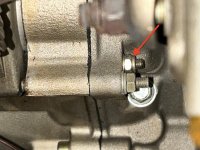
My friend’s RV-12 w/ 450TT 912ULS just experienced a sudden problem with the starter motor. We tried to start the engine and the starter motor spun but the engine didn’t crank. I feared that the Sprag clutch had failed. Upon inspection we found that the starter motor had loosened and backed-out of the ignition housing to the point where the drive gear was no longer in mesh with the annular gear on the Sprag clutch. The two 5mm nuts that hold the starter motor in place were missing. The starter had backed-out about 3/8” and only remained in place because there is a strap that holds the outside diameter to a flange on the ignition housing. See photos... The repair consisted of loosening the strap, reinserting the starter motor, and fastening with new 5mm nuts.

This doesn’t seem like a big problem and no permanent damage was done. I mention this incident because of what could have happened…. If the starter motor had pulled completely out of the ignition housing the crankcase would lose its positive pressure and oil would no longer return to the holding tank. The oil pump would continue supplying oil to the engine and all the oil would accumulate in the crankcase. The oil pump would run dry when the holding tank emptied and the engine would seize. I think before that would happen the oil would pour out of the starter motor mounting hole and most likely catch fire on the hot #3 exhaust stack.

This can happen on all Rotax 9-series engines… I have added a special task to my Annual Condition Inspection that now includes checking the 5mm nuts that hold the starter motor.
----
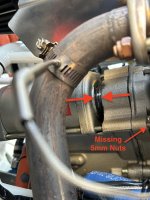
1741939621698.jpeg 1741939688493.jpeg
 
Curious about the maintenance history of this airplane. Is it possible the starter motor was removed at some point and the nuts never reinstalled or not properly tightened? The strap would retain the motor but would slip over time resulting in what you see in the picture.

Is this the same one where the prop was turned backwards ?
 
Last edited:
Correct.... this is engine that had "chatter" when prop was turned backwards. Apparently gears not fully meshed caused the chatter. 5mm nuts missing is big mystery... Everything good now with smooth motion when turned either direction.
 
Why are you turning the prop backwards? I always thought that was a big no no on RV12?

Good catch on starter - something I have never worried about - will add it to my annual checklist. Was there any evidence of torque seal on those nuts or in the general area?
 
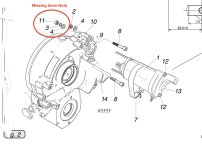
The diagram up top is outdated, as M5 Cap Nuts are specifically allowed per the Rotax Maintenance Manual (Heavy). Tightening torque is 6 Nm (53 in.lb). I also can't see whether the Distance Sleeves are installed on the starter. Also might want to pull it back off and ensure there's a fresh bead of Loctite anti-seize around the o-ring.
 
I’m doing Condition Inspection on my legacy RV-12 with Rotax 912ULS and taking my own advice to check security of starter motor mounting bolts. It appears that the 5mm mounting studs have a flat washer and a nyloc nut. No problems in 950TT operation, but I will be applying Torque Seal and have already added inspection item to Condition Inspection Checklist.
 

Attachments

  • M5STARTER.jpeg
    M5STARTER.jpeg
    1.8 MB · Views: 23
Must pull the top cowl and check my 912 cause just today it made an odd noise during start, like the starter kicked back and the motor stopped dead, once started ran well, investigation coming up👍
 
Must pull the top cowl and check my 912 cause just today it made an odd noise during start, like the starter kicked back and the motor stopped dead, once started ran well, investigation coming up👍
Unlike automotive, Lycoming, or Continental engines that utilize a Bendix engagement to a ring gear…. the Rotax 9-series engines utilize a one-way over-running Sprag clutch. The starter motor gear is always engaged with the gear cluster at the rear accessory housing. When the starter motor is activated the eccentric rollers in the Sprag clutch lock-up and transmit torque to spin the engine. When the engine starts, the eccentric rollers disengage, and the starter motor stops. It is actually a very nice system but it has to be treated with care.

The condition you describe… starter kicked back and the motor stopped dead… is actually worst case scenario for the Sprag clutch.
Early S/N 9-series engines did not have ignition retard for starting and can easily stall the starter motor or kick back as you mentioned. Either case is rough on the Sprag clutch. Replacing the Sprag clutch requires removing the engine from the airplane and purchasing special Rotax tools. Not my idea of fun.

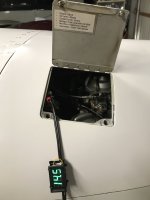
How to treat Sprag clutch with TLC…. keep battery at full charge so starter motor can over-power a kick back. I leave my battery connected to an Odyssey OBC-6A Charger 24/7 when the airplane is hangered. The charger has six automatic charging functions. This is unit is specific for Odyssey AGM batteries and is not a trickle charger. Odyssey recommends using their chargers 24/7. When the battery is at full charge, the charge cycle terminates and only reinstates if the voltage dips low. I have been 24/7 charging my Odyssey PC680 for at least 5 years. Engine cranks fast even in cooler temps…
 

Attachments

  • DAA81B75-FD26-4586-83C0-52F0203B517C_1_105_c.jpeg
    DAA81B75-FD26-4586-83C0-52F0203B517C_1_105_c.jpeg
    120.2 KB · Views: 22
Yes, turning it backwards is a huge no no!
Don't do it.
Actually, turning the 9-series engine backwards doesn’t hurt anything... It does drive the starter motor in reverse, but no damage is done. I wouldn’t turn it backwards a whole lot for fear of sucking air into oil pump, but again no problem if 10 turns or so. I have 970TT and have turned engine backwards many times.
 
Actually, turning the 9-series engine backwards doesn’t hurt anything... It does drive the starter motor in reverse, but no damage is done. I wouldn’t turn it backwards a whole lot for fear of sucking air into oil pump, but again no problem if 10 turns or so. I have 970TT and have turned engine backwards many times.
Have a talk with Lockwood. He and many other experts expressly warn against turning it backwards. You’ll screw up sprags, suck air into lifters, suck air into places that should be oil filled, like the crank shaft…Talk to the experts. I will never turn mine backwards.
 
Have a talk with Lockwood. He and many other experts expressly warn against turning it backwards. You’ll screw up sprags, suck air into lifters, suck air into places that should be oil filled, like the crank shaft…Talk to the experts. I will never turn mine backwards.
I have talked to experts that are independent as well as IRMT instructors. The sprag clutch damage from reverse rotation seems to be based in poor understanding and an implied relationship since it's a once way clutch and there were sprag failures. It's not an established cause of damage, just aviation rumor-mill aka "conventional wisdom".

The guidance not to turn backwards does come from the potential to put air into the oil system. This is to be discouraged, as you mention. It's not something we want to do. I avoid turning mine backwards too, other than what is necessary to position the prop for maintenance tasks.

That said, the air in lifter system and purging scenarios are also often overstated. I have been around people love to state with authority that air in the line means there will be a catastrophic failure if you run the engine without a 100% purged line. I always like to ask them if they have actually read the purge procedure and they say they have. Curiously, they never seem to remember that the guidance if you fail the feeler gauge test a couple times is to start up the engine and run it at power for a few minutes as this is understood to clear the air. If it doesn't, you then have important issues to address. Again, I don't mean to minimize this or say people should take it casually, but the discussion does not always square up with actual Rotax documentation.
 
I hear all the talk about air getting into the oil gallery and pumping up the lifters… What we need to hear from the “experts” is what happens when you drain the remote oil tank when changing oil. The dip tube in the oil tank is approx 8” long and it goes dry when the tank is emptied. When new oil is replenished, the dip tube retains the 8” column of air and it gets sucked into the engine on the next start-up. Likewise with the oil filter… some folks pre-fill the filter before install but some air still gets into the galleries.

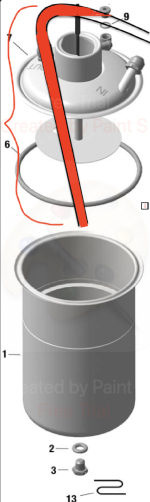
See drawing below... 8” length of dip tube and upper portion of oil hose (marked in red) looses its oil-charge when tank is drained / refilled.
-------
1746800519732.png
 
A little clarification on Sprag clutch as well… The Sprag eccentric rollers will cam and transmit torque regardless if driven from inner or outer race. Back-driving the starter motor is miniscule torque compared to spinning engine with four cylinders at 10.8:1 compression ratio. What the Sprag clutch cannot tolerate well is engine backfire (reverse rotation) while starter motor is engaged. Weak battery and slow cranking speed is the enemy. I keep my battery on Odyssey battery charger 24/7 when airplane is hangered.
 
Wha
"Anytime the oiling system is touched" is not at all what it says, but I would guess you have the reading skills to already know that.

Good luck finishing up the build Tim!

Ok, I'll quote it:

"Compliance

These inspections have to be performed

- before first engine run,

- after re-installation (e.g. after overhaul),

- after lubrication system opened and drained during maintenance work (e.g. removal of oil
pump, oil cooler or suction line).
NOTE: Not affected are the removal and replacement of components that do not drain the oil
pressure galleries.

These maintenance instructions shall be considered at any maintenace events, retrofitting, repair
and overhaul.

"

So, I paraphrased it.
 
NOTE: Not affected are the removal and replacement of components that do not drain the oil
pressure galleries.
"

So, I paraphrased it.
That's why Rotax tells us to perform the oil purge procedure anytime the oiling system is touched.

You didn't paraphrase it, you ignored the note regarding what is not affected. The context of that note is also well understood by most Rotax owners, maintainers, and technical instructors.

Again, I have a feeling that you know this and you are arguing for sport.
 
Per thiggins #18 above, and all the paraphrasing… it appears that if the suction line to the oil tank is removed, then a full purge is required. I understand that Rotax is adamount about not introducing air into the pressure oil system… I get it. However, the question remains... during a normal oil change we introduce a large slug of air into the suction dip tube when the oil tank is drained and refilled. No one is addressing this concern and apparently its not a problem because its done all the time. And… it’s a significant amount of air – 8” L x 0.3” dia = 8 cubic in. See red volume in photo post #14 above.
 
Per thiggins #18 above, and all the paraphrasing… it appears that if the suction line to the oil tank is removed, then a full purge is required. I understand that Rotax is adamount about not introducing air into the pressure oil system… I get it. However, the question remains... during a normal oil change we introduce a large slug of air into the suction dip tube when the oil tank is drained and refilled. No one is addressing this concern and apparently its not a problem because its done all the time. And… it’s a significant amount of air – 8” L x 0.3” dia = 8 cubic in. See red volume in photo post #14 above.
This...along with the procedure for testing for air in the pressurized gallies. If you fail the test you run the engine at 3500 for 5 minutes. If there is still air, you do it again. If there is still air, you do one more time. If there is still air now you probably have a tappet problem. Running the engine pressurizes the gallies unless there is a faulty tappet.

Screenshot 2025-05-09 at 2.54.45 PM.png
 
^^^^ I get all that ^^^^

I just want to know what happens when 8" long slug of air travels into the suction side of the oil pump. This happens everytime I change oil, fire up the engine, and go fly. Zero problems in 970TT.

It would be great if the powers-to-be would address this concern and put our collective minds at ease...
 
I just want to know what happens when 8" long slug of air travels into the suction side of the oil pump.
Based on;
“NOTE: Not affected are the removal and replacement of components that do not drain the oil pressure galleries.”

You are not draining the oil pressure galleries, …… you are not affected.
 
I get that also… Rotax states complete purge needed after lubrication system opened and drained during maintenance work (e.g. removal of oilpump, oil cooler or suction line). My contention is that there is no difference between opening oil suction line allowing ingress of air and draining the oil tank dip tube during an oil change – both instances will allow a slug of air to travel to the inlet of the oil pump. Makes no sense to purge for opening suction line and then not purge and re-establish an oil column in the dip tube after oil change. It appears that after my 20+ oil changes the ingress of air from the oil tank is tolerated well...
 
Are you sure that oil drains out of the intake tube when the tank is drained? Air has to enter form the other side to allow the oil to drain. When a straw is lifted from a soft drink with the upper end covered, the soda pop stays in the straw. Admittedly, the surface tension of oil is not that of water and the diameter of the draw pipe is also a factor.
 
When I added the second oil cooler I replaced a couple of oil lines and added a couple. The work was all done in a few hours. With the top spark plugs out I spun the engine by hand for 100 revolutions, at 20 the oil pressure was up. I started after that and had no problem. I suspect I could have bypassed the hand turning of the engine with the same result.
I just had all the cylinders off and replaced the pistons & lapped the valves. The engine was open for 4 days. After the reassembly I started it with no issues.
Just my experience.
 
When I added the second oil cooler I replaced a couple of oil lines and added a couple. The work was all done in a few hours. With the top spark plugs out I spun the engine by hand for 100 revolutions, at 20 the oil pressure was up. I started after that and had no problem. I suspect I could have bypassed the hand turning of the engine with the same result.
So your recommendation is that it is OK not to bother with the Rotax required procedures? You "suspect" it will be OK. Interesting advice.
 
Back
Top