Van's Air Force

The definitive Van's Aircraft support community! Buying, building or flying an RV? Join our exclusive family of mentors and enthusiasts!

Spark Plugs & Ultrasonic Cleaners....

Reflex

Well Known Member
Friend
After flying off phase I, I'm planning on doing a good inspection and some basic maintenance before taking any passengers. One of the things on my list is inspecting and cleaning spark plugs.

Just wondering if any body has used an ultrasonic cleaner on their plugs and if so how it works? My plan was to make a shelf to sit in the ultrasonic cleaner so that only the dirty end of the spark plug would be immersed. Then use Hoppes #9 solvent as a cleaning fluid.

I did a forum search for "ultrasonic" "spark plugs" and didn't come up with any answers. I see where folks are using ultrasonic cleaners and Hoppes #9 for fuel injectors, but don't see anything for spark plugs.

Thoughts?

Fred
 
After flying off phase I, I'm planning on doing a good inspection and some basic maintenance before taking any passengers. One of the things on my list is inspecting and cleaning spark plugs.

Just wondering if any body has used an ultrasonic cleaner on their plugs and if so how it works? My plan was to make a shelf to sit in the ultrasonic cleaner so that only the dirty end of the spark plug would be immersed. Then use Hoppes #9 solvent as a cleaning fluid.

I did a forum search for "ultrasonic" "spark plugs" and didn't come up with any answers. I see where folks are using ultrasonic cleaners and Hoppes #9 for fuel injectors, but don't see anything for spark plugs.

Thoughts?

Fred
I'd buy a pneumatic plug blaster and save your time. I love Hoppes powder blaster but I doubt its effectiveness on the crystal-like lead deposits often encountered.

Will be hard to beat blasting media for cleaning the electrodes. If lead deposits are a problem, get a vibrating cleaner. Both are inexpensive. If you do decide to experiment with the US cleaner and Hoppes, give us a report.
 
I'm assuming you are talking about aviation spark plugs. My A&P uses a pneumatic blaster for those and he says it works fairly well most of the time. I have pmag electronic ignition and use NGK BR8-ES plugs at $3 per plug so I just pitch 'em about every other oil change.
 
There really is no need to clean the plugs. Lead deposits do not stick to the plug and are very easy to remove with a pick. They are just wedged into the crevices of the plug. All the other stuff is carbon and will burn off at higher temps. Most of what you see on the plug is from the couple of minutes of idle (i.e. not enough heat to burn off deposits) before it was last shut down.
 
Last edited:
I switched a long time ago to iridium and never looked back. No fouling, few if any clunkers, hotter, no gapping, easy to no cleaning, etc…..However, now at over $150/plug, the cost is tough to swallow.
They advertise you will get it back over the life of standard plugs at tbo, but not so sure.
Having just paid for my Slick 500hr inspection and rework, PMags and auto plugs sure look appealing.
 
If you insist on bead blasting your aviation plugs, tape the threads to avoid damage. Also, after the blast with air only that is meant to clear out any remaining grit, do this.....

Take a glass container and pour 2 inches of gas in it and dip the plug in with a pumping movement. This will remove any remaining grit that would have ended up in the cylinder.

I do the same as ir72... If you lean always, your plugs will be clean, except for the lead.
 
I pick out the little granules if any, wire brush the threads, softbrush electrodes with minspit (i.e., mineral spirits), apply champion anti-seize and re-insert. LR72 is right.
 
Actually, they only recommend against using glass beads. Standard plug abrasive cleaning is approved.
I was taught to glass bead plugs in the 70’s while maintaining R2800’s. This was surprising to me when I ran across it a few years ago. When I spoke to Tempest about this they prefer no abrasive blasting, but say that if you must, there are larger diameter plug specific blasting media that will reduce the damage. I no longer blast, rather flush with naptha and pick out the lead beads. Works fine and less messy.
 
I was taught to glass bead plugs in the 70’s while maintaining R2800’s. This was surprising to me when I ran across it a few years ago. When I spoke to Tempest about this they prefer no abrasive blasting, but say that if you must, there are larger diameter plug specific blasting media that will reduce the damage. I no longer blast, rather flush with naptha and pick out the lead beads. Works fine and less messy.
Well Tempest’s own documentation doesn’t say they prefer you not to use abrasive cleaning, just not to use glass beads. I’ve never talked to anyone at Tempest so I have to rely on what they say their documentation which clearly spells it out.
 
I was taught to glass bead plugs in the 70’s while maintaining R2800’s. This was surprising to me when I ran across it a few years ago. When I spoke to Tempest about this they prefer no abrasive blasting, but say that if you must, there are larger diameter plug specific blasting media that will reduce the damage. I no longer blast, rather flush with naptha and pick out the lead beads. Works fine and less messy.
The center insulator is ceramic and blasting will wear it away relatively quickly. I am sure some blasting media is more aggressive and eat it away faster. Again, why wear this away for no real benefit?
 
Not advocating blast vs not. Haven't looked at Champion documentation in a few decades, if ever. Champion did used to sell a very nice, very expensive plug cleaner and tester. Was a little envious of anyone that had one. Anecdote = at least one OEM didn't have a problem with blasting. Of course, maybe it led to some sales revenue because the insulator got eroded through cleaning. Maybe their testers and plugs only warranted a special, approved blast media that you had to purchase from Champion that was 20X the cost of other media.

For the record, I blast clean mine with the bench top ATS device because I always have. Never noticed any insulator erosion. You do have to check for any media lodged between the two electrodes when done.

All this, FWIW.
 
my two engines have reached over 3,000 hrs each with one set of iridium plugs each. the only reason you take them out is to do the engine maintenance at inspection time. flush, scope, comps.
 
I did a forum search for "ultrasonic" "spark plugs" and didn't come up with any answers. I see where folks are using ultrasonic cleaners and Hoppes #9 for fuel injectors, but don't see anything for spark plugs.
Be careful. Hoppes #9 has a flash point of 12.8°C (55°F). Cleans well, but has a low flash point if you heat the Hoppes.
 
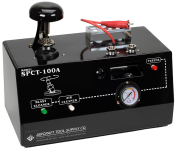
This is the one I have because it can clean and then test spark plugs under pressure. Found one used for considerably less some years back -- it will last a lifetime!

 
I read that and it says to use standard abrasives, 10-30 PSI
I just read the version that I linked to and you are correct. A few years ago, Tempest did a talk at OSH and said only last resort to blast, and at that time the document reflected that. Seems like they moderated that position if you use the proper media. I started cleaning without media back in the 20 teens when they stated no media blasting and have found no reason to go back.
 
I just read the version that I linked to and you are correct. A few years ago, Tempest did a talk at OSH and said only last resort to blast, and at that time the document reflected that. Seems like they moderated that position if you use the proper media. I started cleaning without media back in the 20 teens when they stated no media blasting and have found no reason to go back.
The spark plug cleaner I use, which is now sold by Aircraft Supply Company, was initially designed and manufactured by Champion to specifically clean and test aircraft spark plugs--many of these are in A&P shops around the world. It uses ground-up walnut shells as a softer abrasive medium and doesn't damage plugs. And then, you can test the spark plug under pressure on the same machine--really nice! I've found that my electrodes wear into an oval shape over time as they normally would while running in the engine, and they last just as long. My days of using a dental-pick to clean spark plugs are long past. (y):cool:(y)

1755735008430.png
 
Just a note that Tempest advises against abrasive blasting for cleaning, nor do they recommend soaking the plug in fluids. https://aeroaccessories.com/wp-content/uploads/2020/12/1710A_Rev-E.pdf
The actual wording of Section 4-3-4 Cleaning the Firing and Barrel Ends is:
Clean the firing and barrel ends of plugs with standard abrasive blast cleaning.
40 psi Maximum recommended setting for this operation or other detail.
Glass beads are not good when it comes to cleaning aircraft spark plugs.

Thanks for the link. Very informative and the cleaning procedures are much more extensive than I was taught.
 
The spark plug cleaner I use, which is now sold by Aircraft Supply Company, was initially designed and manufactured by Champion to specifically clean and test aircraft spark plugs--many of these are in A&P shops around the world. It uses ground-up walnut shells as a softer abrasive medium and doesn't damage plugs. And then, you can test the spark plug under pressure on the same machine--really nice! I've found that my electrodes wear into an oval shape over time as they normally would while running in the engine, and they last just as long. My days of using a dental-pick to clean spark plugs are long past. (y):cool:(y)

View attachment 95510
I used an old Champion version of this back in the late 1960’s. The company I worked for had radial engine powered radials. Lots of plugs to clean.
 
Back
Top