Van's Air Force

The definitive Van's Aircraft support community! Buying, building or flying an RV? Join our exclusive family of mentors and enthusiasts!

SL-000121

henrysamson

Active Member
Friend
SL-000121 covers the mods needed to install the new Rotax fuel pumps in an RV-12iS. I sure hope mine last a LONG time! Any info on the actual availability of the old pumps?

Although, I do think that the enlarged bottom hatch in the tail cone will make a lot of maintenance issues much easier.

 
Last edited:
Having yet to attach my tail cone (waiting on one last back-ordered part!) I have to ask how often the fuel pumps fail? Is this something I'd want to consider doing now (and ordering new fuel pumps) or just finish the build and keep my fingers crossed like everyone else? This does not look like fun.
 
Is anyone aware of any failures with the original -12iS pumps that are mounted to the bulkhead?
 
Having yet to attach my tail cone (waiting on one last back-ordered part!) I have to ask how often the fuel pumps fail? Is this something I'd want to consider doing now (and ordering new fuel pumps) or just finish the build and keep my fingers crossed like everyone else? This does not look like fun.
That my friend is the question of the day. Much easier to do this SL before the tailcone is installed. New pumps are $$$$$ plus the kit from Van's. Rotax went to the larger pump to mitigate vaporization issues with more volatile fuels and to consolidate around one pump/part-number for all the 91xx series engines. The larger pumps have been standard on the 916 for quite awhile. I am inclined to purchase the SL kit, install the access hatch and extra support now then if (ever) the pump(s) need replacing then complete the new plumbing. Not sure how that flies in the ELSA rules however as my dates don't match the SL aplicability.
 
I just checked my fuel pumps, which have yet to be installed. I'm wondering now whether I have the older or newer pumps. I understand the part numbers are 889.731 and 889.732. The box containing the pump has both numbers stamped on it. Has anyone else seen that? I think the b/o parts I'm waiting on are the revised fittings and tubing, but I wonder if I'll have to go back and redo the mounting brackets?

I was hoping all would be clear when I received the B/O parts, but now it seems murkier than ever.
 
I just checked my fuel pumps, which have yet to be installed. I'm wondering now whether I have the older or newer pumps. I understand the part numbers are 889.731 and 889.732. The box containing the pump has both numbers stamped on it. Has anyone else seen that? I think the b/o parts I'm waiting on are the revised fittings and tubing, but I wonder if I'll have to go back and redo the mounting brackets?

I was hoping all would be clear when I received the B/O parts, but now it seems murkier than ever.

Let me answer my own question. My engine kit shipped on 12/15/25, so it definitely is covered by this service letter. I misread the packing slip which had a scheduled ship date in October. So those are the newer pumps and I am in for some modifications and $$! Kind of happy to do it now, though, rather than after it's all riveted out of sight!
 
If my tail cone was still off I think I would at least cut out for and install the new larger inspection panel. That should not be too expensive. I had an older non-iS tail cone and had to do a cutout for an inspection panel under the pump for the fuel drain. It was vey easy but I used a Dremel cutting wheel and it cut easily and neatly. BUT, a lot of sparks flew. I would not do that now that there is fuel in the system. Even if it is drained I would still worry unless I was sure everything that had fuel in it was removed.

Henry
 
I'm also thinking of purchasing the kit and installing the access hatch then maybe doing the plumbing and the pumps later. Anyone know of a reason this can't be
done? Also the SL does not mention a cover plate. I assume one is included in the kit..
 
SL-000121 covers the mods needed to install the new Rotax fuel pumps in an RV-12iS.
Looking at the Service Letter it indicates it addresses "fuselage kits shipped before 2/20/26, and powerplant kits shipped after 12/1/25." This seems to be a VERY narrow band of affected builders. I would think Van's should just contact that handful of builders directly rather than issue, yet another, Service Letter.
 
Looking at the Service Letter it indicates it addresses "fuselage kits shipped before 2/20/26, and powerplant kits shipped after 12/1/25." This seems to be a VERY narrow band of affected builders. I would think Van's should just contact that handful of builders directly rather than issue, yet another, Service Letter.
But any of us with the older fuel pumps may have to comply with this Service Letter in the future if our pumps need replacement. With the service letter everything that is involved with changing over to the new pumps is easily accessible.

Henry
 
But any of us with the older fuel pumps may have to comply with this Service Letter in the future if our pumps need replacement. With the service letter everything that is involved with changing over to the new pumps is easily accessible.

Henry
Why would we ever need to change over to the new pumps? This is an optional Service Letter and has anyone with a flying -12iS had issues with their fuel pumps???
 
Why would we ever need to change over to the new pumps? This is an optional Service Letter and has anyone with a flying -12iS had issues with their fuel pumps???

I think the logic here is that the old pumps will not be available in the future. If you ever need to replace your pumps, this whole procedure will be necessary to accommodate the new design.
 
If my tail cone was still off I think I would at least cut out for and install the new larger inspection panel.
The larger inspection panel would be wonderful to have (changing fuel filters is always a dreaded task) but next to impossible to add to a flying -12iS.
 
The Rotax service instruction covering this topic and cause of the changes by Van's is SI-912 i-032 R1. The pumps are significantly different, fittings and electrical connections are all different. This is the 3rd iteration of pumps for the 912 series and yes there have been issues, (I think rcarsey published a video about his travails) particularly with the first generation of pumps. The pumps are time limited to 15 years or 5000 hours. We do have planes past that point in the fleet now.
 
The larger inspection panel would be wonderful to have (changing fuel filters is always a dreaded task) but next to impossible to add to a flying -12iS.
Why do you say that? My plane is flying but not painted and I'm considering adding this inspection panel prior to paint in case I DO need it in the future.
 
Why do you say that? My plane is flying but not painted and I'm considering adding this inspection panel prior to paint in case I DO need it in the future.
You don't have paint yet so one barrier down but the sparks will fly cutting that opening and fuel lines, fuel filters, fuel pumps and fuel drain valve are all located right where the sparks will fly!
 
You don't have paint yet so one barrier down but the sparks will fly cutting that opening and fuel lines, fuel filters, fuel pumps and fuel drain valve are all located right where the sparks will fly!
Can this opening be cut with a nibbler tool?
 
I noticed that the SL has you remove the Fuel Shut-off cable and valve. The POH has also been revised. Does anyone know the reason?
 
SL-000121 covers the mods needed to install the new Rotax fuel pumps in an RV-12iS. I sure hope mine last a LONG time! Any info on the actual availability of the old pumps?

Although, I do think that the enlarged bottom hatch in the tail cone will make a lot of maintenance issues much easier.

I received a reply from vans yesterday that the smaller pumps would not be available in the future as Rotax would not be able to source them. Seems to be part of the reason they are updating to this newer pump assembly.

Vans sl-00121-kit has the components for the fuselage updates and apparently you need to order the fuel pump system from Rotax.

It looks like the wiring connectors may be different and possibly fuse changes? Has anyone figured out what the electrical changes are and how to acquire these components? Would it require pulling heavier wires to the pumps?

Thanks, Dave
 
Well, it looks like all of the fuel lines from the tank through the fine filter are 1/2” now, -8 vs. -6 fittings. This includes the finger strainer at the fuel tank, which means fuel tank removal to replace it on already built 12iS. Not a job I’d be looking forward to.
 
I noticed that the SL has you remove the Fuel Shut-off cable and valve. The POH has also been revised. Does anyone know the reason?
Answer to my own post: Revised Flight Training Supplement page 8-5 “On the RV-12iS, the fuel pumps act as a shut-off valve, stopping the flow of fuel to the engine. To stop flow, set both fuel pumps to the “OFF” position.”
 
I received a reply from vans yesterday that the smaller pumps would not be available in the future as Rotax would not be able to source them. Seems to be part of the reason they are updating to this newer pump assembly.

Vans sl-00121-kit has the components for the fuselage updates and apparently you need to order the fuel pump system from Rotax.

It looks like the wiring connectors may be different and possibly fuse changes? Has anyone figured out what the electrical changes are and how to acquire these components? Would it require pulling heavier wires to the pumps?

Thanks, Dave
Gonna be a huge issue for the 12-IS.
SL-00121 is going to be a huge pain for folks that are past the tailcone attach phase.
 
I think the issue is that Rotax is the only supplier, and they have discontinued production in favor of the new design.
But why not continue production? No R&D, no testing, no nothing. It is a known production product that has an existing market.
 
But why not continue production? No R&D, no testing, no nothing. It is a known production product that has an existing market.
Probably a business decision - standardization of pumps across all engine models, one less supply line to maintain.
 
Some builders in the UK with the old fuselage kit plan to install the Andair PX-375S pump instead of the Rotax pumps. It is smaller than even the old Rotax pumps so it doesn't need the larger inspection panel.
 
But why not continue production? No R&D, no testing, no nothing. It is a known production product that has an existing market.
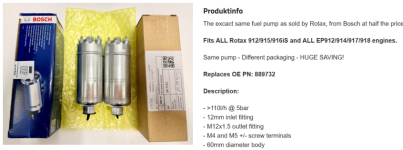
Actually both the old and new are Bosch pumps and available aftermarket. Right now spending 3k$ on pumps from Rotax doesn't make sense to me. Rotax simplified the parts stream as they now have one pump for all 9xx series engines.
 
Actually both the old and new are Bosch pumps and available aftermarket. Right now spending 3k$ on pumps from Rotax doesn't make sense to me. Rotax simplified the parts stream as they now have one pump for all 9xx series engines.
Any chance you know the Bosch p/n for the current pumps used on the RV 12 before the new update?
 
The Bosch pumps were discussed in a VAF thread last fall, which mentioned that they can be sourced from a Norwegian auto parts company. See post #85 in this thread: https://vansairforce.net/threads/2026-rv-12is-upgrades.236552/page-2 (photo below). However, that doesn't include all the associated plumbing pieces, filters, check valves, etc.

Also, Paul Dye and Louise Hose had an article on AvBrief.com on 10 Feb 2026 that included photos of the new pump & plumbing assembly installed on the aft cabin bulkhead, and where the fuel lines come through the firewall. The larger-diameter plumbing is visible in those photos.

I suspect there's going to be continued interest in this very involved SL; might deserve a sticky link of its own, especially if people start reporting their experience putting it into effect.

1774225332223.png
 
Has anyone received their upgrade kit? The web store says it is “in stock”, but my order shows “preparing shipment” for the last 3 weeks. Hmm..
 
Has anyone received their upgrade kit? The web store says it is “in stock”, but my order shows “preparing shipment” for the last 3 weeks. Hmm..
I ordered the kit on 3/22/26 as it showed in stock and I have waited on riveting the tail cone since hearing about the upgrade at airventure last summer. I emailed Vans 4/6/26 and received a reply indicating they were waiting for one part and expecting to have it in a week (never said which week!).
I’m sure they are very busy with so many projects and the push to get the model 15 kits finalized and shipped. I understand the priorities likely gravitate to what generates the most revenue but it really slows down my 12 project.
Long story short, no, I haven’t received my kit yet.
 
Has anyone received their upgrade kit? The web store says it is “in stock”, but my order shows “preparing shipment” for the last 3 weeks. Hmm..
I ordered on 3/18 and my kit shipped on 4/24 and should arrive any day now. I think I was the first to order it because I called in the early afternoon the day the bulletin came out forgetting the time difference and they don't answer the phone until 10am. They did say at the time it'd likely be a month or so since they hadn't started assembling the kits yet, so I feel like they hit that pretty accurately.

Unfortunately, I'm still waiting for the final bag of parts for my engine kit which includes many of the fuel fittings and has been backordered for 5 months. To Van's credit, I emailed them shortly after getting the shipping notice for the SL kit and got a reply within an hour saying they were expecting the final part to complete the backorder sometime in the next week.
 
A synopsis of the reason for the SB as I see it after discussion with Lockwood and others. The new pumps are needed for the higher fuel flows required by the 916 engines and presumably larger displacements to come. Reid Vapor Pressure is a measure of the volatility of gasoline. Even with our "lower" fuel flow demand engines, we can get cavitation at the fuel pump impellors. This can drop fuel pressure with some blends lower than others. I myself have seen drops to 40 psi. According to Lockwood, the engine starts to complain around psi 36. Some folks blend their own by adding a few gallons of 100LL to improve the RVP.

Rotax, for commonality, will supply only one fuel pump assembly. There is no imperative for the 912's to replace the current fuel pump system. If I had a pump failure, I would certainly look to the automotive pump for replacement. That is the origin of the Rotax pumps with different labeling, much like the fuel filters. Maybe even salt one away. We EXP fliers can get away with that.
 
A synopsis of the reason for the SB as I see it after discussion with Lockwood and others. The new pumps are needed for the higher fuel flows required by the 916 engines and presumably larger displacements to come. Reid Vapor Pressure is a measure of the volatility of gasoline. Even with our "lower" fuel flow demand engines, we can get cavitation at the fuel pump impellors. This can drop fuel pressure with some blends lower than others. I myself have seen drops to 40 psi. According to Lockwood, the engine starts to complain around psi 36. Some folks blend their own by adding a few gallons of 100LL to improve the RVP.

Rotax, for commonality, will supply only one fuel pump assembly. There is no imperative for the 912's to replace the current fuel pump system. If I had a pump failure, I would certainly look to the automotive pump for replacement. That is the origin of the Rotax pumps with different labeling, much like the fuel filters. Maybe even salt one away. We EXP fliers can get away with that.
I liked the idea of reducing vapor lock issues but the final straw to hold off building and wait for the kit was the possibility of no pump availability of what I have already assembled. Doing an update to an assembled aircraft looks like a much nastier job than with the tail cone removed.
 
I liked the idea of reducing vapor lock issues but the final straw to hold off building and wait for the kit was the possibility of no pump availability of what I have already assembled. Doing an update to an assembled aircraft looks like a much nastier job than with the tail cone removed.
Yeah, crappy move by Rotax. Image all the aircraft around the world that this impacts. This is a messy one to retrofit due to accessing the area is a real pain!
 
I can’t envision how to install that looooong D fuel line with the tail cone installed. Even running it through the fuselage during construction was a pain let alone after the build. I’ll be interested to see what someone will go through to retrofit on an existing aircraft. Vic said he would post on his experience in doing so. We’ll see how that turns out.
 
I can’t envision how to install that looooong D fuel line with the tail cone installed. Even running it through the fuselage during construction was a pain let alone after the build. I’ll be interested to see what someone will go through to retrofit on an existing aircraft. Vic said he would post on his experience in doing so. We’ll see how that turns out.
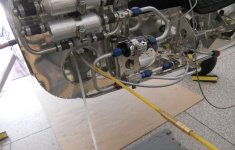
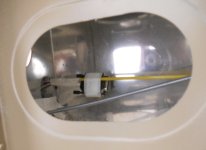
Although I hope never to have to replace my pumps, I had a thought about how to replace that long fuel line if I ever needed to. There is an electrician's tool (Greenlee Fish Stix) that consists of several 3' fiberglass rods (like a fishing pole) that can be screwed together for more length, that would probably fit into the inside diameter of the 3/8" line. It might be possible (not easy though!) to pass the rod(s) through the bulkhead grommets from inside the tailcone, then pass the tubing forward over the rod (the Seldinger technique, if you're a medical person). I've used the Fish Stix several times for purposes other than what they're intended for; this might be another potential use. Hope I never need to find out.
 
Doing an update to an assembled aircraft looks like a much nastier job than with the tail cone removed.
This is a messy one to retrofit due to accessing the area is a real pain!
I can’t envision how to install that looooong D fuel line with the tail cone installed.
Hope I never need to find out.
My thoughts exactly. Rotax should at least run one more production of these fuel pumps so those of us with flying -12iS can stock up on them.
 
That’s what I used to fish the wire harness back to the fuel pumps. The larger diameter tubing will be an added challenge as I seem to recall the 3/8” lines fit pretty tightly in the plastic spacers so not sure how the 1/2” tubes will fit.
 

Attachments

  • IMG_3074.jpeg
    IMG_3074.jpeg
    320.6 KB · Views: 30
  • IMG_3073.jpeg
    IMG_3073.jpeg
    145.6 KB · Views: 28
My thoughts exactly. Rotax should at least run one more production of these fuel pumps so those of us with flying -12iS can stock up on them.
I remember reading somewhere that there is a Bosch pump that appears to have identical appearance and specs to the Rotax pump (wouldn’t be surprised if Rotax uses rebranded Bosch pumps). I’ll have to see if I can dig that up again.
 
I remember reading somewhere that there is a Bosch pump that appears to have identical appearance and specs to the Rotax pump (wouldn’t be surprised if Rotax uses rebranded Bosch pumps). I’ll have to see if I can dig that up again.
My pumps came in a box with a Rotax label, but the pumps themselves are clearly stamped Bosch. (These are the new pumps.)
 
Where does vapor lock occur on the 912iS system? Does it occur from cavitation in the pumps? Somewhere in the fuel lines? Is it related to insufficient fuel flow? The excellent video by Ron Singh & Rian Johnson that summarizes how high temps & high altitude can lead to vapor lock in the 912iS doesn't get into that level of detail.

According to Rotax Installation Manual information, the pumps supplied with the 916iS engine (i.e. the new ones for the 912iS) can supply up to 150 L/hr, while the pumps previously supplied with the 912iS engines can supply up to 120 L/hr. However, both the 912iS and 916iS Installation Manuals specify the same minimum size for fuel lines, both supply and return (3/8"), fittings (AN6), the same fine filter specs, and the same mesh size for the coarse filter.

SL-00121 presents an intimidating total fuel system replacement (I'm eagerly awaiting Vic Syracuse's video of the process), and the Rotax info implies (not proves) that replacing the fuel lines should not be necessary-- is the fuel flow limited by 3/8" lines & AN6 fittings? I would like to know that replacing the fuel lines (tubing, fittings, etc.) as well as the pumps is necessary to prevent vapor lock. I'd like to know what Van's tested when they converted to the new pumps specified in SL-00121: did they test replacing just the pumps but not the lines, and find that inadequate? I sent a question to Van's a few months ago but got a brush-off reply.

Any actual information or data would be welcome.
 
Where does vapor lock occur on the 912iS system? Does it occur from cavitation in the pumps? Somewhere in the fuel lines? Is it related to insufficient fuel flow? The excellent video by Ron Singh & Rian Johnson that summarizes how high temps & high altitude can lead to vapor lock in the 912iS doesn't get into that level of detail.

According to Rotax Installation Manual information, the pumps supplied with the 916iS engine (i.e. the new ones for the 912iS) can supply up to 150 L/hr, while the pumps previously supplied with the 912iS engines can supply up to 120 L/hr. However, both the 912iS and 916iS Installation Manuals specify the same minimum size for fuel lines, both supply and return (3/8"), fittings (AN6), the same fine filter specs, and the same mesh size for the coarse filter.

SL-00121 presents an intimidating total fuel system replacement (I'm eagerly awaiting Vic Syracuse's video of the process), and the Rotax info implies (not proves) that replacing the fuel lines should not be necessary-- is the fuel flow limited by 3/8" lines & AN6 fittings? I would like to know that replacing the fuel lines (tubing, fittings, etc.) as well as the pumps is necessary to prevent vapor lock. I'd like to know what Van's tested when they converted to the new pumps specified in SL-00121: did they test replacing just the pumps but not the lines, and find that inadequate? I sent a question to Van's a few months ago but got a brush-off reply.

Any actual information or data would be welcome.
My understanding is that they switched to the new pumps because the old ones are no longer available. I don't think there's any urgency to replacing working pumps, but if a pump fails you're not going to have an option.

I could be wrong, but that's what I've gathered from various discussions.
 
Where does vapor lock occur on the 912iS system? Does it occur from cavitation in the pumps? Somewhere in the fuel lines? Is it related to insufficient fuel flow? The excellent video by Ron Singh & Rian Johnson that summarizes how high temps & high altitude can lead to vapor lock in the 912iS doesn't get into that level of detail.

According to Rotax Installation Manual information, the pumps supplied with the 916iS engine (i.e. the new ones for the 912iS) can supply up to 150 L/hr, while the pumps previously supplied with the 912iS engines can supply up to 120 L/hr. However, both the 912iS and 916iS Installation Manuals specify the same minimum size for fuel lines, both supply and return (3/8"), fittings (AN6), the same fine filter specs, and the same mesh size for the coarse filter.

SL-00121 presents an intimidating total fuel system replacement (I'm eagerly awaiting Vic Syracuse's video of the process), and the Rotax info implies (not proves) that replacing the fuel lines should not be necessary-- is the fuel flow limited by 3/8" lines & AN6 fittings? I would like to know that replacing the fuel lines (tubing, fittings, etc.) as well as the pumps is necessary to prevent vapor lock. I'd like to know what Van's tested when they converted to the new pumps specified in SL-00121: did they test replacing just the pumps but not the lines, and find that inadequate? I sent a question to Van's a few months ago but got a brush-off reply.

Any actual information or data would be welcome.
I think they were suggesting the vapor lock issues could be from an accumulation of multiple factors. Such as fuel pumps mounted above the bottom of the tank, fuels with lower vapors pressure, high temp/low pressure altitudes, cabin heat soak into fuel tank, same for engine/cowl heat soak into fuel lines, climb attitude with low fuel level under high power setting, and probably more.

The newest kai indicates the latest pump inlet line from the tanks has been increased to 1/2” and possibly the fuel prefilter change but I haven’t looked that over yet.

I would consider continuing on with my supplied pump system since it’s already built but I haven’t found a confirmed source for any alternative pumps that will be a drop in replacement. Rotax has reported they will not be offering the 889691 pump going forward.

Looks to be a lot of 12iS aircraft going to get bit by this if/when they need a pump or two.
 
I think they were suggesting the vapor lock issues could be from an accumulation of multiple factors. Such as fuel pumps mounted above the bottom of the tank, fuels with lower vapors pressure, high temp/low pressure altitudes, cabin heat soak into fuel tank, same for engine/cowl heat soak into fuel lines, climb attitude with low fuel level under high power setting, and probably more.

The newest kai indicates the latest pump inlet line from the tanks has been increased to 1/2” and possibly the fuel prefilter change but I haven’t looked that over yet.

I would consider continuing on with my supplied pump system since it’s already built but I haven’t found a confirmed source for any alternative pumps that will be a drop in replacement. Rotax has reported they will not be offering the 889691 pump going forward.

Looks to be a lot of 12iS aircraft going to get bit by this if/when they need a pump or two.
I emailed the tech support at Edge Performance in Norway, as they sell the Bosch equivalent of the new pumps. Unfortunately, they said Bosch did not manufacture the 889691 pump, and don’t know of an equivalent. I did find that you can still buy (for now) the entire dual pump system and housing, but it’s obscenely expensive.
 
Rotax 921/915 retrofit kit #481377 contains two pumps and the hose connection kit. Last check it was $950 at Lockwood.
 
I have been wrestling with this issue myself since the Service Letter from Rotax came out last year. I think it's imporatnt to realize this is a Rotax issue not Van's. Rotax is forcing the change. Rotax 889691 pump and its predecessors were custom built for Rotax. The pump is by Bosch. The new pump as experience in th 915, 916 has proven to be reliable, more so than the previous 912/914 pumps. Yes the higher fuel flow rates associated with the new larger pump helps reduce the risk of vapor lock but I think the primary reason for change is Rotax wanted to support only one pump for the 9xx series and improve pump reliability. Van's was forced into the change because Rotax started shipping the new lrger pump as standard in the 912is power plant. Asking Van's about the pumps won't get you anywhere and yes I suspect there will be hair pulling and muttering when a 889691 pump fails and has to be replaced. The old style pumps on 912's has been a weak point and failures are not unknown. So I have decided to pull the trigger and do the plumbing change, spring for new pumps (ouch $3300) and will have a couple of old style 889691 unused sitting on the shelf for sale. Kind of like a radiator and oil cooler. The ultimate reason is I have not attached my tail cone yet and thankfully I took the position of waiting until the absolute moment to do so.
 
Back
Top