Van's Air Force

The definitive Van's Aircraft support community! Buying, building or flying an RV? Join our exclusive family of mentors and enthusiasts!

Serious inspection after 5 years and 500 hours on the hardest working RV-14 in the fleet!?

Status
Not open for further replies.
Hey All,

I'm wrapping up the 3rd season competing in the RV-14 that started flying in 2021
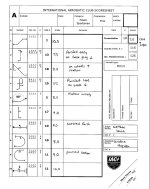
(my 3rd / final flight at the U.S. National Championships was a personal best score of 78.85% and I placed 10th of the 24 mostly purpose built aerobatic planes in the Sportsman class (16th over all across the 3 flights), so I'm pretty happy with that) See attached image of the scores from the most friendly judge.

This winter I'm looking to do a serious airframe inspection (NDT / paint removal as needed) to see how she's doing.
I'm looking for recommendations on anywhere I can take the airplane for help with this, and also mainly to have a new set of trained objective eyes looking it over.
My plan is to publicly share this story regardless of what we find, and how we address it.

As far as I know, I'm the only one taking an RV-14 close to (and occasionally upto) the G limits on a regular basis.
I don't do snap rolls or any big negatives (but do see +5.5 and -1.5 often).
It is also worth noting I take it close to VNE occasionally, but never when pulling Gs.

Thanks,
Steve Thorne
 

Attachments

  • RV14-IAC-2025-F3-best-judge.jpg
    RV14-IAC-2025-F3-best-judge.jpg
    177.3 KB · Views: 289
Hey All,

I'm wrapping up the 3rd season competing in the RV-14 that started flying in 2021
(my 3rd / final flight at the U.S. National Championships was a personal best score of 78.85% and I placed 10th of the 24 mostly purpose built aerobatic planes in the Sportsman class (16th over all across the 3 flights), so I'm pretty happy with that) See attached image of the scores from the most friendly judge.

This winter I'm looking to do a serious airframe inspection (NDT / paint removal as needed) to see how she's doing.
I'm looking for recommendations on anywhere I can take the airplane for help with this, and also mainly to have a new set of trained objective eyes looking it over.
My plan is to publicly share this story regardless of what we find, and how we address it.

As far as I know, I'm the only one taking an RV-14 close to (and occasionally upto) the G limits on a regular basis.
I don't do snap rolls or any big negatives (but do see +5.5 and -1.5 often).
It is also worth noting I take it close to VNE occasionally, but never when pulling Gs.

Thanks,
Steve Thorne
Maybe Vans would like to look it over?
 
Maybe Vans would like to look it over?
I did present this idea to my previous contact at Van's but there didn't seem to be interest in being involved (there has since been a lot of restructuring there, and I don't currently have a good contact for working closely together).

Regardless, my gut feeling about this was that I didn't want there to be any bias, so it makes more sense for a 3rd party that is completely objective to run the inspection.
 
Vic Syracuse sees a bunch of RVs. He’s pretty well-respected and I doubt he’d pull any punches. NDT and more advanced testing is usually farmed out anyway, isn’t it?
 
There are *many* RVs that have seen more use than this. It's nothing special and nothing that would require more than a standard condition inspection. The actual builder of your aircraft should be able to accomplish that without issue, or there are others than can handle it as well as already mentioned.
 
When we, Team AeroDynamix, aka Team RV were doing airshows we put our planes through these same maneuvers for almost 9 years. I pulled 5+ Gs coming out of the bottom of every single 4 ship barrel roll, 3.5 every single loop. Nothing extraordinary about this. The planes were inspected by several sets of eyes every year and held up remarkable well.
It's a testament to the quality of the airframes.
It's a good idea to always give the planes a good going over, but one season of Sportsman acro is not going to break it. Smokey, on our team not only did airshows, he competed and won in many IAC contests and if my old memory serves me correctly, he flew quiet a while in Intermediate. What a stick his is..
 
Maybe a Vans build assist center might be able to help?
I have seen a few example of RVs that were build by the 'build assist center' and I have seen better work from most armature build than those. Those have simply been a very poor job especially from a professional.
 
There are *many* RVs that have seen more use than this. It's nothing special and nothing that would require more than a standard condition inspection. The actual builder of your aircraft should be able to accomplish that without issue, or there are others than can handle it as well as already mentioned.
I didn't say it was the only RV doing this, I said it was (likely) the only RV-14 😉
Over the years, many RV-7s and definitely RV-8s have proven Van's can handle flying to the limit - but the RV-14 is a newer, bigger airframe and arguably not as well suited to the task. (it is VERY heavy on the controls (especially ailerons) when doing serious aerobatics; I flew my first contest in an RV-8 and it was like a little motorcycle with amazing handling compared to the RV-14.
And yes, the crew and I have done many condition inspections, but I'm looking for a new / objective set of eyes, both to see if we've missed anything and also to look deeper than we're qualified to.
 
When we, Team AeroDynamix, aka Team RV were doing airshows we put our planes through these same maneuvers for almost 9 years. I pulled 5+ Gs coming out of the bottom of every single 4 ship barrel roll, 3.5 every single loop. Nothing extraordinary about this. The planes were inspected by several sets of eyes every year and held up remarkable well.
It's a testament to the quality of the airframes.
It's a good idea to always give the planes a good going over, but one season of Sportsman acro is not going to break it. Smokey, on our team not only did airshows, he competed and won in many IAC contests and if my old memory serves me correctly, he flew quiet a while in Intermediate. What a stick his is..
Man I wish I could have seen that team fly!
And yes I expect (hope) to confirm there are no issues - but this is a bigger airframe than the RV-8 and for the reasons I just posted in a previous reply, less well suited to aerobatics than an RV-8.
Also, note: this was the 3rd season of Sportsman, so I think it is reasonable to want to have a more thorough look at it than I or my crew is qualified to do.
 
I agree with both ChiefPilot and RV8iator above. I flew IAC Sportsman and Intermediate for three years in my 8. A thorough Condition Inspection ought to do it, Pay special attention to the various service bulletins. Heck, you’ll find most problems with everyday cleaning. Aluminum airplanes will talk to you. I discovered “smoking” rivets, a fuel leak, and a crack or two that way.

Airplanes flown hard will show some wear and tear. Smokey’s did too. Just got to take care of it.
 
Although I applaud meticulous maintenance and inspection, and the concern for finding things that might have been missed, I’d suggest that you search the internet for the “Waddington Effect” before tearing into things. Yes, the RV-14 is bigger and heavier than a -7 or -8, but only by a few percent. It’s not Ike comparing a fighter to a bomber. Inspect….but first “do no harm”….
 
. (it is VERY heavy on the controls (especially ailerons) when doing serious aerobatics; I flew my first contest in an RV-8 and it was like a little motorcycle with amazing handling compared to the RV-14.
I wonder if some wedges on at the back of the ailerons might lighten the control feel?
 
One golden rule I always adhere to before my annual permit.
Apart from wiping bugs of the leading edges and prop I do not clean the aircraft for 3 or 4 weeks.

This leaves any tell tale signs of wear & tear to be more easily identified.

Just an old grumpy engineers way of doing things.

Rob
 
Keep in mind that Flight Chops also generates content for his various (interesting) social media platforms. The original post would seem to imply a content-generation premise that could well be a series of episodes of interest to a lot of viewers - e.g., 500 hours of EAB operations that go well beyond just puttering around the patch, inspection company selection process, the inspection process itself, findings, resolution of findings, etc. Would be fun to watch!
 
I didn't say it was the only RV doing this, I said it was (likely) the only RV-14
I can assure you, yours in not the only one
It is also worth noting I take it close to VNE occasionally
Let's look at the numbers:
RV14 Vne is 200 Knots
A light one, with a metal prop, WOT, 2700 RPM, would easily exceed 190 Knots in level flight.
We are talking single digit knots from the Vne at nominal engine parameters. That's just how it is. The aircraft has been design this way.
Taking RV14 to the red line is nothing extraordinary. Folks do it on regular bases.
 
Although I applaud meticulous maintenance and inspection, and the concern for finding things that might have been missed, I’d suggest that you search the internet for the “Waddington Effect” before tearing into things. Yes, the RV-14 is bigger and heavier than a -7 or -8, but only by a few percent. It’s not Ike comparing a fighter to a bomber. Inspect….but first “do no harm”….
For sure thanks. I'm always cognizant of that fine line between disassembling components to inspect, and risking breaking a thing that is perfectly fine...
 
Keep in mind that Flight Chops also generates content for his various (interesting) social media platforms. The original post would seem to imply a content-generation premise that could well be a series of episodes of interest to a lot of viewers - e.g., 500 hours of EAB operations that go well beyond just puttering around the patch, inspection company selection process, the inspection process itself, findings, resolution of findings, etc. Would be fun to watch!
Thanks yes, ultimately this is the hope, I'd like to share the process.
 
When we, Team AeroDynamix, aka Team RV were doing airshows we put our planes through these same maneuvers for almost 9 years. I pulled 5+ Gs coming out of the bottom of every single 4 ship barrel roll, 3.5 every single loop. Nothing extraordinary about this. The planes were inspected by several sets of eyes every year and held up remarkable well.
It's a testament to the quality of the airframes.
It's a good idea to always give the planes a good going over, but one season of Sportsman acro is not going to break it. Smokey, on our team not only did airshows, he competed and won in many IAC contests and if my old memory serves me correctly, he flew quiet a while in Intermediate. What a stick his is..
I think that the most important words that Widget said were "... inspected by several sets of eyes ...".

I would add to that one word ... CRITICAL.

Just as the team had to be excruciatingly critical in debriefs, it was important to "call out" anything amiss on your buddy's plane because it might kill YOU in that type of flying!! So, skins thick, they were. Criticism welcomed and applauded. And for good reason.
 
inspectionThis winter I'm looking to do a serious airframe inspection (NDT / paint removal as needed) to see how she's doing.
I'm looking for recommendations on anywhere I can take the airplane for help with this, and also mainly to have a new set of trained objective eyes looking it over.
My plan is to publicly share this story regardless of what we find, and how we address it.
It appears your ELT is mounted upside down (as a decent % of ACK units are). Maybe next inspection have corrected if not already. The red button should be marked "ON" and on the left and the black one "RESET" and on the right. If you push the button marked on (If upside down) after an incident (crash) it will turn the ELT off. (One scan and turns off) Of course as many have reported if it the ELT goes off prematurely (and hearing something on 121.5) and you think you are turning if off by hitting the reset button you will turn it on and get a call, or relatives will get a call.

Good luck with the inspection and let us know what you find.
 
Generally a common thing I find wrong when inspecting airplanes used for acro/airshows are heim joints prematurely wearing. Particularly on the elevator pushrods. Most are undersized and tend to loosen the pressed-in races.
 
I think that the most important words that Widget said were "... inspected by several sets of eyes ...".

I would add to that one word ... CRITICAL.

Just as the team had to be excruciatingly critical in debriefs, it was important to "call out" anything amiss on your buddy's plane because it might kill YOU in that type of flying!! So, skins thick, they were. Criticism welcomed and applauded. And for good reason.
Thanks and yes, this essentially gets back to the main theme of my initial post, I'm looking for extra set of critical eyes that might see things my team and I may have missed over the years, AND we'd like to look harder than a standard inspection, ie: open to NDT testing sections of the tail, etc.
 
Generally a common thing I find wrong when inspecting airplanes used for acro/airshows are heim joints prematurely wearing. Particularly on the elevator pushrods. Most are undersized and tend to loosen the pressed-in races.
Thanks for this insight. How does the worn heim joint present itself?
 
Thanks for this insight. How does the worn heim joint present itself?
The races loosen laterally so the rod end becomes sloppy. They can be pressed back together to restore precise fit. Friend of mine has an Acrosport that keeps eating thru rod-end bearings on the elevators and they need to be upped a size to handle the loads better.

Also I have found RV's that take a lot of heavy G loads will deform the bottom skins where the seat ribs attach at the rear spar carrythru.
 
Please share some specifics, I'd like to learn from others that are competing with an RV-14.
So far I've not found anyone that knows of another.
Now, I'm completely lost. Is this about competing in RV-14 or taking it to G limits on regular basis, as you stated here:
As far as I know, I'm the only one taking an RV-14 close to (and occasionally upto) the G limits on a regular basis.
But, let's look at the number again
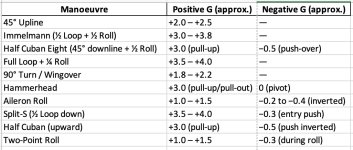
Here are the manoeuvres from the score sheet you attached and my best guess on the respective Gs
2.jpg

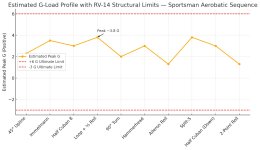
RV14 structural limit is +6G. The manoeuvres don't take the aircraft anywhere close:
3.jpg

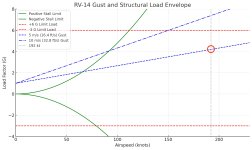
Now, I'd like to return to the example, from my earlier post. Flying straight and level in calm air at nominal IO-390 exp119 parameters. 192 knots is the top speed of my RV14. Let's assume that during this flight I would encounter a mild gust, say 16,4 ft/min (5 m/s). The resulting load is over 4 Gs, here is the Vg diagram:

4.jpg

Let's put it all together, shall we?
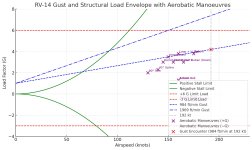
Here is a Vg diagram showing the manoeuvres from your score sheet and my encounter with a mild gust during straight and level flight:
6.jpg

Looks like my RV14 is working at least equally hard as yours :)

And finally, how many Gs is one hard landing as portrayed here? Vans wouldn't' tell us, but my guess is that it's not a small number.

7.jpg

Steve, don't get me wrong. I like your productions.
IMHO, you suggesting that your RV14 is the hardest working in the fleet is an exaggeration, to say the least.
 
Now, I'm completely lost. Is this about competing in RV-14 or taking it to G limits on regular basis, as you stated here:

RV14 structural limit is +6G. The manoeuvres don't take the aircraft anywhere close:

Now, I'd like to return to the example, from my earlier post. Flying straight and level in calm air at nominal IO-390 exp119 parameters. 192 knots is the top speed of my RV14. Let's assume that during this flight I would encounter a mild gust, say 16,4 ft/min (5 m/s). The resulting load is over 4 Gs, here is the Vg diagram:

Here is a Vg diagram showing the manoeuvres from your score sheet and my encounter with a mild gust during straight and level flight:

Looks like my RV14 is working at least equally hard as yours :)

And finally, how many Gs is one hard landing as portrayed here? Vans wouldn't' tell us, but my guess is that it's not a small number.

Steve, don't get me wrong. I like your productions.
IMHO, you suggesting that your RV14 is the hardest working in the fleet is an exaggeration, to say the least.
Thanks for the detailed analysis. 👍
I think it is important to differentiate between gentleman's aerobatics and competition flying.
If I'm with a passenger I'll see numbers like you're showing, but I can't imagine scoring well when flying those figures so gently.

I need to preface the following by saying I am far from an expert, but here's my understanding:
The main difference between flying for fun and competing is (in no particular order) keeping it in the box, setting definitive lines, and showing crisp entry / exit from figures; Pulling to a vertical and only getting to 3 or 4 Gs would be a very round radius covering much more distance, and also leave less time / energy to set a clean vertical before the rest of the figure.
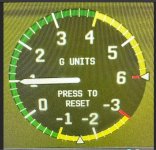
For example, on my personal best flight I executed the way I was coached by several experienced and big players in that world (Luke Penner, Ryan Chapman, Aaron McCartan, and Michael Goulian to name a few) and I will consistently see max +5.5 to 6 and -1.5 flying the sequence. (see image of my G-meter from that flight below)

We do live in a world of headlines, and if something is framed as a question, you can make pretty much any claim, right? 🤡
Notice that I end my title to this post with "!?" 🤓
I am legitimately asking if my airplane is at least among the hardest working RV-14s, and so far I haven't found anyone else that competes in one and I think that's a legitimate reason to tell a story about doing a more than standard condition inspection after 3 seasons of flying it that hard.., because yes, according to the numbers you presented, mine is being flown harder (and probably in that regime more often when accounting for training, practice and competing?).

RV14-2025US-nats-PB-Gmeter-small.jpg
 
I always wondered about gust loading vs aerobatics. Do you have a plot of the G load during your sequence?
Mike
 
Assuming you are actually hitting 6G, you are indeed testing the limits of the airframe, you also got way bigger kahunas than me!
Trouble with inspections is you can't really access everything, so you are hoping what you can't see is ok.
 
Assuming you are actually hitting 6G, you are indeed testing the limits of the airframe, you also got way bigger kahunas than me!
Trouble with inspections is you can't really access everything, so you are hoping what you can't see is ok.
Thanks - I see from your signature, this is your business - wanna do the inspection with me? I'll fly the airplane to you 🤷🏼‍♂️😂👌
And yes, I'm getting to 6 G's in competition (more so than training / practice) but a goal for next season will be to stay more disciplined and keep it at or under 5.5
- I don't have to pull THAT hard... but it happens with the adrenaline of competition, much like a musician playing a live gig at a faster tempo...
 
Love heart emoji.

If the aeroplane limit is 6, I would l suggest making the max gauge marking as maybe 7g or 8g- otherwise how do you know if you’ve over g’d the machine?

We owned a one-design for 10 years or so. Someone once asked what speed I dived into the box - “don’t know, max everything, will check the video”. I was 217 knots! Wow. Faster than I thought.

I asked the other 2 owners to check their videos - they were also BOTH 217 knots!! Turns out the max displayed value on the unit was 217 knots! So we will never know how fast we were going. Obviously faster than that. Oops.

Same thing on your g meter? Could you have been 8 g in the pursuit of the perfect pitch up?
 
I'm looking for recommendations on anywhere I can take the airplane for help with this, and also mainly to have a new set of trained objective eyes looking it over.
I was coached by several experienced and big players in that world (Luke Penner, Ryan Chapman, Aaron McCartan, and Michael Goulian to name a few)
How about asking the guys that trained you who they recommend you use for inspections? Perhaps they know of a shop that caters to planes flying competition aerobatics...

Thanks,

Joe
 
Love heart emoji.

If the aeroplane limit is 6, I would l suggest making the max gauge marking as maybe 7g or 8g- otherwise how do you know if you’ve over g’d the machine?

We owned a one-design for 10 years or so. Someone once asked what speed I dived into the box - “don’t know, max everything, will check the video”. I was 217 knots! Wow. Faster than I thought.

I asked the other 2 owners to check their videos - they were also BOTH 217 knots!! Turns out the max displayed value on the unit was 217 knots! So we will never know how fast we were going. Obviously faster than that. Oops.

Same thing on your g meter? Could you have been 8 g in the pursuit of the perfect pitch up?
Yes, I was inspired to pull the data to analyse it on a computer, and did find a few pulls slightly over six, but luckily only slightly.
The good news is that the airplane is very hard to get there and it will usually accelerated stall when pulling too hard.
 
How about asking the guys that trained you who they recommend you use for inspections? Perhaps they know of a shop that caters to planes flying competition aerobatics...

Thanks,

Joe
I thought about that, but I need an RV expert. Serious aerobatic pilots are flying airframes like Extras, Pitts, and Super D's.
 
Seriously, I know of no field mechanics or shops that have experience inspecting the structure of RV’s that might have been over-G’s. The only organization I know that is qualified to make that judgement would be the engineering department of Van’s.

I have a test pilot friend who got into some serious (serious) bumps over the mountains in his RV-7 a few years that asked a similar question here - our only conclusion that the factory engineers are the only ones who know where the weak(est) points are in the structure that might be checked.

Paul
 
Thanks - I see from your signature, this is your business - wanna do the inspection with me? I'll fly the airplane to you 🤷🏼‍♂️😂👌
Thanks, I do appreciate the offer, but honestly I have no desire to be a part of a utube 'inspection' or have my name in your logbook due the nature of how you use the aircraft. "Gentleman" aerobatics (3-4G) occasionally is one thing; competition aerobatics IMO is not what the 14 was designed for. Maybe I'm wrong but that's the way I feel.
 
competition aerobatics IMO is not what the 14 was designed for

I would take it a step further:
RV14 was not designed for aerobatics. It's basically the same wing as RV10.
It's a travelling machine with enough structural margins to perform aerobatic.
I'm loving it!
 
"Gentleman" aerobatics (3-4G) occasionally is one thing; competition aerobatics IMO is not what the 14 was designed for. Maybe I'm wrong but that's the way I feel.
And that is why the OP is asking the question and seems to reinforce he might not have the "hardest working RV-14 in the fleet" but seems to have the highest number of G load hours in the fleet and looking for best practice how to evaluate wear for critical components, worthy endeavor!

Seems a great question before going to a design dedicated aero platform.
 
So coincidentally, I am in the LSR-I course and the topic of NDI came up. You could come up with your own program based on material found in the FAA AC43.13 Chapter 5 covering non destructive inspection. Even so, the majority of these inspections include lots of visual observation of the things you are inspecting, except for maybe Eddie current testing.
 
Last edited:
As for what to inspect, I’d suggest starting with Van’s LCP list. Van’s engineers have already identified the critical components for this family of parts. For parts not on the LCP list, you’ll need to examine components in the critical load path—but with paint in the way, that’s not so easy. Visual inspection alone, i.e., trusting the human eye at that level, isn’t very reliable.

Speaking from experience as a former NDT engineer for a major, we only inspected known problem parts, either as guided by the manufacturer or based on tribal knowledge. Remember, not all cracks are detrimental—those jets have cracks that sit for years without issue. As noted in the Van's engineering reports on LCPs, cracks were observed, but many weren’t a concern.

The best approach you could take is to get a field FPI kit and learn to use it. That’s a doable skill, especially since you’ve already built a plane. Most other methods require a high level of skill, expensive equipment, and/or removing components down to the piece-part level.

Good luck.
 
As for what to inspect, I’d suggest starting with Van’s LCP list. Van’s engineers have already identified the critical components for this family of parts. For parts not on the LCP list, you’ll need to examine components in the critical load path—but with paint in the way, that’s not so easy. Visual inspection alone, i.e., trusting the human eye at that level, isn’t very reliable.

Speaking from experience as a former NDT engineer for a major, we only inspected known problem parts, either as guided by the manufacturer or based on tribal knowledge. Remember, not all cracks are detrimental—those jets have cracks that sit for years without issue. As noted in the Van's engineering reports on LCPs, cracks were observed, but many weren’t a concern.

The best approach you could take is to get a field FPI kit and learn to use it. That’s a doable skill, especially since you’ve already built a plane. Most other methods require a high level of skill, expensive equipment, and/or removing components down to the piece-part level.

Good luck.
Thanks for all the insights in this thread. 👍
 
Status
Not open for further replies.
Back
Top