Van's Air Force

The definitive Van's Aircraft support community! Buying, building or flying an RV? Join our exclusive family of mentors and enthusiasts!

SDS - line from pumps to firewall

TASEsq

Well Known Member
Patron
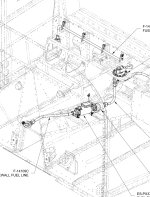
I’m building a -14 with SDS so have the dual fuel pump module mounted on the floor of the tunnel in the ‘stock’ location.

A few people have told me that it’s not the done thing to have a rigid alu fuel line from the pump to the firewall, and it needs to be braided. Same for the fuel return back to the fuel selector.

My issue is that these braided lines are $$$$$ and I already have the fuel line and fittings.

Is this really a concern?

I note that the -14 plans show a rigid line between the andair pump and the firewall
 

Attachments

  • IMG_3008.jpeg
    IMG_3008.jpeg
    366.8 KB · Views: 32
  • IMG_3012.jpeg
    IMG_3012.jpeg
    202.6 KB · Views: 32
I'll offer that while braided might be a "better way" to do it in a pure technical view for vibration minimization, my certified aircraft is soft tubing lines from fuel selector to firewall. So this might be a "never ending" question.
 
Last edited:
Both my planes have metal tubes from the pumps to the firewall. It is the standard way to do it and there is no downside if done correctly. I recently installed an sds on a 7. I used some metal tube, but mostly braided for ease of retrofitting. Make your own hoses. You can get 10’ of good quality braided rubber hose for around $50 and earls fittings are only $5 a piece. Not really that expensive. Teflon hose is similar in price, but has more critical bend radius limitations and create issues in cramped confines.
 
I'll offer that while braided might be a "better way" to do it in a pure technical view for vibration minimization, my certified aircraft is all rigid lines from fuel selector to firewall. So this might be a "never ending" question.
Most use 3003 lines for this application and it is NOT rigid.
 
Most use 3003 lines for this application and it is NOT rigid.
Yes soft tubing, but more rigid than flex lines, correct? Same argument, is the vibration an issue, the answer is yes, but the cycle time limit is most likely higher then we need. My point was that certified plane doesn’t have flex line, so following vans plans isn’t an issue, and maybe you were trying to ensure that is a soft tubing connection, per the 14 plans.
 
If the outlet of the Andair pump and the SDS module are the same location then follow the engineering direction from Vans. The airplane does not know what the manufacturing sticker on the pump module says.
 
I’m building a -14 with SDS so have the dual fuel pump module mounted on the floor of the tunnel in the ‘stock’ location.

A few people have told me that it’s not the done thing to have a rigid alu fuel line from the pump to the firewall, and it needs to be braided. Same for the fuel return back to the fuel selector.

A rigid line is fine, as long as it includes enough bends to allow for possible relative movement of the ends. From AC43.13-1B, para 8-31.c:

Never install a straight length of tubing between two rigidly-mounted fittings. Always incorporate at least one bend between such fittings to absorb strain caused by vibration and temperature changes.

For example, on my RV-8 the SDS fuel pump module is installed just aft of the firewall, with rigid tube bent as shown:

fuselage_2025-04-05_02.png
 

Attachments

  • fuselage_2025-04-05_02.png
    fuselage_2025-04-05_02.png
    702 KB · Views: 6
Most use 3003 lines for this application and it is NOT rigid.
Yes, I meant the soft tube when I said ‘rigid’. Aka, not flexible hose.

I am hesitant to make my own fuel lines - confident in alu tube but had a bear of a time with the Teflon brake hoses.
 
Fabricating fuel lines are just another skill to learn in this building process. It can be easy, or hard if you don’t have good quality tools & patience.
I helped one 14 builder, he used prebuilt braided hoses for all his fuel lines. His tunnel got pretty filled up in the end after he stuffed it with those hoses, pumps, wiring bundles, control cables. I would hate to have to get in there & do any maintenance later!
 
Fabricating fuel lines are just another skill to learn in this building process. It can be easy, or hard if you don’t have good quality tools & patience.
I helped one 14 builder, he used prebuilt braided hoses for all his fuel lines. His tunnel got pretty filled up in the end after he stuffed it with those hoses, pumps, wiring bundles, control cables. I would hate to have to get in there & do any maintenance later!
Trent, rigid is perfectly acceptable. We use hose in our kit for pump to firewall for flexibility. AND--years ago I saw an accident where the engine mount pulled the firewall at the right lower longeron mount, and was enough to break the rigid tube at the firewall flare. My theory was a flex hose might provide some safety in that area. Some like it, some make their own tubes.
 
Yes soft tubing, but more rigid than flex lines, correct? Same argument, is the vibration an issue, the answer is yes, but the cycle time limit is most likely higher then we need. My point was that certified plane doesn’t have flex line, so following vans plans isn’t an issue, and maybe you were trying to ensure that is a soft tubing connection, per the 14 plans.
Yes, It is more rigid than braided, but far from traditional rigid tubing. This line and any rigid line should not be affected by vibration found in the airframe, assuming that both devices that the tube is attached to are solidly mounted to the airframe. In that case, everything is vibrating at the same frequency and not stress cycling the tubing. I think you might be thinking about attachments between the airframe and separately moving assemblies, like the engine. In that case, the engine is moving in a completely different way than the airframe, due to rubber mounts, and the tube would see constant cycling. There we must use hoses that don't fatigue from that movement.
 
Yes, It is more rigid than braided, but far from traditional rigid tubing. This line and any rigid line should not be affected by vibration found in the airframe, assuming that both devices that the tube is attached to are solidly mounted to the airframe. In that case, everything is vibrating at the same frequency and not stress cycling the tubing. I think you might be thinking about attachments between the airframe and separately moving assemblies, like the engine. In that case, the engine is moving in a completely different way than the airframe, due to rubber mounts, and the tube would see constant cycling. There we must use hoses that don't fatigue from that movement.
To add to this, I think the 3003 can handle A LOT of cycling as long as the range of movement is limited. Look at the std brake line installation on an RV at the calipar. The line is rigidly attached to the gear leg. It then makes a large loop, to provide material for movement. It then attaches to a calipar that floats on its attachment to the leg. That calipar has about a 1/16" range of motion or more in all directions and is constantly rattling around. No fatigue stress typically seen in this application across thousands of planes.
 
Yes, It is more rigid than braided, but far from traditional rigid tubing. This line and any rigid line should not be affected by vibration found in the airframe, assuming that both devices that the tube is attached to are solidly mounted to the airframe. In that case, everything is vibrating at the same frequency and not stress cycling the tubing. I think you might be thinking about attachments between the airframe and separately moving assemblies, like the engine. In that case, the engine is moving in a completely different way than the airframe, due to rubber mounts, and the tube would see constant cycling. There we must use hoses that don't fatigue from that movement.
There was a one design here where the builder elected to use some aluminium line between the bottom of the fuel tank, and the bottom skin for the fuel drain. The tank hangs on straps off the steel frame of the fuselage and the bottom skin has some flex. Needless to say the line broke, and he lost the whole tank of fuel into the bottom of the aeroplane. Made it to the ground and the engine stopped when taxiing back.
 
There was a one design here where the builder elected to use some aluminium line between the bottom of the fuel tank, and the bottom skin for the fuel drain. The tank hangs on straps off the steel frame of the fuselage and the bottom skin has some flex. Needless to say the line broke, and he lost the whole tank of fuel into the bottom of the aeroplane. Made it to the ground and the engine stopped when taxiing back.
Yes, where ever you have movement, you need a flexible material that doesn’t fatigue. But that example is quite different than the pump to the firewall. 1000’s of planes done that way with limited failures reported here. Also possible there were other factors in the cause of that incident. I mentioned the brake line application above. Not as much movement as a tank swinging on straps, but plenty of repetitive motion and used on 1000’s of planes. All the RVs use that 3003 line from the tank to the fuse and in flight, that wing is flexing quite a bit on its spar.
 
Back
Top