Van's Air Force

The definitive Van's Aircraft support community! Buying, building or flying an RV? Join our exclusive family of mentors and enthusiasts!

RV6A too slow!

agusgroh

I'm New Here
Hi everyone,

This is my first post on the forum, although I've been a visitor for a while.
I own a Van's RV-6A equipped with a Lycoming O-320-D1A and a Sensenich 70CM86160-0-16 propeller. I've been flying the airplane for about a year, and I've noticed it seems slower compared to other RV-6As with the same engine and propeller combination.

Here's some data from recent flight tests:
  • Pressure altitude: 7,500 ft
  • MP: 22" Hg
  • RPM: 2,300
  • IAS: 130 kt
  • OAT: 57°F
  • TAS: 145 kt

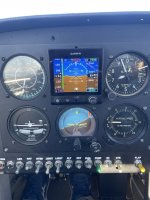
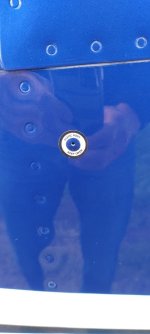
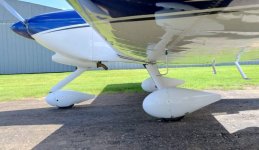
The airplane has gear leg fairings and wheel pants, but no intersection fairings installed. I've attached a photo showing the current setup.
Another thing I've noticed is that the airplane doesn't accelerate easily past 130 KIAS. Even pitching the nose down, I can't easily increase the speed. It feels like the airplane has a lot of drag.

Do these numbers look right for this model, or could something be wrong?

Thanks in advance!
 

Attachments

  • 2026-06-12 16.25.44.jpg
    2026-06-12 16.25.44.jpg
    60.7 KB · Views: 58
Hi everyone,

This is my first post on the forum, although I've been a visitor for a while.
I own a Van's RV-6A equipped with a Lycoming O-320-D1A and a Sensenich 70CM86160-0-16 propeller. I've been flying the airplane for about a year, and I've noticed it seems slower compared to other RV-6As with the same engine and propeller combination.

Here's some data from recent flight tests:
  • Pressure altitude: 7,500 ft
  • MP: 22" Hg
  • RPM: 2,300
  • IAS: 130 kt
  • OAT: 57°F
  • TAS: 145 kt

The airplane has gear leg fairings and wheel pants, but no intersection fairings installed. I've attached a photo showing the current setup.
Another thing I've noticed is that the airplane doesn't accelerate easily past 130 KIAS. Even pitching the nose down, I can't easily increase the speed. It feels like the airplane has a lot of drag.

Do these numbers look right for this model, or could something be wrong?

Thanks in advance!
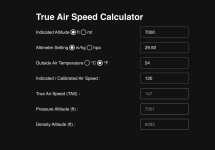
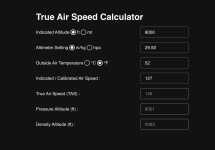
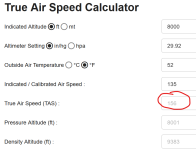
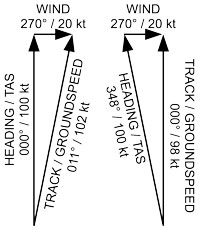
1. (Minor) Using your numbers for PA and OAT 130 kias converts to 149 ktas.
2. At that altitude your MP looks to be at or close to full throttle, in which case your RPM looks low. Either your prop is over-pitched, or your engine is not making rated power. What do your climb numbers look like?
 
Check if the airspeed indicator is accurate.
Are the static ports the type called for in the plans? [Photo and we can help]
Give us photos of the engine baffling.
Does the plane fly straght, level, ball centered with hands and feet off?
 
The intersection fairings will be worth a few knots, give or take. As the others have said, FIRST make sure what you're measuring is correct. There are ground tests to validate your static system and another test to confirm your pitot system is correct. If you have GPS, there's also an in-flight test to confirm if the speeds you're seeing are correct. A brief search should lead you down the right path to perform these tests, or you can use the EAA Phase I testing book. It's not without some effort, but maybe another builder in your area can help. And yes, the location and type of the static ports can absolutely skew the results. Many a builder has purchased expensive static ports that don't work as well as the drilled out pulled rivets that Van's shows in their plans.

Once you've confirmed the TAS you're seeing is actually true, then we can start looking for what's slowing you down.
 
I’m having trouble decoding the prop model number. What pitch is your prop?

With a metal Sensenich that is optimized for your RV you should be able to see 2600 rpm at 7500’.
 
1. (Minor) Using your numbers for PA and OAT 130 kias converts to 149 ktas.
2. At that altitude your MP looks to be at or close to full throttle, in which case your RPM looks low. Either your prop is over-pitched, or your engine is not making rated power. What do your climb numbers look like?
Hi Bob,


  1. Thanks for the correction!
  2. The throttle wasn't fully open — I still had some MP available. As for climb performance, I'm seeing about 1,000 ft/min with pilot and passenger (308 lbs combined) and 19 gallons of fuel.
 
Check if the airspeed indicator is accurate.
Are the static ports the type called for in the plans? [Photo and we can help]
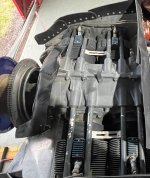
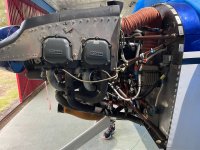
Give us photos of the engine baffling.
Does the plane fly straght, level, ball centered with hands and feet off?
Hi, I will take some photos to the static ports.
I've attached some photos of the engine bafflings
The airplane fly straight with hands and feet off.
 

Attachments

  • 2026-06-12 18.05.59.jpg
    2026-06-12 18.05.59.jpg
    166.5 KB · Views: 30
  • 2026-06-12 18.05.55.jpg
    2026-06-12 18.05.55.jpg
    175.9 KB · Views: 30
"It's not the plane, it's the pilot".

Not picking on you, just thought it would be fun to end the week with a bit of Top Gun: Maverick humor.
 
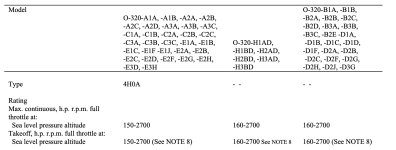
150 or 160 hp?
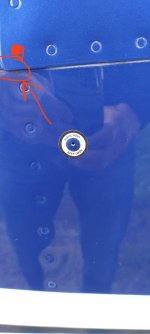
Poor picture angle, appears you do not have upper & lower leg fairings installed.
Pitot tube appears to be pointing down a bit.
Front engine baffle seals definitely not sealing properly.

Lots of posts on VAF regarding steps to maximize power & speed efficiency
 
If I recall correctly from testing we did fifteen years ago, Upper and Lower intersection fairings are good for 8-10 knots…huge compared to their size!
 
The intersection fairings will be worth a few knots, give or take. As the others have said, FIRST make sure what you're measuring is correct. There are ground tests to validate your static system and another test to confirm your pitot system is correct. If you have GPS, there's also an in-flight test to confirm if the speeds you're seeing are correct. A brief search should lead you down the right path to perform these tests, or you can use the EAA Phase I testing book. It's not without some effort, but maybe another builder in your area can help. And yes, the location and type of the static ports can absolutely skew the results. Many a builder has purchased expensive static ports that don't work as well as the drilled out pulled rivets that Van's shows in their plans.

Once you've confirmed the TAS you're seeing is actually true, then we can start looking for what's slowing you down.
Thank you for the detailed response — that makes a lot of sense. I'll validate the pitot-static system first before chasing drag issues.

I've looked into several static system tests. For the in-flight TAS verification, is there a specific table or spreadsheet you'd recommend for recording the data and calculating the results?
 
150 or 160 hp?
Poor picture angle, appears you do not have upper & lower leg fairings installed.
Pitot tube appears to be pointing down a bit.
Front engine baffle seals definitely not sealing properly.

Lots of posts on VAF regarding steps to maximize power & speed efficiency
Thank you Ralph,
Lycoming 160 HP.
I will take some more detailed pictures. I don't have installed the upper and lower leg fairings.

Pitot tube appears to be pointing down a bit.
Is there an specif positions in the plans? I am not the builder of the airplane.


Front engine baffle seals definitely not sealing properly.
I will do some research on how to improve engine baffling
 
If I recall correctly from testing we did fifteen years ago, Upper and Lower intersection fairings are good for 8-10 knots…huge compared to their size!
That's exactly one of the tests I'd like to perform. I've read a lot of threads on this — some people say the intersection fairings improve speed significantly, while others report little to no difference.
 
I've looked into several static system tests. For the in-flight TAS verification, is there a specific table or spreadsheet you'd recommend for recording the data and calculating the results?

Put EAA GPS method for validating airspeeds into Mr. Google's AI brain. It gives you all kinds of fodder for your perusal.

Lemme see if I can answer some more of your questions...
  • Regarding the pitot tube alignment, Van's typically has the pitot tube inlet leg parallel with the level flight reference. On a 7, that's the longeron at the cockpit. I would assume the 6 is the same. If I'm wrong, a 6 driver will chime in.
  • Yeah, your front baffle looks like it's seen better days. There are myriad threads on here about best practices for this. You can spend a lot of time going down that rabbit hole. Dan Horton has several posts on this forum with very good photos.
  • You can purchase both upper and lower intersection fairings from a place like Fairings, Etc., or you can make your own. If you don't have experience with fiberglass, I'd suggest just buying them. You still have to do some fitting to customize them to your build, but it'll save you a lot of time.
  • It sounds like you may not be the original builder, but it doesn't actually say that in your post. You can spend a lot of time chasing down each of these issues on a plane you're not intimately familiar with, but everything you learn adds to your knowledge base. it's not wasted time.
  • Lastly, I don't see a bunch of wires going to EGT and CHT probes on your photo. Just wait until you see the rabbit hole you can go down when you start chasing those numbers!!
 
Last edited:
Also, I like to test at 7500' Density Altitude. Otherwise on hot day vs. cold days your numbers are going to wander significantly.
At 7500' DA, the engine can only do 75% power, and so despite being Full Throttle, it isn't full power, and can run there all day long.
 
There's the first variable you can control. Go fly WOT and report back with IAS, TAS, RPM. And at that altitude, you can run WOT and lean too.
Just be aware that prop has a 2600 rpm do-not-exceed restriction.

We still don’t know the pitch of the prop so can’t determine if it is optimized for climb or cruise.
 
Back
Top