Van's Air Force

The definitive Van's Aircraft support community! Buying, building or flying an RV? Join our exclusive family of mentors and enthusiasts!

RV10 Flight Testing Questions

mike newall

Well Known Member
Sponsor
Friend
Guys,

1st flight on G-CMFZ in the UK - lovely build, flew nicely, high cht's but it is a new motor.

I am the tester, not the builder.

Questions.....

IO-540 with dual Surefly ignitions. Dynon displays, MT 3 blade prop.

RPM indication is not right. The sounds are right, the prop cycles, it makes loads of power, but it is indicating 1900rpm at full power. I am guessing it is a pulse detector issue but if you have info, let me know please.

Trim indicators don't read correctly - full up, full aileron left.

Nose wheel shimmies badly.

Ta


Mike
 
Guys,

1st flight on G-CMFZ in the UK - lovely build, flew nicely, high cht's but it is a new motor.

I am the tester, not the builder.

Questions.....

IO-540 with dual Surefly ignitions. Dynon displays, MT 3 blade prop.

RPM indication is not right. The sounds are right, the prop cycles, it makes loads of power, but it is indicating 1900rpm at full power. I am guessing it is a pulse detector issue but if you have info, let me know please.

Trim indicators don't read correctly - full up, full aileron left.

Nose wheel shimmies badly.

Ta


Mike
Trim indicators are calibrated in the Efis so I’m guessing that’s just a setting. The shimmy in the nose wheel is likely low breakout force on the front axel. We had to tighten ours several times as we tested and things settled In. Now I have 500hrs and haven’t had to tighten it in a few years.

Guessing the RPM is also a screen configuration issue but don’t know. Had you said it was high I would have said it was configured for a 2 blade but not sure since it’s low.
 
Last one, first step is easy: jack up the nose wheel, pull sideways per the builder’s manual with a fish scale, check breakout force is correct. If not tighten the nut at the bottom of the gear leg assembly.
 
The surefly ignitions give 3 pulses per revolution, so the Dynon EMS needs to be set to that also. It sounds like it is set to 2 pulses per revolution. (SETUP MENU > HARDWARE CALIBRATION > EMS CALIBRATION > TACHOMETER CALIBRATION).

How high are the CHT's?
 
IO-540 with dual Surefly ignitions. Dynon displays, MT 3 blade prop.

RPM indication is not right. The sounds are right, the prop cycles, it makes loads of power, but it is indicating 1900rpm at full power. I am guessing it is a pulse detector issue but if you have info, let me know please.
1900 + 0.5 (1900) = 2,750 actual RPM, max RPM 2,700, be careful.
 
Last edited:
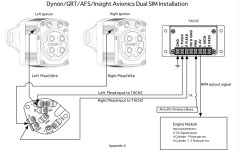
Are you using P-lead pulse sensing? If so, I think Surefly recomended either using their TACH2 interface board or a magnetic pickup.
 
AFAIK you need a Tach2. I have one SF and a magnetic pickup on the other standard mag. I’ve been planning to add a second SF instead of overhauling my mag at 500h but the extra cost of a Tach2 is irritating.

I suspect he already has a Tach2 but is just set to one pulse instead of 1.5 pulse per revolution.

IMG_2788.jpeg
 
Great info as always chaps.

CHT's are hovering around 220c (430f) in the climb which i was expecting. Trying to keep the power up as it is a factory new Lycoming. Settles down a bit when level. We are re checking various things this morning, including swapping units into sensible Imperial measurement :love:
 
Moving forward……

RPM sorted thanks, set to 1.5 pulses.

Another 2 hours today. CHT on 1 and 6 high but not over 430f. Settles to under 400f at 24/24 cruise. Oil consumption quite acceptable, 4 hours on the engine now. We have to do a 2 hour proving flight here.. our fly off is min 5 hours and 15 landings. I usually do it in 10 hours including break in.

Ammeter widget is odd. It shows alternator output, but doesn’t show discharge when only on battery with engine off - just says 0 amps.

2 hour flight and AoA calibration tomorrow.
 
Next..... !!

2 hour flight up at 8,000' today doing break in and endurance. CHT's still a little high in the climb, settled in the cruise.

Question - flap reflex. This aeroplane doesn't have it configured. Flap up is zero, first stage gives 3° down, then 15° down and finally 30° down.

I am guessing that the builder hasn't set reflex. Is this an issue ?

Reading the forum, reflex seems to be a variable feast - some like it, some don't.

He is a basic flyer - doubt he will venture much above 5,000' so I think he will be fine as is.

Comments and opinions welcome, as we know - opinions vary :love:
 
Ammeter widget is odd. It shows alternator output, but doesn’t show discharge when only on battery with engine off - just says 0 amps.
This arrangement is quite common on Piper singles, looks odd to Cessna pilots.

As to the flap question. Did you mean that when the flaps are in reflex (3 deg up from ‘in trail’) the indicator reads 0; then in trail it reads 3 deg, etc? I see no issue as long as the PIC understands this. But if you meant that the flaps will not go to -3 reflex, that in-trail is as high up as they go, then I would object. You’re throwing away some performance.
 
This arrangement is quite common on Piper singles, looks odd to Cessna pilots.

As to the flap question. Did you mean that when the flaps are in reflex (3 deg up from ‘in trail’) the indicator reads 0; then in trail it reads 3 deg, etc? I see no issue as long as the PIC understands this. But if you meant that the flaps will not go to -3 reflex, that in-trail is as high up as they go, then I would object. You’re throwing away some performance.
Same question, is UP, in this case, reflex and 3 degrees in trail?

As for giving up performance, I have studied almost 500 hours of Savvy reports on my -10 and haven't found the performance I'm giving up. I have tried reflex and in trail, sometimes on the same flight, and haven't noted any appreciable difference. As a data point, normal cruise is between 8k and 10k, WOT, 2400 rpm, LOP, and near gross weight. I have settled on flaps in trail for all ops.

Yes, I completely understand the theoretical benefit, I just am not seeing it in actual flight data. YMMV
 
Same question, is UP, in this case, reflex and 3 degrees in trail?

As for giving up performance, I have studied almost 500 hours of Savvy reports on my -10 and haven't found the performance I'm giving up. I have tried reflex and in trail, sometimes on the same flight, and haven't noted any appreciable difference. As a data point, normal cruise is between 8k and 10k, WOT, 2400 rpm, LOP, and near gross weight. I have settled on flaps in trail for all ops.

Yes, I completely understand the theoretical benefit, I just am not seeing it in actual flight data. YMMV

This mirrors my experience. I have a lot of data too (admittedly not weight - I toyed with going and adding that to flysto per flight)

I ended up settling on reflex for all ops though if for no other reason that staring out at the flaps not aligning with the aileron and also the bottom of the fuse seemed to “look” draggier.
 
Same question, is UP, in this case, reflex and 3 degrees in trail?

As for giving up performance, I have studied almost 500 hours of Savvy reports on my -10 and haven't found the performance I'm giving up. I have tried reflex and in trail, sometimes on the same flight, and haven't noted any appreciable difference. As a data point, normal cruise is between 8k and 10k, WOT, 2400 rpm, LOP, and near gross weight. I have settled on flaps in trail for all ops.

Yes, I completely understand the theoretical benefit, I just am not seeing it in actual flight data. YMMV
I find this odd, mostly because I find it hard to believe that Vans went to the trouble of this unusual arrangement if there’s no gain. I *think* I see a few knots gain in reflex, down low. I checked once at 17,000’ DA and could see no difference. How did you align your ailerons? Are they level with the flaps in reflex, or in trail?
 
I find this odd, mostly because I find it hard to believe that Vans went to the trouble of this unusual arrangement if there’s no gain. I *think* I see a few knots gain in reflex, down low. I checked once at 17,000’ DA and could see no difference. How did you align your ailerons? Are they level with the flaps in reflex, or in trail?
I had an e-mail conversation with the designer of the -10's airfoil. His indication was that reflex gained you a few knots at virtually every point on a cruise profile and that even at relatively low IAS, there was nothing to be gained by using the non-reflex position. Logically, there has to be a crossover point where trail (not reflex) would be more efficient, but if it is 110 knots or something like that, does it really matter?
 
I find this odd, mostly because I find it hard to believe that Vans went to the trouble of this unusual arrangement if there’s no gain. I *think* I see a few knots gain in reflex, down low. I checked once at 17,000’ DA and could see no difference. How did you align your ailerons? Are they level with the flaps in reflex, or in trail?
They are aligned per the plans. As far as going to the trouble, well, you could look no farther than the elevator trim arrangement. It seems to be far more complicated than it needed to be but that how they decided to do it.

I have no doubts the reflex looks good on paper, and I understand the reasoning, I’m just not seeing it in a practical sense.
 
I had an e-mail conversation with the designer of the -10's airfoil. His indication was that reflex gained you a few knots at virtually every point on a cruise profile and that even at relatively low IAS, there was nothing to be gained by using the non-reflex position. Logically, there has to be a crossover point where trail (not reflex) would be more efficient, but if it is 110 knots or something like that, does it really matter?
If it is actually a couple of knots, I should be able to see that in a data analysis. I haven’t.

Willing to try again, though. I have several flights coming up and I’ll try it both ways again.
 
I had an e-mail conversation with the designer of the -10's airfoil. His indication was that reflex gained you a few knots at virtually every point on a cruise profile and that even at relatively low IAS, there was nothing to be gained by using the non-reflex position. Logically, there has to be a crossover point where trail (not reflex) would be more efficient, but if it is 110 knots or something like that, does it really matter?
An early builder told me "Reflex was a waste of a push". My VPX set-up even documented a "reflex" position so I thought there must be some value (even gliders that I flew had "reflex" positions so surely something to it). After multiple long cross countries (3 to 4 hours at various altitudes) and now well over 500 hrs. don't see a bit of speed difference at exact same power and altitude, (Would fly one hour in reflex and one hour not in reflex), download the data and compare. Yes, there is a small pitch change but zero on average change in performance. I now use the push to lower flaps 10 degrees.
 
I had an e-mail conversation with the designer of the -10's airfoil. His indication was that reflex gained you a few knots at virtually every point on a cruise profile and that even at relatively low IAS, there was nothing to be gained by using the non-reflex position. Logically, there has to be a crossover point where trail (not reflex) would be more efficient, but if it is 110 knots or something like that, does it really matter?
I’ve also spoken with Steve via email. He thought the cross-over would be in the mid-teens altitude and/or at higher weights.

Thread drift: there is a historical reason for the unconventional elevator trim.
 
I’ve also spoken with Steve via email. He thought the cross-over would be in the mid-teens altitude and/or at higher weights.

Thread drift: there is a historical reason for the unconventional elevator trim.
What’s the historical reason?
 
What’s the historical reason?
The RV prototype had two independent trim tabs, left and right. One was supposed to be run by the power to the electric flaps, so that the plane would remain in trim during flap extension/retraction. Vans later abandoned the idea but did not rework the elevators/trim tabs.
 
The RV prototype had two independent trim tabs, left and right. One was supposed to be run by the power to the electric flaps, so that the plane would remain in trim during flap extension/retraction. Vans later abandoned the idea but did not rework the elevators/trim tabs.
It would be simple to use a single bellcrank to drive both tabs. Also simple to make the travel differential so as to have far less down trim than up.
 
As for the CHT’s. On #1, is there an air dam in front of the cylinder? May need trimmed. #6, I’d take a close look at the baffle sealing.
 
Loads of good info - thanks.

This is set up as in trail at 0, then it goes plus 3 ish, plus 15 ish and plus 30 ish.

Really can't be bothered to alter the settings and I doubt he would bother using the facility. KISS !!!
 
Loads of good info - thanks.

This is set up as in trail at 0, then it goes plus 3 ish, plus 15 ish and plus 30 ish.

Really can't be bothered to alter the settings and I doubt he would bother using the facility. KISS !!!

I’m not sure that sounds like it’s set up right - or terminology differences.
It should be:
-3 reflex (this should be aligned with the ailerons neutral and wingtips and where most 10s spend their life)
0 - “in trail”
+15ish
+30ish

I agree that the -3 or 0 is in the marginal gains category as discussed but I’d (and probably the LAA) still expect the airframe to be rigged per plans and able to be “reflexed”.
It’s a pretty straightforward adjustment.
Especially if it’s just a config change.

If it was me - given the rest of the airfoil outboard is permanently reflexed - I’d just have called the stages 0 (reflex), +3, +18ish +33ish or whatever.
 
Last edited:
Yea, I know what you mean, but there is sufficient discussion now to regard it as an option, so we will probably leave as is.

Needs a little wedge for right rudder, but otherwise - all good.
 
Something I haven’t seen mentioned: in full up (reflex) the flap rests against the aft spar, which carries that part of the load (not carried by the hinges). In all other positions that part of the load is carried by the flap actuating rod. On the earlier -10’s Vans had recommended max IAS limits for all ‘extended’ flaps, including ‘in trail’. Then, around 2015(??), Vans engineering removed the in trail limitation. Still, I think there’s more safety margin in flaps in reflex. Is it important? I do not know.
 
- I’d just have called the stages 0 (reflex), +3, +18ish +33ish or whatever.
This business of nomenclature is confusing to many. I’ve given some transition training in -10’s and generally try to avoid numbers completely, e.g., ‘full up’, ‘in trail’, ‘half’, ‘full’ flaps. I’ve also come across at least one -10 that had flap presets at -3, 10, 20, 30, e.g., there was no preset ‘in trail’ position.
 
Something I haven’t seen mentioned: in full up (reflex) the flap rests against the aft spar, which carries that part of the load (not carried by the hinges). In all other positions that part of the load is carried by the flap actuating rod. On the earlier -10’s Vans had recommended max IAS limits for all ‘extended’ flaps, including ‘in trail’. Then, around 2015(??), Vans engineering removed the in trail limitation. Still, I think there’s more safety margin in flaps in reflex. Is it important? I do not know.
Agree. I think to intentionally make a 10 spend its whole life at flaps in trail should be done eyes wide open.
The “in trail” theoretical benefit occurs at heavy weights and low IAS (ie high altitude).
Flying around at the top of the green at 8k in trail seems to me not what it was designed to do.

Edit- I still think there’s a reasonable chance that 0 deg indicated here may well be -3. I find it hard to imagine that someone would rig the plane without reading the manual and then not scratch their heads when everything didn’t line up?
 
Last edited:
This business of nomenclature is confusing to many. I’ve given some transition training in -10’s and generally try to avoid numbers completely, e.g., ‘full up’, ‘in trail’, ‘half’, ‘full’ flaps. I’ve also come across at least one -10 that had flap presets at -3, 10, 20, 30, e.g., there was no preset ‘in trail’ position.
Is there an issue with this flap set-up? With VPX this would give 10 a non-speed limited push and the 20 and 30 would be speed limited.
 
Is there an issue with this flap set-up? With VPX this would give 10 a non-speed limited push and the 20 and 30 would be speed limited.
This particular aircraft had no VPX speed control - strictly up to the pilot to observe. Vans engineering recommends no speed limits necessary in-trail, but does publish numbers for 20 deg. They are silent about 10 deg. That doesn't necessarily mean it's okay. My comment really was just meant to point out that with EAB aircraft there are no guarantees. Someone unfamiliar with this particular plane might think cruising around all day at "1 notch of flaps" was approved by Vans, while in fact Vans has not said anything about 10 deg.
 
This particular aircraft had no VPX speed control - strictly up to the pilot to observe. Vans engineering recommends no speed limits necessary in-trail, but does publish numbers for 20 deg. They are silent about 10 deg. That doesn't necessarily mean it's okay. My comment really was just meant to point out that with EAB aircraft there are no guarantees. Someone unfamiliar with this particular plane might think cruising around all day at "1 notch of flaps" was approved by Vans, while in fact Vans has not said anything about 10 deg.
I now cruise around in -3 deg. I don't believe I've seen published data for 20 deg. Can you point me to it, and thanks for the input !
 
I now cruise around in -3 deg. I don't believe I've seen published data for 20 deg. Can you point me to it, and thanks for the input !

IMG_2795.jpeg

Page 21 of the flight test section.

It’s actually 18 degrees (from full up) as a marginally higher Vfe.

Note that vans does actually call full up (reflex) zero and in trail +3. Proving Bobs point about confusion!

I am 99% sure that this particular RV is set up right and the confusion came from Mike saying 0 degrees was trail when it was in fact reflex.
I’d just confirm that 0 is indeed “full up” flap hitting the spar and all is good.
 
View attachment 72164

Page 21 of the flight test section.

It’s actually 18 degrees (from full up) as a marginally higher Vfe.

Note that vans does actually call full up (reflex) zero and in trail +3. Proving Bobs point about confusion!

I am 99% sure that this particular RV is set up right and the confusion came from Mike saying 0 degrees was trail when it was in fact reflex.
I’d just confirm that 0 is indeed “full up” flap hitting the spar and all is good.
Thanks, this is actually for a 14 but similar and probably a little more robust.
 
Mike

Great to see another-10 in the UK skies.

Question - flap reflex. This aeroplane doesn't have it configured. Flap up is zero, first stage gives 3° down, then 15° down and finally 30° down.
Ok you need to check but I’m guessing this is just a terminology issue. The RV-10 should be set up so that when the elevator is neutral the ailerons line up with the wingtips and flaps in the fully retracted position. Note I use the wording full retracted ie as far up as they will go and the flaps should align with the bottom of the fuselage.
Now this position is also called reflex.
Then you lower them 3 degrees to the - airfoil in trail position, Then further for takeoff and lastly fully for landing.
On the two UK RV-10’s I’ve tested we just called it 0, 3,18,33
Why I say above about the elevators being neutral is that,as you move the elevators, the ailerons will also move slightly, so everything should be setup at neutral.

Where is the aircraft based?

Regards Peter
 
Ok, so I just returned from a 6 hour cross country out and back.

On the way out I tested in trail versus reflex at two different altitudes, WOT, 2400 rpm, LOP. I let the aircraft stabilize for 15 minutes in each configuration before noting any parameters. The ambient temp was the same for each test as well as the winds at altitude. Weight was about 2550. Tests were conducted at 5500’ and 6500’.

The difference was less than two knots. As the speed has 1 knot resolution; I have to call the difference less than two because the speed would vary up to two knots but wouldn’t stay there.

Returning home, the test parameters remained the same except the altitudes were 7500’ and 8500’.

The result was almost identical; difference of less than two knots.

In summary, at mid altitudes and heavy, it would appear that reflex is less than two knots faster. In a 350 mile leg that amounts to about 80 seconds difference in time. A difference? Yes. A significant difference, no. Likely not even noticeable…unless you have to pee.
 
Back
Top