Van's Air Force

The definitive Van's Aircraft support community! Buying, building or flying an RV? Join our exclusive family of mentors and enthusiasts!

RV-7 Cowl - Modify or Replace?

yahugh

Member
Patron
In an earlier post, I described a problem I was trying to work through with a cowling mod. That turns out to have been the least of my worries! The bigger issue is modifying the inlets from the the old Subaru configuration back to an O-360 setup. The picture below shows the existing inlet configuration. I do have an inlet kit from from James Aircraft that's supposed to mate to their plenum (which I also have). That fiberglass piece in the lower right of the picture is part of the kit. However, modifying the inlets requires fiberglass skills that I don't really have. So I'm trying to decide from one of the following courses of action:

1. Adapt the James Aircraft inlet kit to the cowling
2. Somehow revert the inlets to the stock factory configuration
3. Buy a complete new cowling kit from Van's and build on

Any advice appreciated. Snarky comments will be graded :^)
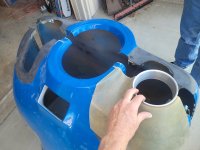

20250607_084105.jpg
 
As you already have the rings for the James Cowl inlets, and the matching plenum, why not just buy a new James Cowl?

The mess you have in your photos just looks like endless hours of irritation.

Carl
Two RV-10s using the James Cowl and plenum
 
As you already have the rings for the James Cowl inlets, and the matching plenum, why not just buy a new James Cowl?

The mess you have in your photos just looks like endless hours of irritation.

Carl
Two RV-10s using the James Cowl and plenum
Yes, endless hours of irritation is what I'm feeling as well!

I've been talking to James Aircraft about their cowl, and that is also an option. I should have listed that as #4.
 
If you have a James plenum and inlets, and it looks like they can be fiberglassed to your cowl, go for it. Fiberglass can always be repaired.

Consider how you will couple the inlets to the plenum.

I have a home brew plenum and made a modification. Just takes patience.
View attachment 95799
Wow! Nice work, Larry. Coupling the inlets to the plenum is the least of my worries. Bonding the inlets to the cowl is what has me scratching my head.
 
Fibreglass work really isn't difficult. Find someone locally to show you how and modify what you have.
It will be much cheaper, and probably quicker, than starting from scratch.
Pete
 
You’ll most likely need high temp resin which will need to be post heat cured. Then if there is core in that cowling, you’ll need to figure that out. I just screwed up a James cowling and decided it was too much work, money and time to fix it and had to buy a new one. If you have the plenum, diffusers, rings, I’d vote that you go for purchasing a James cowl. It’s pretty straightforward as long as you don’t screw it up from the get go(make sure you have a 4” prop spacer for a fp)
 
I had a Van's updraft cowl which I cut the whole induction and exhaust scoop off of. Gulp! I made my own aluminum induction ring which I bonded to a homemade scoop and made my own exit duct. I even cut in and hinged cowl flaps with a remote actuator. I homemade large ring inlets and bonded those into the upper cowl and faired that all back in. Yup, it was a chore, and proceeding step by step, it got done. I used regular old west systems for all that and the plenum top. It's all worked really well. It looks crazy and unmanageable when you start out, but it's just fiberglass. Look at Dan Horton's cowl journey for guidance.

Ed
 
You’ll most likely need high temp resin which will need to be post heat cured. Then if there is core in that cowling, you’ll need to figure that out. I just screwed up a James cowling and decided it was too much work, money and time to fix it and had to buy a new one. If you have the plenum, diffusers, rings, I’d vote that you go for purchasing a James cowl. It’s pretty straightforward as long as you don’t screw it up from the get go(make sure you have a 4” prop spacer for a fp)

Jeremy: Thanks for your reply. I don't get your meaning when you say "make sure you have a 4” prop spacer for a fp".
As for the resin system, a local Cozy builder recommends West System 105.
 
I had a Van's updraft cowl which I cut the whole induction and exhaust scoop off of. Gulp! I made my own aluminum induction ring which I bonded to a homemade scoop and made my own exit duct. I even cut in and hinged cowl flaps with a remote actuator. I homemade large ring inlets and bonded those into the upper cowl and faired that all back in. Yup, it was a chore, and proceeding step by step, it got done. I used regular old west systems for all that and the plenum top. It's all worked really well. It looks crazy and unmanageable when you start out, but it's just fiberglass. Look at Dan Horton's cowl journey for guidance.

Ed
Ed: The induction system is still a bit of a mystery to me. Do you have any pics posted of your work?
 
What are you working with an O-360 with updraft carb?

Ed
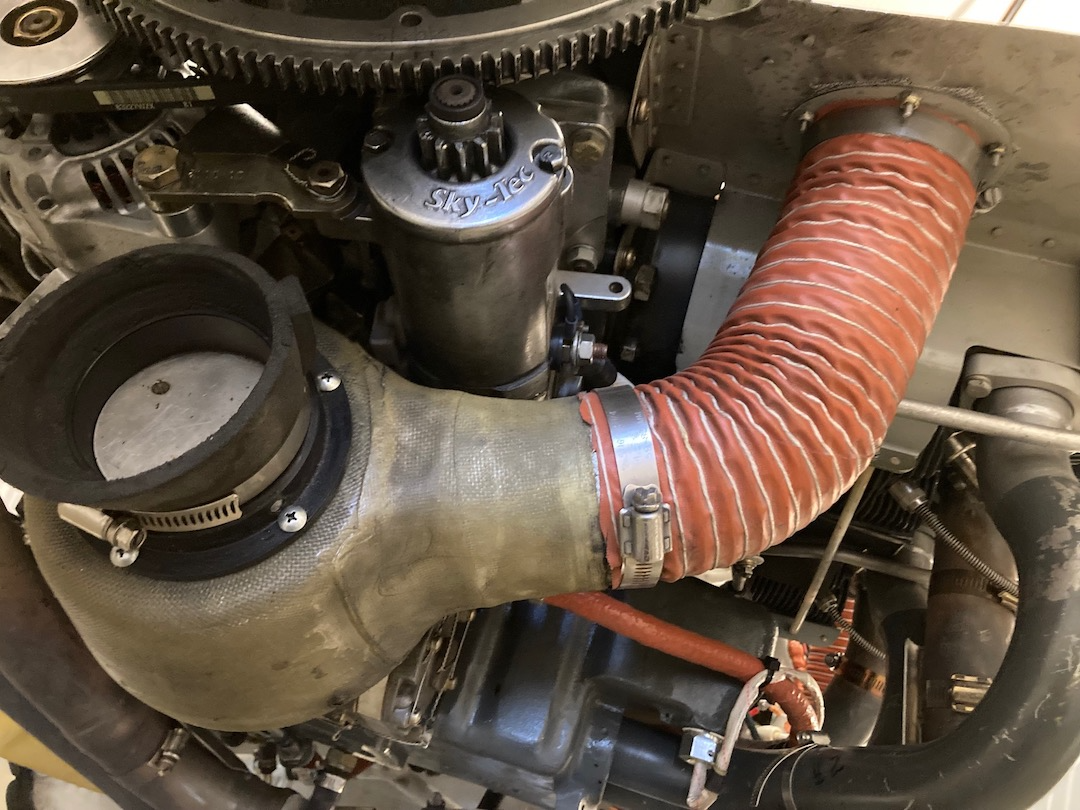
It's an O-360 with a FlyEFII* System 32 fuel injection system, which includes the throttle body in the attached picture.
20250824_124618.jpg

*I'm aware of some of the concerns about FlyEFII's fuel injectors.
 
IMG_20140110_131305[1].jpgOK, so forward throttle body. It should be fairly straightforward to convert the rectangular scoop in your first post to something that mates up. It will involve fabbing up something out of fiberglass. The inlet ring wants to have a nice large radius on it. It looks as if you have sufficient room in front of your throttle body to do a filtered airbox of some sort hooked up to an inlet on the cowl. I rolled my own filtered airbox and later adapted a type 2 from here:
A type 3 would be simpler. You wouldn't have to run a control cable. Steven at HP air could probably do an inlet ring for you if you asked him.

Here's my early version:

IMG_20131121_201718[1].jpgIMG_20130826_170820[1].jpg
If you are near SoCal, I could show you mine.

Ed
 
Last edited:
OK, so forward throttle body. It should be fairly straightforward to convert the rectangular scoop in your first post to something that mates up. It will involve fabbing up something out of fiberglass. The inlet ring wants to have a nice large radius on it. It looks as if you have sufficient room in front of your throttle body to do a filtered airbox of some sort hooked up to an inlet on the cowl. I rolled my own filtered airbox and later adapted a type 2 from here:
A type 3 would be simpler. You wouldn't have to run a control cable. Steven at HP air could probably do an inlet ring for you if you asked him.
This looks like just the thing! I wonder how much of a performance hit there is with the type 3.
 
Not much. They're calling it a quarter inch MAP. That jibes with what I see with my type 2 - typically .2". It's worth a knot or two. My original setup had a cable actuated emergency flapper for alternate air which I never used. As long as you don't pack the filter full of snow or eat a pigeon... It's worth shooting them an email to discuss. The ones on their website are intended to bolt up to a Bendix style servo, but I'm sure they could do something for a flange mount like yours.

Ed
 
You’ll most likely need high temp resin which will need to be post heat cured.
I don't agree, any regular epoxy that will take a post cure (ie not West) will be suitable. The heat from the engine will provide the post cure.
 
Jeremy: Thanks for your reply. I don't get your meaning when you say "make sure you have a 4” prop spacer for a fp".
As for the resin system, a local Cozy builder recommends West System 105.
You’re welcome. The 4” prop spacer was speaking to if you were going to go with a James forward facing long cowl with any fixed pitch(may not pertain to you but, it was my issue)
 
I don't agree, any regular epoxy that will take a post cure (ie not West) will be suitable. The heat from the engine will provide the post cure.
My opinion only in regards to cowling areas exposed to engine/exhaust heat would require(in my opinion) a high temp resin. But at the end of the day, it’s your plane, so it could be anything you as the pic is comfortable operating.
 
You’re welcome. The 4” prop spacer was speaking to if you were going to go with a James forward facing long cowl with any fixed pitch(may not pertain to you but, it was my issue)
Got it. I've got a Hartzel constant-speed prop. The clearance from the existing cowl to the spinner looks like it'll work out perfectly. If I was to go with the James cowl instead, I'd have to go with the shorty.
 
My opinion only in regards to cowling areas exposed to engine/exhaust heat would require(in my opinion) a high temp resin. But at the end of the day, it’s your plane, so it could be anything you as the pic is comfortable operating.
Informed opinions are welcome! What resin system would you be comfortable flying with?
 
I used West Systems for everything including a plenum top. It experiences heat soak after shut down and is just fine after 8 years. I never painted it and it looks slightly yellowed, but is otherwise perfect. There are epoxies that are rated for high heat that are more expensive. WS has proven good enough for me and is pretty easy to work with. You'll want to use some sort of core to fab shapes and get the same thickness as the surrounding cowl. Hexcel or something like it.

Ed
 
I used West Systems for everything including a plenum top. It experiences heat soak after shut down and is just fine after 8 years. I never painted it and it looks slightly yellowed, but is otherwise perfect. There are epoxies that are rated for high heat that are more expensive. WS has proven good enough for me and is pretty easy to work with. You'll want to use some sort of core to fab shapes and get the same thickness as the surrounding cowl. Hexcel or something like it.

Ed
Used West System to completely scratch build a custom carbon fiber cowling for a Reno Racer, great results!
Now that’s a high heat environment!
 
So you're saying that the West epoxy isn't suitable for this application?
It’s will work and several have used it in the high heat environment but I think it’s rated to like 118 ish but it’s not the best for the application. Which is why James uses vinyl ester resins I believe.
 
I used MGS L285/H286 as it takes a post cure and is just better than West, but I had easy access to both that and West.
 
Back
Top