
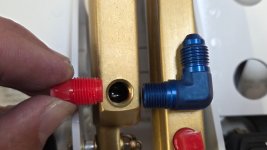
The AN elbows that come with the brakes only thread into the brake cylinders about 1.5 turns. I can't tell if the end of the fitting are NPT threads, which would be one explanation. But if they are, 1.5 turns hardly seems secure. I don't want to strip anything. The red plastic shipping inserts are straight threads and screw all the way into the cylinders. If they are not NPT, then the fittings are incorrect. Does anyone have any insight on this?

Van's Air Force
You are using an out of date browser. It may not display this or other websites correctly.
You should upgrade or use an alternative browser.
You should upgrade or use an alternative browser.
RV-7 brake master cylinder elbow fittings
- Thread starter SonexGuy
- Start date


I think I used NPT to quick connect and they worked. I do know that SAE JIC fittings may be closer to this thread type as it is not tapered the only catch is if the seal they use fits correctly and is safe with the hydro fluid being used; which they are hydro fittings for high pressure applications.

Your photo shows Matco brake cylinders. Per their assembly drawing for those cylinders, the threads are 1/8 NPT. The non flared end of the AN elbow is also 1/8 NPT. You have the correct parts to fit together.The AN elbows that come with the brakes only thread into the brake cylinders about 1.5 turns. I can't tell if the end of the fitting are NPT threads, which would be one explanation. But if they are, 1.5 turns hardly seems secure. I don't want to strip anything. The red plastic shipping inserts are straight threads and screw all the way into the cylinders. If they are not NPT, then the fittings are incorrect. Does anyone have any insight on this?
I am currently adding brakes to the right side on my 6A. I ran into the same issue you did...the AN elbows thread in about 1.5 to 2 turns, even with thread sealant providing a bit of lubrication. It doesn't seem like the fittings are loose enough to spin them in one more turn. I am still working on the installation and will take a second look at things the next time I am at the hangar.

Try a different fitting. The manufacturing tolerances on these fittings seem to vary widely.
Try working the fitting like a tap. Tighten, loosen 1/4 turn, tighten, repeat. You may be able to work the fitting around. Once they are close, remove them, clean, reapply sealant, and reinstall. One key point is once you get them clocked, do not turn them back or loosen them.
Also, search the forum. Some folks are using straight fittings with 90deg. adaptors and avoiding the need for clocking.
Try working the fitting like a tap. Tighten, loosen 1/4 turn, tighten, repeat. You may be able to work the fitting around. Once they are close, remove them, clean, reapply sealant, and reinstall. One key point is once you get them clocked, do not turn them back or loosen them.
Also, search the forum. Some folks are using straight fittings with 90deg. adaptors and avoiding the need for clocking.
I have the Matco brakes and experienced the same thing. Only about 1.5 turns and it was tight. I was concerned but have no leaks in any of the fittings. Used the recommended loctite thread sealant.
Southern Pete
Well Known Member
Buy a different fitting, while you are at it use a -3 (instead of -4) fitting and -3 hoses to save weight.
I suspect the anodizing on the threads is part of the issue. In threads, 2-3 threads produces the rated strength, so you don't need as much as you think. Use a thread sealant with PTFE, like 565 / 567. I thought mine were pretty yight and said I am going for one more turn and got it. NPT fittings need to be tighter than must people are used to.
Hard to provide advice on something like this without being there to see it and feel it.
Hard to provide advice on something like this without being there to see it and feel it.
I have 4 fittings; 2 brass and 2 AN. They all "fit" the same, so it's not a manufacturing issue.Try a different fitting. The manufacturing tolerances on these fittings seem to vary widely.
Try working the fitting like a tap. Tighten, loosen 1/4 turn, tighten, repeat. You may be able to work the fitting around. Once they are close, remove them, clean, reapply sealant, and reinstall. One key point is once you get them clocked, do not turn them back or loosen them.
Also, search the forum. Some folks are using straight fittings with 90deg. adaptors and avoiding the need for clocking.
Two 90 deg brass fitting are part of the installation kit, as well, and they "fit" just the same. 1.5 turns just does not seem like nearly enough, and if I turn them too tightly to get them clocked, I'm afraid I will strip the master cylinders or crack them.I suspect the anodizing on the threads is part of the issue. In threads, 2-3 threads produces the rated strength, so you don't need as much as you think. Use a thread sealant with PTFE, like 565 / 567. I thought mine were pretty yight and said I am going for one more turn and got it. NPT fittings need to be tighter than must people are used to.
Hard to provide advice on something like this without being there to see it and feel it.
Do some research on npt fittings. They are tapered and different from bolts. You need to apply more force for them to seal, as they slightly deform the threads as they go in and this adds a lot of resistance.Two 90 deg brass fitting are part of the installation kit, as well, and they "fit" just the same. 1.5 turns just does not seem like nearly enough, and if I turn them too tightly to get them clocked, I'm afraid I will strip the master cylinders or crack them.

I frequently find people talking about straight threaded pipe thread fittings. I believe there is no such thing. As far as I know, there is no spec for a straight thread of the same diameter and pitch as an NPT thread. This is by design of course, to avoid fitting incorrect threads. For example, a 1/8 NPT thread is pretty close to a 3/8-24 UNF thread, except that it has 27 tpi. There is no normal straight thread standard with 27 tpi. People just don't seem to recognize tapered threads. I run into this over and over.
It does seem like Matco brake master cylinders are a little shy on how deep they run their tapered taps. I have found this regularly,
Stoo in post #8 above has the right idea - run a 1/8 NPT threading die onto the fitting a turn or two past when it comes shug. Then clean the fitting thoroughly and try it again.
It does seem like Matco brake master cylinders are a little shy on how deep they run their tapered taps. I have found this regularly,
Stoo in post #8 above has the right idea - run a 1/8 NPT threading die onto the fitting a turn or two past when it comes shug. Then clean the fitting thoroughly and try it again.
I considered that recommendation, but fear you could leave metal debris in the mc, unless you pull them apart and clean the bodies. The spring keeps the piston pretty far from the bottom, so it could just sit there and not bother anything, but must be considered.I frequently find people talking about straight threaded pipe thread fittings. I believe there is no such thing. As far as I know, there is no spec for a straight thread of the same diameter and pitch as an NPT thread. This is by design of course, to avoid fitting incorrect threads. For example, a 1/8 NPT thread is pretty close to a 3/8-24 UNF thread, except that it has 27 tpi. There is no normal straight thread standard with 27 tpi. People just don't seem to recognize tapered threads. I run into this over and over.
It does seem like Matco brake master cylinders are a little shy on how deep they run their tapered taps. I have found this regularly,
Stoo in post #8 above has the right idea - run a 1/8 NPT threading die onto the fitting a turn or two past when it comes shug. Then clean the fitting thoroughly and try it again.

Steve-actually there is a NPS thread, same dimensions as NPT, but a straight thread, normally used with a oring, or crush washer like an ORB fitting. not real common. Newton fuel valves use them. In the OPs case, differences in the cylinder port threading and the external threads are creating the snugness after 1.5 turns. A 1/8 NPT tap, not to change the taper of the threads, but to help the threads merge, may help. Ive taken steel NPT fittings and threaded them into mastercylinders to 'help' the threads , then install the AN aluminum fittings. I use a sharpie to mark on the mastrcylinder where I want the flare to orient, then install the fitting. Snug, then tighten about 3/4 to 1 turn, or what ever around that, that orients the flare. That usually yields around 2 1/2 -3 turns or about 1/2 the length of the threads. With Loctite 567 or equivalent, the fittings seal just fine. I would, however, only do that with known good fittings. Some cheap import fittings arent 2024T3 or 7075, (some are 5052 and YES you can break them) so use an AN equivalent aluminum fitting.I considered that recommendation, but fear you could leave metal debris in the mc, unless you pull them apart and clean the bodies. The spring keeps the piston pretty far from the bottom, so it could just sit there and not bother anything, but must be considered.
Tom
Thats why I suggested threading the fitting with a die, rather than running a tap into the master cylinder. I think the depth of threading of the MC is the issue, but one would have to take it apart and clean it thoroughly after tapping.I considered that recommendation, but fear you could leave metal debris in the mc, unless you pull them apart and clean the bodies. The spring keeps the piston pretty far from the bottom, so it could just sit there and not bother anything, but must be considered.
Sorry missed that. Great idea!Thats why I suggested threading the fitting with a die, rather than running a tap into the master cylinder. I think the depth of threading of the MC is the issue, but one would have to take it apart and clean it thoroughly after tapping.
I'll give that a try, thank you.Thats why I suggested threading the fitting with a die, rather than running a tap into the master cylinder. I think the depth of threading of the MC is the issue, but one would have to take it apart and clean it thoroughly after tapping.

I have had to fix more than a few of these that weep a bit of brake fluid because they aren't tightened enough. Usually, just taking the fitting out, cleaning it thoroughly, and putting it back in an extra turn will fix the problem. Definitely use the correct sealant. On one of these master cylinders the fitting started to gall and then seized at the wrong clocking. We had to get a big old crescent wrench on the elbow to remove it. We put a different fitting in that master cylinder and it went in just fine. I have found that generally, get it in and tight and then go another turn for a leak free fitting.
+1I have had to fix more than a few of these that weep a bit of brake fluid because they aren't tightened enough. Usually, just taking the fitting out, cleaning it thoroughly, and putting it back in an extra turn will fix the problem. Definitely use the correct sealant. On one of these master cylinders the fitting started to gall and then seized at the wrong clocking. We had to get a big old crescent wrench on the elbow to remove it. We put a different fitting in that master cylinder and it went in just fine. I have found that generally, get it in and tight and then go another turn for a leak free fitting.
Have also addressed a couple that were loose. You can’t be timid with npt fittings. I tell those inexperienced the same thing. Tighten untill you think it feels tight, then one more turn.
In the process of purchasing a 6A Ava just realized there are no right side brakes. This 6A has floor mounted rudder pedals too. Would love to get deals on best way to accomplish this addition.Your photo shows Matco brake cylinders. Per their assembly drawing for those cylinders, the threads are 1/8 NPT. The non flared end of the AN elbow is also 1/8 NPT. You have the correct parts to fit together.
I am currently adding brakes to the right side on my 6A. I ran into the same issue you did...the AN elbows thread in about 1.5 to 2 turns, even with thread sealant providing a bit of lubrication. It doesn't seem like the fittings are loose enough to spin them in one more turn. I am still working on the installation and will take a second look at things the next time I am at the hangar.
My 6A was a late enough build it came with overhead rudder pedals and brakes. The copilot brake addition mentioned in my original post involved adding the brake pedals to the rudder pedal weldment, adding the two brake cylinders to the right side, installing 2 new high pressure hoses between the left and right side brake cylinders, and some minor brake line re-routing.In the process of purchasing a 6A Ava just realized there are no right side brakes. This 6A has floor mounted rudder pedals too. Would love to get deals on best way to accomplish this addition.
As for converting floor mounted brakes to overhead brakes, my understanding is it can be done. Van's lists a dual overhead brake kit that fits the 6,7,9 airframes. (It is currently on back order per their online store.)
Good luck.
Thanks for the quick reply. I’ll plan to get my A&P to help me with the brake addition when it’s time. ( son is interested in learning to fly)My 6A was a late enough build it came with overhead rudder pedals and brakes. The copilot brake addition mentioned in my original post involved adding the brake pedals to the rudder pedal weldment, adding the two brake cylinders to the right side, installing 2 new high pressure hoses between the left and right side brake cylinders, and some minor brake line re-routing.
As for converting floor mounted brakes to overhead brakes, my understanding is it can be done. Van's lists a dual overhead brake kit that fits the 6,7,9 airframes. (It is currently on back order per their online store.)
Good luck.
Not sure if I will go through the effort to swap from floor mounted rudder pedals. Maybe if after I own it and fly a while I’ll change my mind. I’m assuming most prefer the newer overhead setup. I know the previous owner was flying all the time in it. So that’s a positive sign!
Double check this SB while you’re at it. It could influence your decision.Thanks for the quick reply. I’ll plan to get my A&P to help me with the brake addition when it’s time. ( son is interested in learning to fly)
Not sure if I will go through the effort to swap from floor mounted rudder pedals. Maybe if after I own it and fly a while I’ll change my mind. I’m assuming most prefer the newer overhead setup. I know the previous owner was flying all the time in it. So that’s a positive sign!
SB 98-03-1

Steel fitting in aluminum will prevent galling.I have had to fix more than a few of these that weep a bit of brake fluid because they aren't tightened enough. Usually, just taking the fitting out, cleaning it thoroughly, and putting it back in an extra turn will fix the problem. Definitely use the correct sealant. On one of these master cylinders the fitting started to gall and then seized at the wrong clocking. We had to get a big old crescent wrench on the elbow to remove it. We put a different fitting in that master cylinder and it went in just fine. I have found that generally, get it in and tight and then go another turn for a leak free fitting.
Thanks for sharing that! I’m setting up pre buy with BaseLeg now. I asked them to check if the patch has been applied. That’s very good to know and I appreciate the knowledge share!Double check this SB while you’re at it. It could influence your decision.
SB 98-03-1
You’re welcome, but I doubt Gil would miss that anyway. You’re in good hands.Thanks for sharing that! I’m setting up pre buy with BaseLeg now. I asked them to check if the patch has been applied. That’s very good to know and I appreciate the knowledge share!
The first things any mechanic worth their salt checks is paper work, SB’s, and applicable AD’s, and Gil isn’t just “any” mechanic.
