Van's Air Force

The definitive Van's Aircraft support community! Buying, building or flying an RV? Join our exclusive family of mentors and enthusiasts!

RV-12 Transition Training

Brantel

Well Known Member
Benefactor
So the time is getting close for my RV-12IS to take to the sky.

According to my insurance I need a current checkout in the RV-12 and a current BFR with a CFI that has at least 25hrs of RV-12 (has to be the 12) time under their belt before flying my airplane as PIC. My normal CFI has a bazillion hours in lots of things but no RV-12 time.
No surprise and I would want to do that anyway even if I did not care about the insurance.

My normal CFII/ATP has a bazillion hours in lots of things from turboprops to DC-3's and all the traditional RV's but no RV-12 time. That leaves me looking for a CFI that meets my needs with access to an S-LSA RV-12 and hopefully I don't have to travel too far to go fly with them.

Anyone with any knowledge of such a person within a reasonable radius of East Tennessee?
 
I did my transition training at Hawkins Flight Academy in Shelbyville, TN. When I was there they had 3 RV-12iS. All with Garmin electronics. Now, according to their website, they're up to 5, with two more on the way!

 
As you can see by the above posts, the recommendation is to go somewhere where you can legally rent a -12 and get your BFR and transition training in that plane. Your new plane will be in phase 1 and that is NOT the place to be doing transition training nor BFRs, not even with the "2 pilot" rule for phase 1.
 
As you can see by the above posts, the recommendation is to go somewhere where you can legally rent a -12 and get your BFR and transition training in that plane. Your new plane will be in phase 1 and that is NOT the place to be doing transition training nor BFRs, not even with the "2 pilot" rule for phase 1.

I think we are in agreement. Kinda the point of the post looking for appropriate options and referrals. It’s also not legal to obtain training during phase I regardless of the underwriter’s requirements.

That being said, the phase I is only 5 hrs minimum ( yeah I know it should take longer than that) so even if I let a qualified pilot do the phase 1, I still need some help from another CFI that meets the underwriter’s requirements.

One thing is for sure. I won’t fly this thing till I am 100% confident in my skills and ability to do so safely.
 
I think we are in agreement. Kinda the point of the post looking for appropriate options and referrals. It’s also not legal to obtain training during phase I regardless of the underwriter’s requirements.

It would be a good idea to provide the regulation when making this claim.
 
As you can see by the above posts, the recommendation is to go somewhere where you can legally rent a -12 and get your BFR and transition training in that plane.

I also think this is a good idea, but it's perfectly reasonable to borrow an RV-12 with no compensation and fly with a CFI, who may or may not be compensated.

I don't mean to be argumentative, but this is a subject that in my circles has garnered a lot of attention. One of my close friends is a CFI teaching in mostly owner provided aircraft, one of those being the instruction of my daughter in the -12 that I built as well as other ELSA and Experimentals. There are perfectly safe, legal, and insurable scenarios to provide dual instruction (especially FR and transition) in a homebuilt. I know you did not say otherwise, but my prolonged exposer to this topic has me sensitive to things that could be misinterpreted by someone who needs to accomplish something.
 
I also think this is a good idea, but it's perfectly reasonable to borrow an RV-12 with no compensation and fly with a CFI, who may or may not be compensated.

I don't mean to be argumentative, but this is a subject that in my circles has garnered a lot of attention. One of my close friends is a CFI teaching in mostly owner provided aircraft, one of those being the instruction of my daughter in the -12 that I built as well as other ELSA and Experimentals. There are perfectly safe, legal, and insurable scenarios to provide dual instruction (especially FR and transition) in a homebuilt. I know you did not say otherwise, but my prolonged exposer to this topic has me sensitive to things that could be misinterpreted by someone who needs to accomplish something.
good phrase "someone who needs to accomplish something" ... aren't we all !
 
I think we are in agreement. Kinda the point of the post looking for appropriate options and referrals. It’s also not legal to obtain training during phase I regardless of the underwriter’s requirements.

That being said, the phase I is only 5 hrs minimum ( yeah I know it should take longer than that) so even if I let a qualified pilot do the phase 1, I still need some help from another CFI that meets the underwriter’s requirements.

One thing is for sure. I won’t fly this thing till I am 100% confident in my skills and ability to do so safely.
I don't think it is correct to say "it is not legal to obtain training during phase I" regarding a flight review. If Phase I is conducted according to AC 90-116, Additional Pilot Program for Flight Test Phase I, it will include maneuvers of the Builder/Pilot Maneuvers List (BPML). These are exactly the maneuvers that would be included in a Flight Review. Unless the Operating Limitations specifically excluded flight review during Phase I (which would be exceptional), if the Additional Pilot is a CFI, the flight(s) could qualify as a Flight Review.

At least that's the interpretation here and from the other CFIs I've worked with.
 
It would be a good idea to provide the regulation when making this claim.
I don't think it is correct to say "it is not legal to obtain training during phase I" regarding a flight review. If Phase I is conducted according to AC 90-116, Additional Pilot Program for Flight Test Phase I, it will include maneuvers of the Builder/Pilot Maneuvers List (BPML). These are exactly the maneuvers that would be included in a Flight Review. Unless the Operating Limitations specifically excluded flight review during Phase I (which would be exceptional), if the Additional Pilot is a CFI, the flight(s) could qualify as a Flight Review.

At least that's the interpretation here and from the other CFIs I've worked with.

I am not qualified to argue the fine details around why it is not legal to obtain flight instruction during phase 1. I will say that the insurance underwriters sure believe that to be true and since they have the final say in the matter when it comes to insurability, my opinion does not matter anyway.

However, I did let AI have a go at making the argument and here is what it came up with (yep it is AI and yep it most likely will include errors):
__________________________________________________________________________________________________________________________________________________________________________
The prohibition of flight instruction during Phase I is primarily established by 14 CFR § 91.319 and the specific Operating Limitations issued with the aircraft's experimental certificate. [1, 2]
While § 91.319 provides the general framework, the specific "no instruction" rule comes from the mandatory limitations listed in FAA Order 8130.2L (the inspector's handbook for issuing certificates). [1, 2]

1. 14 CFR § 91.319: The Regulatory Basis [1]
This regulation states that experimental aircraft must be operated in accordance with their assigned operating limitations: [1, 2]
  • § 91.319(a)(1): "No person may operate an aircraft that has an experimental certificate for other than the purpose for which the certificate was issued". During Phase I, that purpose is exclusively flight testing to show compliance with safety requirements.
  • § 91.319(i): Explicitly gives the FAA authority to "prescribe additional limitations... including limitations on the persons that may be carried in the aircraft". [1, 3, 4]
2. FAA Order 8130.2: The Mandatory Operating Limitations [1]
When an experimental certificate is issued, the FAA (or a designee) must attach specific operating limitations. For an aircraft in Phase I, the standard limitation (EDIT: Error correcting AI - Limitation #10 ) typically reads:
"When operating in Phase I, no person may operate this aircraft for other than the purpose of meeting the requirements of § 91.319(b)... No person may be carried in this aircraft during flight unless that person is essential to the purpose of the flight." [1]
Because a flight instructor is providing training—rather than assisting in the mechanical testing or data collection required for airworthiness—they are legally deemed non-essential for the "purpose of the flight". [1, 2]
3. Recent Changes to Training Rules
In late 2024 and early 2025, new rules (such as 14 CFR § 91.326) simplified training in experimental aircraft by removing the need for a LODA (Letter of Deviation Authority) for many operations. However, these changes only apply to Phase II. The fundamental safety requirement remains: Phase I is for testing the machine, not training the pilot. [1, 2, 4, 5]

Rule Source [1, 2, 3, 4, 5]Key RestrictionApplication
14 CFR § 91.319(a)Must fly only for the certificate's issued purpose (Flight Testing)Federal Law
FAA Order 8130.2Prohibits non-essential persons (Instructors)Certification Standard
Operating Limitations"No person may be carried... unless essential"Aircraft-Specific Document
 
Last edited:
It’s also not legal to obtain training during phase I regardless of the underwriter’s requirements.
I will say that the insurance underwriters sure believe that to be true and since they have the final say in the matter when it comes to insurability,
Some underwriters are more liberal than others.

The AI slop is a great example of the worst. Let me know when you get yours, what it says in section 42 :ROFLMAO:

In all likelihood the restriction relevant to the AI hallucination in your op lims will be in section 2, which will bind to 91.319(b). 91.319(b) is where you are limited to your test area until the P1 objectives are accomplished.
 
Some underwriters are more liberal than others.

The AI slop is a great example of the worst. Let me know when you get yours, what it says in section 42 :ROFLMAO:

In all likelihood the restriction relevant to the AI hallucination in your op lims will be in section 2, which will bind to 91.319(b). 91.319(b) is where you are limited to your test area until the P1 objectives are accomplished.
Like I said, my opinion does not matter. Not here to attempt to convince anyone of anything. I really don't care but my insurance underwriter does (as do many others that were quoted) so that is all that matters to me in this context.
 
If Phase I is conducted according to AC 90-116, Additional Pilot Program for Flight Test Phase I, it will include maneuvers of the Builder/Pilot Maneuvers List (BPML). These are exactly the maneuvers that would be included in a Flight Review.
All flight maneuvers required for a flight review are flight maneuvers that would be commonly executed during Phase 1 flight testing.

This does not mean that because the maneuvers are the same, that if done during Phase 1, a CFI could sign off a Flight Review for the pilot/owner. The important detail is what the purpose of the maneuvers was.

As Brian pointed out in his post # 11, the operating limitations specifically state that the only allowed purpose of Phase 1 flight is to meet the requirements of FAR 91.319. If no other purpose is allowed, then officially designating the flight as meeting the requirements of a flight review, is not allowed.

So, if the Additional Pilot program is utilized, it can only be used legally for its intended purpose... to add a higher level of safety than would exist if the pilot / builder were to do the flight testing solo.
That doesn't mean that the (likely) more highly experienced additional pilot would not be providing instruction / advice during flights (that's kind of to be expected), but the flight can't legally be turned into an official CFI/Student training flight with any kind of flight review or advanced aircraft (High performance, Complex, tail wheel, etc.) sign off.

I am not saying this doesn't happen. It probably does. Possibly a lot. But it is not legal per the operating limitation (which I would bet a lot of CFI's flying in experimental's don't even know exist).
 
  • Like
Reactions: Mel
Hey Brian - FWIW, my underwriter (AIG) also required that I have transition training consisting of 10 hours of dual and 5 hours of solo in an RV-12 that was NOT my own. Because we did all of the required BFR maneuvers, the CFI that I did the dual with signed me off for a new BFR, even though I had another year on my previous one. I was much more comfortable at first flight and through Phase 1 for having had that time in a -12.
 
I am not saying this doesn't happen. It probably does. Possibly a lot. But it is not legal per the operating limitation (which I would bet a lot of CFI's flying in experimental's don't even know exist).
I know this is not exactly the same as this topic, but….
I have an faa LODA to give transition training, for hire, in my -10. That LODA explicitly forbids me from signing anything else off - no ‘high performance’ endorsement, no (b)FR, nothing except ‘transition training given’.
 
Does anyone have the current standard Operating Limitations for E-LSA that could be shared here?
 
I know this is not exactly the same as this topic, but….
I have an faa LODA to give transition training, for hire, in my -10. That LODA explicitly forbids me from signing anything else off - no ‘high performance’ endorsement, no (b)FR, nothing except ‘transition training given’.
Yes. I didn’t mention that detail because it is a bit of a different circumstance.
But the LODA Vans Aircraft has always operated under for use of all of their aircraft for transition training has the same restriction.
This is for Aircraft certificated in the experimental market survey category, of which one of the stated operation purposes is specifically customer transition training.
The emphasis is that it is exclusively for training to transition to the Aircraft. Not enabling any certification of the pilot to fly the specific aircraft.
 
You will have to reference the list to appendix D in order 8130.2L to see what the specific text for each limitation is.
Thanks Scott!
As Brian pointed out in his post # 11, the operating limitations specifically state that the only allowed purpose of Phase 1 flight is to meet the requirements of FAR 91.319. If no other purpose is allowed, then officially designating the flight as meeting the requirements of a flight review, is not allowed.

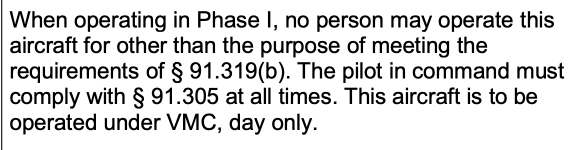
The standard operating limitations have not changed from the previous with respect to the allowed purpose language. It's curious that the FAR references are specific to 91.319(b) and not 91.319 in general as proposed in this thread or imagined by AI.

Screenshot 2026-05-07 at 2.58.13 PM.png

91.319(b) is what obligates an operator to stay in the assigned area *until* establishing the aircraft is controllable through speeds and maneuvers, and clearing any hazardous operating characteristics or design features.

  • (b) No person may operate an aircraft that has an experimental certificate outside of an area assigned by the Administrator until it is shown that—
    (1) The aircraft is controllable throughout its normal range of speeds and throughout all the maneuvers to be executed; and
    (2) The aircraft has no hazardous operating characteristics or design features.

There are items described in the PAP test cards that would not satisfy those two requirements and would also be illegal based on the strict interpretation.

This isn't meant to make a strong case that transition training is not addressed (or even appropriate). Based on what we all understand about the importance of Op Lims and how they are written it seems weird that they refer specifically to part (b); leading to the interpretation that anything unrelated to controllability and hazardous characteristics is thus illegal.
 
Thanks Scott!


The standard operating limitations have not changed from the previous with respect to the allowed purpose language. It's curious that the FAR references are specific to 91.319(b) and not 91.319 in general as proposed in this thread or imagined by AI.

View attachment 116938

91.319(b) is what obligates an operator to stay in the assigned area *until* establishing the aircraft is controllable through speeds and maneuvers, and clearing any hazardous operating characteristics or design features.

  • (b) No person may operate an aircraft that has an experimental certificate outside of an area assigned by the Administrator until it is shown that—
    (1) The aircraft is controllable throughout its normal range of speeds and throughout all the maneuvers to be executed; and
    (2) The aircraft has no hazardous operating characteristics or design features.

There are items described in the PAP test cards that would not satisfy those two requirements and would also be illegal based on the strict interpretation.

This isn't meant to make a strong case that transition training is not addressed (or even appropriate). Based on what we all understand about the importance of Op Lims and how they are written it seems weird that they refer specifically to part (b); leading to the interpretation that anything unrelated to controllability and hazardous characteristics is thus illegal.
Since 91.319 (b) states that flight operations must remain in the test area until sub part one and two are met, and the relevant operating limitation is stating that flights can be made for the soul purpose of meeting the requirements in 91.319(b), I don’t see how there is a valid argument for completing other purposes during a test flight. I don’t think any of us need a law degree to make a determination that receiving a sign off for a flight review as a result of making a phase one test flight, is an entirely different and unrelated purpose.
 
Since 91.319 (b) states that flight operations must remain in the test area until sub part one and two are met, and the relevant operating limitation is stating that flights can be made for the soul purpose of meeting the requirements in 91.319(b), I don’t see how there is a valid argument for completing other purposes during a test flight. I don’t think any of us need a law degree to make a determination that receiving a sign off for a flight review as a result of making a phase one test flight, is an entirely different and unrelated purpose.

Right, I understand that interpretation. The problem with the Op Lims and FARs as presented, is that PAP items like flying a speed box or the timed climb is illegal. Just like a flight review, those are also entirely different and unrelated to controllability or hazards. We can't just pretend that the specific items in (b) 1 & 2 don't exist, or mean a nebulous bundle of favored but unlisted purposes.

An interpretation that does work is that is that you are not limited to the allowed purposes and test area while in phase 1, if you have flown enough of a test program to establish controllability and cleared hazards. You don't need a law degree to see that's what the words in 91.319(b) 1 & 2 say.

This could be worded better whatever the true intent. @Brantel , sorry to muck up your thread with geeky reg's stuff. It happens sometimes. :)
 
Right, I understand that interpretation. The problem with the Op Lims and FARs as presented, is that PAP items like flying a speed box or the timed climb is illegal.
I am totally baffled regarding how you made that determination…🤷🏼‍♂️

How can confirming performance values published in the POH, and verifying that instrumentation indications are correct and remain within normal parameters, not be associated with confirming there are no hazardous operating characteristics or design features?
 
I am totally baffled regarding how you made that determination…🤷🏼‍♂️

How can confirming performance values published in the POH, and verifying that instrumentation indications are correct and remain within normal parameters, not be associated with confirming there are no hazardous operating characteristics or design features?

You're measuring the text with a ruler and a rubber band at the same time. Establishing performance numbers and calibrating instruments is not the same thing as verifying controllability and identifying hazards.

You're the DAR. I can accept that your word is the one to rely if the text of the op lims and regs aren't important and there is discretion to include "associated" activities. It's totally reasonable to do calibration and performance, and it's conventional wisdom. It's just not what the words say and this is the first time I've seen the rubber band approach applied to reading op limits by someone credible.
 
You're measuring the text with a ruler and a rubber band at the same time. Establishing performance numbers and calibrating instruments is not the same thing as verifying controllability and identifying hazards.

You're the DAR. I can accept that your word is the one to rely if the text of the op lims and regs aren't important and there is discretion to include "associated" activities. It's totally reasonable to do calibration and performance, and it's conventional wisdom. It's just not what the words say and this is the first time I've seen the rubber band approach applied to reading op limits by someone credible.
It only works to say it is not what the words say, if you apply your own self determine definitions to those words.

Repeating myself, I am totally baffled why you are posing an argument that goes directly against pretty much universal policy within the FAA for many many decades… regardless what we think the minutiae levels of definition are for a few words.

If your argument were valid, it would make a large percentage of all of the phase 1 flight testing flights that have been made in the past by Home builders, entirely illegal.
That is nothing short of silliness

That’s all from me

Apologies to you, Brian for the extremely off track thread drift.
 
  • Like
Reactions: Mel
Back
Top