Van's Air Force

The definitive Van's Aircraft support community! Buying, building or flying an RV? Join our exclusive family of mentors and enthusiasts!

RV-12 Flaperon Tube Corrosion?

Brett H

Well Known Member
Patron
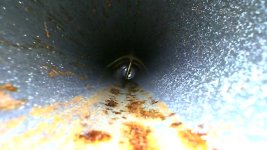
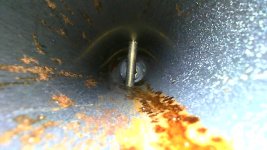
While performing the annual condition inspection on my RV-12, I put my boroscope into the outboard end of the Flaperon Tubes and was surprised to see the reddish brownish areas.

Have others seen this and what have they done about it?

I’m assuming that it is light rust due to the powder coating being limited inside the tube. Particularly as one gets further from the ends. My RV-12 ULS has 175 hours it and has always been hangared.

The alternatives seem to be:
1.) Do nothing and monitor at the annual condition inspection
2.) Leave them installed and apply something like Corrosion X
3.) Remove them, clean up the inside diameter, prime and reinstall. Removing the right side Flaperon Tube would require removing the Fuel Tank.

Your experience/thoughts would be appreciated.

Brett H
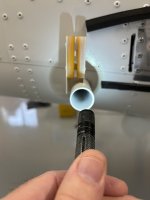
IMG_3877.jpeg

Image_2026-01-13 09_50_09_683.jpeg

Image_2026-01-13 09_53_02_421.jpeg

Image_2026-01-13 09_54_01_638.jpeg
 
Could that be rusted drilling swarf from when the inboard ends of the tubes were originally drilled? Time+vibration could spread it around and through the tubes.
 
Last edited:
Excellent catch. Very diligent on the inspection. I have never thought of using my scope to look inside my stick, the only powder coated tube on my 6.
All other tubes are internally primed per Vans instructions.
I am not familiar enough with the 12 to know, but if you could run a rod, like gun cleaning brass brush down it, vacuum out, and prime in place, I would do it.
You will know right away if it is just surface rust. If it’s just surface rust, I’d leave it and inspect next year.
 
While performing the annual condition inspection on my RV-12, I put my boroscope into the outboard end of the Flaperon Tubes and was surprised to see the reddish brownish areas.

Have others seen this and what have they done about it?

I’m assuming that it is light rust due to the powder coating being limited inside the tube. Particularly as one gets further from the ends. My RV-12 ULS has 175 hours it and has always been hangared.

The alternatives seem to be:
1.) Do nothing and monitor at the annual condition inspection
2.) Leave them installed and apply something like Corrosion X
3.) Remove them, clean up the inside diameter, prime and reinstall. Removing the right side Flaperon Tube would require removing the Fuel Tank.

Your experience/thoughts would be appreciated.

Brett H
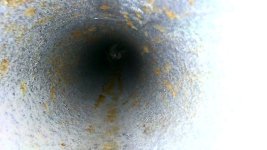
View attachment 107188

View attachment 107189

View attachment 107191

View attachment 107192

Thanks the replies.

When building my RV-12 I assumed that the powder coating would provide the needed corrosion protection. Unfortunately, the powder coating coverage on the inside diameter gets more limited as it gets further from the ends.

Regarding how long has the discoloration been there, great question. This is the first time that I put a boroscope into these tubes and it is difficult to see without the use of a boroscope. So, I really don’t know.

The Flaperon Tube on the left side also had some discoloration. Fortunately, it didn’t extend all the way to bolt and cleaned up the maroon scotchbrite.

The right side Flaperon Tube discoloration extends beyond the bolt and thus, makes cleaning up that one more challenging. To remove the bolt requires removing the fuel tank.

Whether is could have been caused from chips created during drilling the holes, that is possible. The discoloration is the worst on the bottom. But, some discoloration exists around the full circumference.

If one were to use Corrosion X, which one of the Corrosion X variants would be preferred?

Brett H
 
I found the same thing in my 12 on the first CI after I purchased it in 2021.

It was just surface rust. I ran a bottle brush in and out, then used my 12 gauge cleaning rod with isopropyl alcohol soaked patches , and finally used Corrosion X on a cleaning patch to coat the bore.

I do this every CI now, and it still looks great.
 
I ran into the same issue on my plane. It was worse on the inboard end around the 2 bolt holes. Cleaned it out, cleaned the outside of the holes, primed everything I could (sprayed down the inside with primer and let it run down). Once it's dry I'll shoot some ACF-50 down there as well.
 
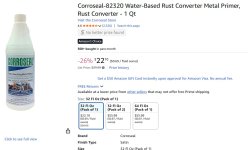
IF IT were mine, I would use Coroseal and apply it using a swab on a stick. It does nothing till it comes in contact with rust.
It stops the rust and chemically changes it. It then can be painted. I used this for years on propane tanks with 100% success.
coroseal.jpg
 
Thanks for the replies.

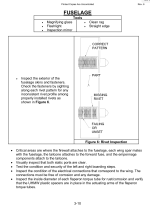
As a reference, the RV-12 Service Manual calls for inspecting the Flaperon Torque Tube for rust/corrosion as shown in the last bullet point.

Screen grab 1-17-26 reduced.PNG

I have sent the same photos to Van's Builder Support and they recommended removing, cleaning and priming rather than using Corrosion X because it would prevent the future ability to prime this surface. I have sent them a follow-up question two days ago and have not heard back yet.

My plan at this time is to remove the left side Flaperon Torque Tube, clean the inside diameter to the bare metal and then coat it with epoxy primer. After this I will decide if I will treat the right side in place (i.e., not remove the fuel tank) with Corrosion X / Corroseal / similar or remove the fuel tank and epoxy prime the right side Flaperon Torque Tube.

I think the bigger concern is that one cannot depend on the powder coating of the various supplied tubes to provide the corrosion protection on the inside diameter.

Brett H
Columbus, IN
 
Thanks for the replies.

As a reference, the RV-12 Service Manual calls for inspecting the Flaperon Torque Tube for rust/corrosion as shown in the last bullet point.

View attachment 107407

I have sent the same photos to Van's Builder Support and they recommended removing, cleaning and priming rather than using Corrosion X because it would prevent the future ability to prime this surface. I have sent them a follow-up question two days ago and have not heard back yet.

My plan at this time is to remove the left side Flaperon Torque Tube, clean the inside diameter to the bare metal and then coat it with epoxy primer. After this I will decide if I will treat the right side in place (i.e., not remove the fuel tank) with Corrosion X / Corroseal / similar or remove the fuel tank and epoxy prime the right side Flaperon Torque Tube.

I think the bigger concern is that one cannot depend on the powder coating of the various supplied tubes to provide the corrosion protection on the inside diameter.

Brett H
Columbus, IN
 
A few days ago, I received a response from Van's Tech Support to my follow up questions from mid-January. So, this is my update.

The Tech Support email made the following three points:
1.) Any rust should be cleaned and primed.
2.) Discouraged using Corrosion X fog or ACF50 fog as it will limit the ability to paint the airplane later. The response didn't address my question about applying Corrosion X with a swab to the inside of the effected powder coated tubes.
3.) The response didn't address my question about why the Van's supplied powder coated tubes are having some rust on the inside diameter.

Unfortunately, there are multiple powder coated tubes in my RV-12 have some light rust on the inside diameter. I am surprised because my airplane has always been hangared, is located in central Indiana far away from lakes/oceans, has never been in rain and only washed with a hose once. I thought the powder coating would have provided the needed corrosion protection.

So, this is my conclusions:
1.) Where possible without significantly disassembling the airplane clean and epoxy prime.
2.) The powder coated tubes are 4130 and thus, any corrosion growth should be slow.
3.) Apply Corrosion X with swab to inside on tube outside of the airplane and monitor if it stays where applied or if it moves. If it doesn't migrate, apply at the next annual condition inspection to the affected areas.
4.) On future projects the inside diameter of the powder coated tubes will need to be epoxy primed.

Brett H
Columbus, IN N4BH
 
Unfortunately, there are multiple powder coated tubes in my RV-12 have some light rust on the inside diameter. I am surprised because my airplane has always been hangared, is located in central Indiana far away from lakes/oceans, has never been in rain and only washed with a hose once. I thought the powder coating would have provided the needed corrosion protection.
The powder coating is electrostatically applied (as a dry powder) by spraying to the charged external surface, then baked; it would be very difficult to evenly apply the powder inside a relatively small diameter tube.
 
How do you prime the inside of these steel tubes?
Actual primer?
Boiled linseed oil?
How would you do each of these?
Thanks
 
How do you prime the inside of these steel tubes?
Actual primer?
Boiled linseed oil?
How would you do each of these?
Thanks
For the steel tube parts on my -4, I used a couple of different approaches:

For the control sticks, I applied a phosphate conversion coating (by dipping) and then had them powder-coated. As others have mentioned, no significant amount of coating is applied to the bore of the tube.

For the aileron push-pull tubes, I welded the threaded stud to one end, used a syringe to squirt a couple of cc's of tube oil into the open end of the tube, and welded the second stud in place. For these assemblies, I applied the same phosphate conversion coating, but used epoxy primer on the exterior surface.

Good luck,

Dean
 
For the steel tube parts on my -4, I used a couple of different approaches:

For the control sticks, I applied a phosphate conversion coating (by dipping) and then had them powder-coated. As others have mentioned, no significant amount of coating is applied to the bore of the tube.

For the aileron push-pull tubes, I welded the threaded stud to one end, used a syringe to squirt a couple of cc's of tube oil into the open end of the tube, and welded the second stud in place. For these assemblies, I applied the same phosphate conversion coating, but used epoxy primer on the exterior surface.

Good luck,

Dean
Gh
 
Thank you for replying. Your method, unfortunately, won’t work for me as I’m doing an RV-12iS and the steel tubes I’m concerned with are already powder coated on the outside. I want to do priming on the insides of the tubes only.
 
Thank you for replying. Your method, unfortunately, won’t work for me as I’m doing an RV-12iS and the steel tubes I’m concerned with are already powder coated on the outside. I want to do priming on the insides of the tubes only.
Apologies, I'm not very familiar with the RV-12 construction. For the elevator push-pull tube(aluminum) on the -4, I primed the interior, by temporarily plugging both ends after placing a small quantity of primer inside. I rolled the tube and manipulated in an effort to fully coat the interior surface. Before the paint cured, I hung it vertically to drain the excess. I had anodized this particular tube prior to priming, but as long as you can clean the bore, you may be able to do something similar.
 
Any rattle can self-etching primer sprayed long enough at each end until it runs out the other is probably adequate. Roll the tube around during application the spray and run some solvent on a swatch beforehand for prep.

I work with Van every Saturday at Teen Flight mentoring high schoolers and this is what Dick recommends.
 
Any rattle can self-etching primer sprayed long enough at each end until it runs out the other is probably adequate. Roll the tube around during application the spray and run some solvent on a swatch beforehand for prep.

I work with Van every Saturday at Teen Flight mentoring high schoolers and this is what Dick recommends.
This is also what I did.
 
How do you prime the inside of these steel tubes?
Actual primer?
Boiled linseed oil?
How would you do each of these?
Thanks

My approach to priming the inside of tubes based on my previous limited success at attempting to spray primer onto the inside diameter was to apply it with a long swab that I had made.

The stick portion of the swab was made from the 48” plastic rod of a driveway reflector. On the end that the absorbent material would be attached to I drilled two holes.

To absorb the primer I cut a one inch strip from a new microfiber towel/rag.

One end the microfiber strip was attached to the plastic rod via thread. The microfiber strip was wrapped around the plastic rod until it was slightly smaller in diameter than the inside diameter of the tube to be primed. The excess microfiber strip was cut off and the loose end was sown to the wrapped microfiber strip.

This swab was dipped in the primer and then the swab was slid into the tube to apply the primer.

I would recommend trying this on a similar tube before using this approach on your project parts.

Brett H
Columbus, IN
 
Back
Top