Van's Air Force

The definitive Van's Aircraft support community! Buying, building or flying an RV? Join our exclusive family of mentors and enthusiasts!

RV-10 Fwd CG Issue

Hooker47

Member
Friend
I've heard of the -10 having FWD CG issues and searched the forums trying to find prior discussions. My current W&B is showing an empty CG of 105.22. With Me and min fuel (60lbs) alone the CG is still 106.18. Posted range is 107.84-116.24. If I am calculating thing right I will need approximately 16lbs of weight over the tail tie down point to be with in CG with just me and min fuel. If someone know where previous discussions are or would entertain me with what's been done I would greatly appreciate it.

Chris
RV-10 (almost ready for the DAR!)
 
Put the stuff in the baggage area that you will have on every trip, towbar, spare toolkit, covers, Gats, tub with a qt oil, rags, etc. Then re weigh. What is your empty weight?
 
That empty CG seems forward. Mine is 107.7
Tell us more about your 10. Standard engine/prop/battery location?
The “forward CG issues” is just that they can be close to the forward limit empty or without rear pax or baggage. It’s not physically possible to put mine through the forward limit.
Most 10 owners put ballast the baggage compartment to bring the solo/light CG aft.
It’s not technically necessary but makes for a much nicer handling airplane.
 
Mine is 108.6 empty and 109.1 with me plus full fuel. All of my stations are aft of the front limit so the more of anything I put in the plane the more aft it goes.

I'm also building a 10 and I'm worried about ending up with a wonky center of gravity. Do you know what you might have done to have it so far forward?
 
106.9” empty here. Simple light weight RV-10. With a single pilot and nothing else onboard I hit the forward CG as fuel falls below 30 gal., but just five pounds of ballast (tie downs or tools) in the baggage compartment is enough to keep me in the envelope with light fuel loads. I don’t know how you could get a cg as far forward as yours is.
 
Provide your weight data. Then we can verify your calculations.

For example, my old RV-10 empty (with full paint, avionics and interior):
- Nose 362# Arm 50.44”
- Left Main 652# Arm 124.31”
- Right Main 645#. Arm 124.44”

Empty weight: 1659#
Empty Moment: 179,573
Empty CG: 108.24”

Now add reality:
Solo, pilot 200# at 144.58”; Moment 28,916
Full Fuel, 360# at 108.9”; Moment 39,204

Solo with full fuel:
Weight: 2219#. Moment: 247,693
New CG: 111.6”

Carl
 
That empty CG seems forward. Mine is 107.7
Tell us more about your 10. Standard engine/prop/battery location?
The “forward CG issues” is just that they can be close to the forward limit empty or without rear pax or baggage. It’s not physically possible to put mine through the forward limit.
Most 10 owners put ballast the baggage compartment to bring the solo/light CG aft.
It’s not technically necessary but makes for a much nicer handling airplane.
1727# Empty wt.
10 gal and me @200# = 110.1
50 gal, 400# front, 250 # back = 114.4
Baggage is what I travel with, some tools, oil, towbar, etc. (in my CG already).
Pretty much any combo for useful load #973 works in my RV 10. I have com2 where stock battery is called for. My EarthX (4#) is on top of tunnel just inside cockpit. I had to put 22# of lead just under the tail fairing to achieve this.
 
Sounds like a great excuse to mount an oxygen bottle in the rear somewhere...
 
Sounds like a great excuse to mount an oxygen bottle in the rear somewhere...
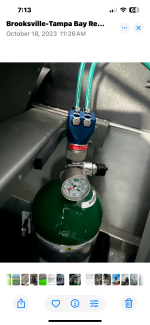
I forgot, I have a 22 cu cylinder behind r passenger seat there as well, also included in the CG. I routed the tubes up into the Aerosport console up to pilot/co pilot.
 

Attachments

  • IMG_6321.png
    IMG_6321.png
    3.1 MB · Views: 27
To the OP. Did you level the aircraft per Van's instructions before weighing it? Read that part of the manual and make sure you get the airplane oriented in pitch the way Van's specifies. We had an RV-14 owner locally who borrowed ramps and scales from me to do his W/B. He was very disappointed that his CG ended up far from what he expected or wanted. His aircraft was equipped like most RV-14's and the numbers were nowhere close. Turned out he'd just rolled it up on the scales without leveling (or inclining?) the aircraft per Van's directions. He corrected that, re-weighted, and got the CG he expected.
 
1727# Empty wt.
10 gal and me @200# = 110.1
50 gal, 400# front, 250 # back = 114.4
Baggage is what I travel with, some tools, oil, towbar, etc. (in my CG already).
Pretty much any combo for useful load #973 works in my RV 10. I have com2 where stock battery is called for. My EarthX (4#) is on top of tunnel just inside cockpit. I had to put 22# of lead just under the tail fairing to achieve this.
Tks. Question was for the OP.

Question for you though… why not just batteries in the stock location? Carrying around 22# of lead in the tail has more consequences than just moving the CG aft (not to mention reducing the useful load).
Sounds quite experimental to me.

Related: For whatever reason, sling added ballast weights (only a few lbs) into the internal elevator counterbalances for Sling TSIs. Apparently not for flutter reasons.
The UK LAA determined that this introduced negative longditudinal stability in some corners of the flight envelope despite the aircraft being statically within CofG. Not to mention the effect on rotational inertia and spin recovery.
I think in the UK you must remove them.
 
I've heard of the -10 having FWD CG issues and searched the forums trying to find prior discussions. My current W&B is showing an empty CG of 105.22. With Me and min fuel (60lbs) alone the CG is still 106.18. Posted range is 107.84-116.24. If I am calculating thing right I will need approximately 16lbs of weight over the tail tie down point to be with in CG with just me and min fuel. If someone know where previous discussions are or would entertain me with what's been done I would greatly appreciate it.

Chris
RV-10 (almost ready for the DAR!)
Using your numbers 50 lbs. in the baggage area resolves the issue which is not unusual at all. They fly and land much better if CG is more centered but obviously ok as long as CG in the envelope. I would hold off adding permanent weight to the tail as the 10 unlike all the other 2 seaters can easily exceed MGW with 2 passengers in the back and not even full fuel. (That's if you still have standard range tanks), ER hopefully have time to burn some fuel before landing. Adding 16 lbs. in the tail will be harder to remove than a case of water in the baggage area when you have passengers.
 
Tks. Question was for the OP.

Question for you though… why not just batteries in the stock location? Carrying around 22# of lead in the tail has more consequences than just moving the CG aft (not to mention reducing the useful load).
Sounds quite experimental to me.

Related: For whatever reason, sling added ballast weights (only a few lbs) into the internal elevator counterbalances for Sling TSIs. Apparently not for flutter reasons.
The UK LAA determined that this introduced negative longditudinal stability in some corners of the flight envelope despite the aircraft being statically within CofG. Not to mention the effect on rotational inertia and spin recovery.
I think in the UK you must remove them.
The OEM builder didn’t want the heavy cables running that long length and he put the Garmin Com2 remote back there. The EarthX up front at 4# with cable lengths <1’. The permanent 22# was purposeful to allow just about any combination of useful load regardless of position to be in the CG envelope. I helped him finish the plane in 2020. He sold it to me 1 yr after the finish build. His wife was not into the XC like he wanted her to be.
 
1750 and 107.42”

I would be curious to see your calculations. I figured my -10 was a worst case as I have Barrett 540, CAI, EFII, Showplanes cowl and induction. All this adds weight to move the empty cg forward. I also have an MTV-9 three blade prop which is at least 12lbs heavier than the vans recommended MTV-12 prop. Add in the retread nose wheel and the aft mounted ETX900 batteries (aft mounted), and the empty cg moves further forward.

You said your calculated cg is 2+ inches even further forward.

Can you post your calculations?
 
1750 and 107.42”

I would be curious to see your calculations. I figured my -10 was a worst case as I have Barrett 540, CAI, EFII, Showplanes cowl and induction. All this adds weight to move the empty cg forward. I also have an MTV-9 three blade prop which is at least 12lbs heavier than the vans recommended MTV-12 prop. Add in the retread nose wheel and the aft mounted ETX900 batteries (aft mounted), and the empty cg moves further forward.

You said your calculated cg is 2+ inches even further forward.

Can you post your calculations?
I didn’t post my CG empty wt.
I have 1727# empty @109.6 which is 2.2” aft of yours. Unless I mis transposed something from Foreflight from the spreadsheet.
 
I didn’t post my CG empty wt.
I have 1727# empty @109.6 which is 2.2” aft of yours. Unless I mis transposed something from Foreflight from the spreadsheet.
I think he’s asking the OP.
Any EW CG that is aft of 107.84 is effectively limiting your loading to some extent as every station is aft of that. Why don’t you remove some of that lead until your empty CG is 107 or so. You’ll get more payload and greater CG flexibility.
Just a suggestion.

For the OP, Im with rocket man, I thought mine was also towards the front of the pack for forward CGs too. Yours sounds a long way forward and sounds like a reweigh may be in order unless you have batteries up front or some such.
 
106.9” empty here. Simple light weight RV-10. With a single pilot and nothing else onboard I hit the forward CG as fuel falls below 30 gal., but just five pounds of ballast (tie downs or tools) in the baggage compartment is enough to keep me in the envelope with light fuel loads. I don’t know how you could get a cg as far forward as yours is.
Mine's empty CG is 107 even. Metal prop, panel mounted avionics. Lightweight airplane. I do have the overhead console, and the ELT is mounted right behind the baggage bulkhead, but I figure mine (like yours) is about as far forward as a semi-stock airplane is gonna get. I don't see how the OP's is at <106 unless he has an angle valve engine or some other forward mounted heavy items (e.g. prestolite starter) I just don't have.
 
Mine's empty CG is 107 even. Metal prop, panel mounted avionics. Lightweight airplane. I do have the overhead console, and the ELT is mounted right behind the baggage bulkhead, but I figure mine (like yours) is about as far forward as a semi-stock airplane is gonna get. I don't see how the OP's is at <106 unless he has an angle valve engine or some other forward mounted heavy items (e.g. prestolite starter) I just don't have.
Exactly
 

Empty Weight & CG

Wt (lbs.)

Arm (in.)

Moment (in. lb.)

Front Wheel

403.0
49.25
19,847.8
Left Wheel
616.0
123.50
76,076.0
Right Wheel
617.5
123.50
76,261.3
Aircraft Empty Weight
1,636.5
172,185.0
CG
105.22
Most Aft Weight & CG

Wt (lbs.)

Arm (in.)

Moment (in. lb.)

Aircraft Empty Weight

1,636.5
172,185.0
Front Seats
200
113.26
22652
Rear Seats
400.0
151.26
60,504.0
Baggage
100.0
175.40
17,540.0
Fuel
361.2
108.90
39,334.7
Total Weight
2,697.7
312,215.7
CG
115.73
Most Forward Weight & CG

Wt (lbs.)

Arm (in.)

Moment (in. lb.)

Aircraft Empty Weight

1,636.5
172,185.0
Front Seats
200
113.26
22652
Rear Seats
0.0
151.26
0.0
Baggage
25.0
175.40
4,385.0
Fuel
60.0
108.90
6,534.0
Total Weight
1,921.5
205,756.0
CG
107.08

These are the numbers we calculated with the aircraft level using the lower edge of the door opening as the leveling point as suggested. Standard IO-540 with only addition being a plane around standby alternator. 2 blade Hartzell from Vans. I agree the a case of oil and gear that could be helpful sounds a lot better then added lead. Wasn't sure if the DAR would buy off on that though. The panel with is also forward of the intended point is 3 G3X, and a full host of avionics with VPx all forward of the dash. EXT900 in original battery location.
 
Last edited:
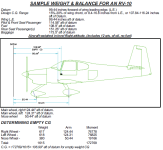
Below is a snip from the RV-10 manual which shows an example W&B. I notice that some of your moment arms are different by an inch or so. In particular, the wheels are all about an inch further back. Also swapping the standard battery for an ETX900 moves the CG forward about 3/4" (if I recall correctly). Perhaps it's just down to an accumulation of small differences.

1737822678320.png
 
Chris,

With that light battery you will need to add ballast aft. Keep in mind that the 20 pounds or so of paint will be more aft of CG than forward, so that will help your issue. The numbers I posted are after paint and two PC-625 batteries mounted in the standard aft location.

Carl
 

Empty Weight & CG

Wt (lbs.)

Arm (in.)

Moment (in. lb.)

Front Wheel

403.0
49.25
19,847.8
Left Wheel
616.0
123.50
76,076.0
Right Wheel
617.5
123.50
76,261.3
Aircraft Empty Weight
1,636.5
172,185.0
CG
105.22
Most Aft Weight & CG

Wt (lbs.)

Arm (in.)

Moment (in. lb.)

Aircraft Empty Weight

1,636.5
172,185.0
Front Seats
200
113.26
22652
Rear Seats
400.0
151.26
60,504.0
Baggage
100.0
175.40
17,540.0
Fuel
361.2
108.90
39,334.7
Total Weight
2,697.7
312,215.7
CG
115.73
Most Forward Weight & CG

Wt (lbs.)

Arm (in.)

Moment (in. lb.)

Aircraft Empty Weight

1,636.5
172,185.0
Front Seats
200
113.26
22652
Rear Seats
0.0
151.26
0.0
Baggage
25.0
175.40
4,385.0
Fuel
60.0
108.90
6,534.0
Total Weight
1,921.5
205,756.0
CG
107.08

These are the numbers we calculated with the aircraft level using the lower edge of the door opening as the leveling point as suggested. Standard IO-540 with only addition being a plane around standby alternator. 2 blade Hartzell from Vans. I agree the a case of oil and gear that could be helpful sounds a lot better then added lead. Wasn't sure if the DAR would buy off on that though. The panel with is also forward of the intended point is 3 G3X, and a full host of avionics with VPx all forward of the dash. EXT900 in original battery location.
Plugging your listed weights in to my spreadsheet with VANS listed arms yields an empty CG of 106.16.

It is interesting that your nose weight is a full ten pounds more than mine, yet I have an MT 3 blade MTV9 prop (12 lb heavier hub than the MTV12), dual alternators, and CAI. I do, however have two ETX900s mounted in the stock aft location.
 
The CG of my -10 at the BEW of 1605.5 pounds is 106.96. With just me and 10 gallons of fuel, the CG is 108.1 which is pretty close to the forward edge of the CG envelope. Even with a more normal 20-40 gallons of fuel, I find that at or near that CG, I don't have enough nose-up trim to fly the final approach without holding the elevator manually. I'm not sure what the CG was when it was originally built but the previous owner (#2) had swapped out the stock prop with a Whirlwind composite prop but then had also replaced the stock battery with 2 x ETX900 which are mounted on the front of the firewall and added a backup alternator.

In any case, I find that with just the front seat occupant(s), 50 pounds of ballast in the baggage makes it handle much more nicely on the final approach and in the flare. If for any reason, I expect to lose or pick up passengers at an intermediate stop, I move the ballast to the passenger area. If the plane is going to be close to max gross on any of the legs and I need more flexibility with the ballast, I swap the ballast bags with a 5 gallon water container.

Vas
 
The CG of my -10 at the BEW of 1605.5 pounds is 106.96. With just me and 10 gallons of fuel, the CG is 108.1 which is pretty close to the forward edge of the CG envelope. Even with a more normal 20-40 gallons of fuel, I find that at or near that CG, I don't have enough nose-up trim to fly the final approach without holding the elevator manually. I'm not sure what the CG was when it was originally built but the previous owner (#2) had swapped out the stock prop with a Whirlwind composite prop but then had also replaced the stock battery with 2 x ETX900 which are mounted on the front of the firewall and added a backup alternator.

In any case, I find that with just the front seat occupant(s), 50 pounds of ballast in the baggage makes it handle much more nicely on the final approach and in the flare. If for any reason, I expect to lose or pick up passengers at an intermediate stop, I move the ballast to the passenger area. If the plane is going to be close to max gross on any of the legs and I need more flexibility with the ballast, I swap the ballast bags with a 5 gallon water container.

Vas
Pretty much what I do. The -10 has zero issues carrying the ballast weight and it handles much better with the cg near the midpoint.
 
I've heard of the -10 having FWD CG issues and searched the forums trying to find prior discussions. My current W&B is showing an empty CG of 105.22. With Me and min fuel (60lbs) alone the CG is still 106.18. Posted range is 107.84-116.24. If I am calculating thing right I will need approximately 16lbs of weight over the tail tie down point to be with in CG with just me and min fuel. If someone know where previous discussions are or would entertain me with what's been done I would greatly appreciate it.

Chris
RV-10 (almost ready for the DAR!)
The DAR might not be ok with a toolbox in baggage to make CG.. after your inspection you can make a small "flight box" with things we travel with. Examples: spare tube, oil, minimum tools, plexi cleaner, tie downs, etc.. then weigh the plane and put weight in the tail.
 
Back
Top