


Van's Air Force

The definitive Van's Aircraft support community! Buying, building or flying an RV? Join our exclusive family of mentors and enthusiasts!

RV-10 Fuel Pressure Fluctuations at High RPM

kkendall2718

I'm New Here
I have a brand new RV-10 with 4 one hour long flights completed. The plane has a Lycoming IO-540 and I am running Dynon Skyview HDX on the panel. The first three flights all produced low fuel pressure warnings on takeoff. This is with the fuel boost pump off.

The lower limit for "red" fuel pressure was set for 15 psi and after double checking the Lycoming manual I have changed this to 14 psi. Plotting the Skyview HDX data shows a "noisy" fuel pressure signal that only begins to get noisy with the engine reaches 2600 RPMs (full throttle). The fuel pressure never drops below 14 psi. The engine purrs like a kitten throughout takeoff and the entire flight.

I am wondering if this is related to my engine driven fuel pump, a vibrating fuel line, something else? Why does it only happen at max RPM and reliably settles out once the prop is brought back?

On my most recent flight I conducted a test while stopped and verified that by turning on the fuel boost pump, the pressure stabilized back at nominal values with the boost pump. I will be employing the boost pump for takeoff/landing until I get more information.

Below is a plot from my second flight, showing the "noisy" fuel pressure signal. Note that fuel flow is shadowing the noise at the same frequency, implying to me that this is a real measured anomaly and not electrical noise on the transducer. Also note that the fuel pressure smooths out and climbs as soon as the prop is brought back to 2500 RPMs.
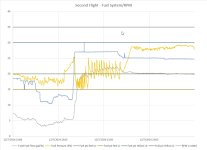

SecondFuelRPM.jpg

Any help or observations would be greatly appreciated.

Thanks
 
Firstly congratulations on finishing your Rv-10
I ALWAYS have the fuel pump on for takeoff. I’d rather find out about a fuel pump failure at a safe height than early in the takeoff.
Is your fuel system exactly per the plans? Is your fuel flow meter in the tunnel?
First thought is to check every connection for a fuel leak. It’s possibly sucking air when the demand is high.
Some people have found that with the fuel flow meter placed in the tunnel that they experienced fluctuations. By placing it as per the red cube manufacturer’s recommendation behond the last fuel pump, this was solved.

Regards Peter
 
I have a brand new RV-10 with 4 one hour long flights completed. The plane has a Lycoming IO-540 and I am running Dynon Skyview HDX on the panel. The first three flights all produced low fuel pressure warnings on takeoff. This is with the fuel boost pump off.

The lower limit for "red" fuel pressure was set for 15 psi and after double checking the Lycoming manual I have changed this to 14 psi. Plotting the Skyview HDX data shows a "noisy" fuel pressure signal that only begins to get noisy with the engine reaches 2600 RPMs (full throttle). The fuel pressure never drops below 14 psi. The engine purrs like a kitten throughout takeoff and the entire flight.

I am wondering if this is related to my engine driven fuel pump, a vibrating fuel line, something else? Why does it only happen at max RPM and reliably settles out once the prop is brought back?

On my most recent flight I conducted a test while stopped and verified that by turning on the fuel boost pump, the pressure stabilized back at nominal values with the boost pump. I will be employing the boost pump for takeoff/landing until I get more information.

Below is a plot from my second flight, showing the "noisy" fuel pressure signal. Note that fuel flow is shadowing the noise at the same frequency, implying to me that this is a real measured anomaly and not electrical noise on the transducer. Also note that the fuel pressure smooths out and climbs as soon as the prop is brought back to 2500 RPMs.


View attachment 77621

Any help or observations would be greatly appreciated.

Thanks
How are you measuring fuel flow? With a real flow meter (turbine style, red cube or other) or with a pressure transducer on the fuel divider?
 
Firstly congratulations on finishing your Rv-10
I ALWAYS have the fuel pump on for takeoff. I’d rather find out about a fuel pump failure at a safe height than early in the takeoff.
Is your fuel system exactly per the plans? Is your fuel flow meter in the tunnel?
First thought is to check every connection for a fuel leak. It’s possibly sucking air when the demand is high.
Some people have found that with the fuel flow meter placed in the tunnel that they experienced fluctuations. By placing it as per the red cube manufacturer’s recommendation behond the last fuel pump, this was solved.

Regards Peter
Thanks. There is nothing like a first flight.

I also fly an RV-7A and standard operating procedures are to have the boost pump on for takeoff/landing. I am encountering a lot of Van's pilots, almost entirely pilots flying injected fuel systems, that do not use the boost pump. I have always considered it a backup for the engine driven pump and a great idea to have on during critical operations.

I have a "per plans" fuel system with the red cube in the tunnel downstream of the boost pump. I did not realize that the manufacturer recommends a different position.

The fact that this anomaly occurs only at very high RPM leads me to believe that I have some kind of mechanical vibration inducing a fluid dynamics response. Cavitation of the pump or some sort of resonance in the fuel line. I am considering adding some anchoring to the fuel line in an attempt to dampen vibration.
 
How are you measuring fuel flow? With a real flow meter (turbine style, red cube or other) or with a pressure transducer on the fuel divider?
I have the red cube for flow and a transducer on the firewall. Standard installation. Nothing fancy. I wouldn't even know about this anomaly unless I was running a fancy set of avionics and EMS, aka Skyview HDX. Is this a case of too much data? In the golden age of Cessnas there was just a needle migrating through a simple color coded gauge. Is it green or red?
 
As I said in the previous post there’s absolutely no harm in checking all the fuel line fittings for leaks. Does it do it on either tank?
Do a search here and you’ll find lots of RV-10 owners that have had fuel flow fluctuations until they changed the location of the red cube to be either after the engine driven pump or between the fuel control unit and the fuel divider. (That’s where mine is located)
If you read the instructions for the red cube they state that it must be installed after all fuel pumps.
 
As I said in the previous post there’s absolutely no harm in checking all the fuel line fittings for leaks. Does it do it on either tank?
Do a search here and you’ll find lots of RV-10 owners that have had fuel flow fluctuations until they changed the location of the red cube to be either after the engine driven pump or between the fuel control unit and the fuel divider. (That’s where mine is located)
If you read the instructions for the red cube they state that it must be installed after all fuel pumps.
Well....I did indeed find a loose AN fitting on the fuel line. After tightening this up and flying, the fuel pressure is rock solid. Thanks for the troubleshooting advice.
 
Well....I did indeed find a loose AN fitting on the fuel line. After tightening this up and flying, the fuel pressure is rock solid. Thanks for the troubleshooting advice.
Glad that you’ve solved your problem and that it was indeed a cheap and easy fix.
Also thanks for posting the results as it always helps when someone else has a similar problem.
Good luck with your-10 I’m sure you’ll enjoy it, there such great aircraft.

Regards Peter
 
Glad that you’ve solved your problem and that it was indeed a cheap and easy fix.
Also thanks for posting the results as it always helps when someone else has a similar problem.
Good luck with your-10 I’m sure you’ll enjoy it, there such great aircraft.

Regards Peter
I’m glad you found the problem. I always run the electric fuel for take off and landing being a low wing airplane. I was experiencing dropping in fuel pressure in climb attitude at high altitude (8-10 K) and the engine continued to run strong regardless. The engine driven pump was replaced (500 hrs) remedied the problem EXCEPT I have seen the problem once sine the new pump install. The electric fuel pump always brings the pressure up to high normal.
 
Back
Top
