Van's Air Force

The definitive Van's Aircraft support community! Buying, building or flying an RV? Join our exclusive family of mentors and enthusiasts!

Rudder Pedal Puzzle w/ Beringer brakes

bertschb

Where's my engine????
Sponsor
I temporarily attached the rudder pedals today and noticed I'm not getting the full range of motion for the rudder when I step on the left rudder pedal. What I've done so far to troubleshoot:
  • I removed the rudder cables from the rudder and the rudder swings freely
  • I checked for binding/obstructions of the cables themselves and they are fine
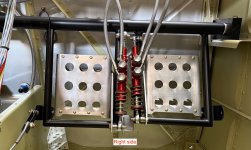
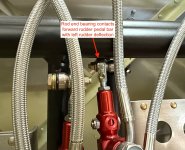
The problem is the rod end bearing for the right foot brake cylinder (for both the left and ride side of the cockpit) contacts the forward horizontal rudder pedal bar about halfway through the range of motion. This prevents full left rudder deflection. My wife and I have stared at the plans for an hour and compared that to my assembly and we can't find a mistake in how I assembled them. The only thing we can think of is the upper bracket where the right foot master cylinder attaches was welded on too high. But, that seems unlikely. I must have done something wrong but I don't see it.

What in the world am I missing???

Disclaimer: Everything you see in the photos below is not the final torqued assembly! And yes, I know I shouldn't have painted the pedal brackets because I can't see cracks in them now if they were to form. New builder here. The brake line routing isn't final yet either. My focus here is solely on figuring out why the rod end bearing is contacting the forward pedal bar.

Note: Only the last photo shows the bearing making contact.
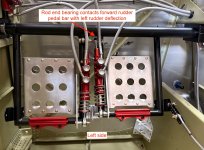
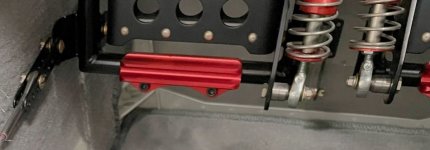
IMG_2317.jpg IMG_2319.jpg

IMG_2320.jpg
 
Have you tried reversing the direction of those 2 top m/cyl rod end bolts?
Also you might be able to use one length shorter bolts with a different mix of washers.
 
Have you tried reversing the direction of those 2 top m/cyl rod end bolts?
If you mean the AN bolts that go through the rod end bearings, no. I'm not seeing how that would prevent the rod end bearing from making contact but then I'm cross eyed from staring at this all day.
 
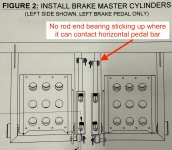
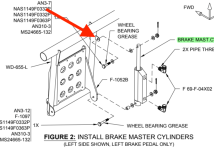
One thing I noticed in the plans is the "factory" brake cylinders don't use rod end bearings and don't stick up as high. This sounds like a Beringer specific problem but then how are folks with Beringer brakes making this work???

Factory brake cylinders:
IMG_2323 copy.jpg
 
I think you will need to measure that attachment point of the rod end bearing and compare it with the other side or other people. From what I can see, it looks like the attachment point is welded a bit higher than normal
 
Is "full left rudder deflection" with the rudder stops installed, i.e. has the rudder deflection in degrees been set and measured per the plans? If the stops have not yet been installed then there may be ehough travel once they are.

Otherwise, it will probably require a physical mod to the rod end bearing to prevent it from contacting the tube.
 
Oh, I see now. Picture looked like the nuts were colliding.
Only other thought would be have the offending tab be cut off & repositioned a bit lower, loosen off the rod end to see if you could possibly shorten the master cylinder.

Another thought. As is done in prior RV models,, the links between the pedal and rudder cables could be lengthened to make the pedal assembly hang at different angles (neutral & degrees of sweep), this might gain the angle of sweep that works better for you.
 
Hi Brian ... you are correct, it's because the Beringer rod ends are much larger than the Vans stock brake cylinder connectors. I had the same issue with my RV14. I considered various options, but ended up configuring the rudder cable length so that the rudder pedal neutral position is more vertical. Doing this just allows full movement without interference. I was concerned about the geometry being awkward for foot angle, but I fitted pedal extension blocks on the bottom of each pedal and it has been just fine.
 

Attachments

  • Installation - 1 of 1.jpeg
    Installation - 1 of 1.jpeg
    89.6 KB · Views: 62
Not relevant to the issue you are trying to resolve but when fixed it is worth making sure that the cylinders are vertical and are operating without any side load, this will prevent leaks down the road.
Figs
 
Hi Brian ... you are correct, it's because the Beringer rod ends are much larger than the Vans stock brake cylinder connectors. I had the same issue with my RV14. I considered various options, but ended up configuring the rudder cable length so that the rudder pedal neutral position is more vertical...
Aha! I wasn't losing my mind!!!!

So I see several ways I can improve left rudder deflection with these Beringer brakes:

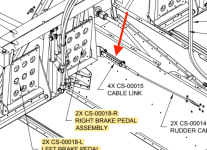
1- I can move the rudder cables to the aft most position on the cable links. As Steve pointed out above, this moves the pedals to a more upright position. I already tried this before making my initial post and it did improve left rudder deflection but I still couldn't get full deflection.
Screenshot 2025-02-09 at 2.50.28 PM.png

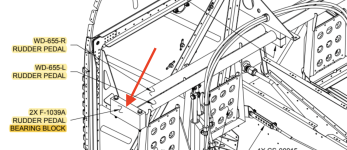
2- I could move the rudder pedal bearing blocks aft. I'm 6'4" so I have my bearing blocks at the forward most position. Doing this exacerbates the geometry problem.
Screenshot 2025-02-09 at 3.23.23 PM.png

3- I could weld a new tab on the right rudder pedals below the existing tabs where the upper rod end bearings connect to the rudder pedals. This would move the top of the rod end bearings down and improve clearance. The picture below doesn't show the correct pedal but the tab I've highlighted is what I'm talking about moving lower.
Screenshot 2025-02-09 at 3.28.28 PM.png

Option 3 would let me keep the longer leg room I need as well as the proper neutral pedal position (not as upright as options 1 and 2 will be) but it's the worst option from my perspective because it involves modifying the brake cylinder attachment points. Not a risk I'm willing to take.

I'm planning on doing both option 1 and 2 tomorrow. I'm REALLY hoping that the center position on the bearing blocks is enough.
 
Not that it would fix the interference issue, but are those Beringer master cylinders upside down? The posted plan page shows the mast oriented up. Maybe the Beringer instructions say different?
 
Not that it would fix the interference issue, but are those Beringer master cylinders upside down? The posted plan page shows the mast oriented up. Maybe the Beringer instructions say different?
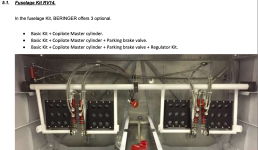
Photo from the Beringer installation manual:

Screenshot 2025-02-09 at 8.22.04 PM.png
 
UPDATE:

I left the rudder cables in the aft-most hole in the rudder cable link and then moved the rudder torque tubes from the most forward position to the middle position. Full, unobstructed left rudder deflection! I then moved the rudder cables to the 2nd hole from the aft-most position in the rudder cable link but the rod end bearing on the brake cylinder contacted the torque tube. So, I moved the rudder cables back to the rear-most hole in the cable links. Problem solved!

Thanks so much for the feedback guys! I couldn't build this airplane without your help.
 
UPDATE:

I left the rudder cables in the aft-most hole in the rudder cable link and then moved the rudder torque tubes from the most forward position to the middle position. Full, unobstructed left rudder deflection! I then moved the rudder cables to the 2nd hole from the aft-most position in the rudder cable link but the rod end bearing on the brake cylinder contacted the torque tube. So, I moved the rudder cables back to the rear-most hole in the cable links. Problem solved!

Thanks so much for the feedback guys! I couldn't build this airplane without your help.
Brian----with beringer master cylinders with Heim joint connections, its important to triple check all range of motions, and adjust the heims. Make sure that the master cylinder pistons are fully extended---as to not keep residual pressure in the lines. Also, make sure that NOTHING can get in the way of movement--like the upper mounting bolts and nuts contacting each other. We've seen 1 instance where a builder didnt check all of that, and after applying more than ample rudder pressure actually had the bolts contact each other and broke off the upper mounting tabe from the pedal bar. Take your time-----I'd to all the mock up stuff on a workbench ---beats crawling insde the fuselage.
 
...Make sure that the master cylinder pistons are fully extended---as to not keep residual pressure in the lines....
Hi Tom

It's been several months since I set up the brakes and temporarily connected the attaching hardware and brake lines. But, I seem to recall the Vans plans calling for adjusting the length of the master cylinder pistons so the pedals were in the neutral position. Beringer says nothing about this. I'll check this later today but while sitting in my recliner I'm going to assume the cylinders are fully extended for two reasons. First, I don't recall holding pressure on the cylinders in order to attach them. But most importantly, I never did like how far the rod end bearings extend past the end of the cylinders. This indicates to me that they are fully extended because I would prefer the cylinders were another 1/2" longer so as not to expose so many threads. IMO, there is way too much thread showing. If you look at the left foot cylinders in the picture in the first post you'll see what I mean. The only way to "fix" this would be to adjust the pedals so they are not in the neutral position or re-weld the ears on the torque tubes so the distance between the rod end bearings is shorter.

The BIG problem I have with the Beringer brakes is the lack of detail in the plans. I was not able to find any exploded views showing how to attach the brakes to the torque tubes. All they give you is a very blurry photo. Some of the blurry photos I've seen show the nuts for the AN bolts connecting the rod end bearings at the top of the cylinders facing each other. Some are the opposite. The photos you provide on your website are more clear but there is still nothing that shows exactly how to connect the brakes. Builders are forced to either figure it out on their own or copy what others have done from random photos they find. I intentionally didn't final torque or zip tie anything because of this.

One other thing - a couple of the brake lines rub on the torque tubes (3rd brake line from the left in the first photo in post #1 and 2nd line from the right in the 2nd photo). I flipped the 3rd brake line from left yesterday and that gave me the clearance I wanted for the torque tube but made the clearance near the parking brake worse. I need to play around with the orientation of the brake lines some more but my options are limited because of the shape of the brake lines.

The bottom line is because of the lack of decent instructions, I will be checking the mounting hardware, brake line routing and clearances many, many, MANY times before I finally torque things down. Right now I'm not happy with the mounting hardware, brake line routing and the exposed threads on the rod end bearings. I do have full left rudder deflection now though :-)
 
Would a clevis end work? Not sure if you have the space. It's what I ended up using on my 8.
 

Attachments

  • IMG_20250211_095400.jpg
    IMG_20250211_095400.jpg
    114.9 KB · Views: 32
Would a clevis end work? Not sure if you have the space. It's what I ended up using on my 8.
The clevis would displace the master cylinders & brake lines closer to the brake pedals (since it would straddle the steel mounting tab whereas the rod ends mount to the side of the tab). Not sure if it would be far enough to interfere but something to take a close look at. The 14 and 8 use very different rudder/brake pedal geometries so what works on the 8 in this case might not work on the 14. I nominate Brian to try it and let us know ;)
 
Slightly different question.
Control approach rudder pedals on my RV -10 with full Beringer system. Does the orientation of the master cylinders make any difference to the operation. Mainly spring on top or spring on bottom?
 
Just began installing the Beringer master cylinders in my RV-14A this morning and have a question for the team already. I installed the rod end bearings on the spring end of the cylinders but can't find anything that specifies the proper length. The stock Van's cylinders are not adjustable but I don't have them to measure. Does anyone know the proper length for this assembly?
 
I would suggest making the legnth the exact length needed to mount them between the two mount points without compressing the cylinder. Any compression will prevent bleeding. Not sure if that helps. I just filled mu Berringer breaks with fluid for the first time and any little compression, prevented fluid from travelling through them.
 
Adjust the rod ends about 1/2 way between top and bottom. Figure out approximately where you want the brake pedals. You don't want to ride them, but you don't want to be dancing trying to get your feet in the right place after landing either. Set the weldments on the bench and shim so a four rudder bars are inline. Shim the brake pedals so all four are where you want also inline. Mark the hole locations and drill. You should have plenty of adjustment fore/aft to fine tune the positions later.
 
Adjust the rod ends about 1/2 way between top and bottom. Figure out approximately where you want the brake pedals. You don't want to ride them, but you don't want to be dancing trying to get your feet in the right place after landing either. Set the weldments on the bench and shim so a four rudder bars are inline. Shim the brake pedals so all four are where you want also inline. Mark the hole locations and drill. You should have plenty of adjustment fore/aft to fine tune the positions later.
The heim joints (rod end bearings) are adjustable for the various different pedal systems. A (very) quick measurement on my 7A with Matco showed about 7.5 center to center. NOT anywhere close to flight status. So for the Beringers, adjust accordingly. BUT, CAUTION, dont allow the piston to be depressed, make sure its fully extended when you set this up. A depressed pistion, even a slight amount, can keep some residual pressure in the lines, forcing the pads against the rotors. Heat buildup, amoung other bad things can happen.
Tom
 
Back
Top