Van's Air Force

The definitive Van's Aircraft support community! Buying, building or flying an RV? Join our exclusive family of mentors and enthusiasts!

Rotax 912ULS Throttle Management

Piper J3

Well Known Member
I recently bought a flying RV-12 with 50TT. The throttle control is horrible with the carburetor springs pulling toward the open position all the time. I understand this is for safety in case the throttle cable breaks. So my question is... has anyone ever had a cable break? The cable looks pretty stout and the installation is clean with nice large radius bends. Operation is smooth except for the constant spring pressure. The friction knurl knob at the base of the throttle control is barely able to prevent creep. Is there a fix short of buying the vernier control? Does the vernier control really fix the weird throttle management? Last question... are weaker springs used with the vernier setup? Sorry for rambling - my thumb and forefinger are sore from flying.

On a positive note - I can't believe how nice this plane flies. I owned a J3-Cub for 23 years and have ~1200 hrs in type. Basically got into the RV-12 and flew it like hand-in-glove. Really sweet. We're going to have good times together.

Oh, and glad to "meet" all you folks finally.

Piper J3
 
Last edited:
The springs also maintain tension so that the carburetors remain in synch, but I found the throttle creep a problem, so I found a set of springs at Home Depot that provide smooth operation without creep. I recently flew an SLSA with the new "reduced tension" springs, and they were pretty good. My HD springs are still better.
 
The original throttle springs are way too strong and make the throttle difficult to operate smoothly. I flew for the first year with springs from my local Ace Hardware store, just strong enough to eventually pull the throttle open should the cable break. Once new "official" throttle springs were available from Van's, I replaced mine. I think the real solution to the throttle issue is to go with the vernier throttle replacement for the -12.

I've not heard of a cable breaking but that doesn't really mean anything. It's a simple safety measure that should be employed to avoid an unnecessary off-field landing in the event of a break.
 
The original throttle springs are way too strong and make the throttle difficult to operate smoothly. I flew for the first year with springs from my local Ace Hardware store, just strong enough to eventually pull the throttle open should the cable break. Once new "official" throttle springs were available from Van's, I replaced mine. I think the real solution to the throttle issue is to go with the vernier throttle replacement for the -12.

I've not heard of a cable breaking but that doesn't really mean anything. It's a simple safety measure that should be employed to avoid an unnecessary off-field landing in the event of a break.
I don't worry about the cable itself breaking, I worry about that one little nut/bolt that holds the cable to the throttle arm.
 
I've been in a Rotax 912 powered aircraft when the throttle cable broke on an aborted landing and a go-around. Fortunately, the carbs did go to full throttle. Not an RV12 and it had an inferior throttle setup.

I installed a McFarland in my Rans S6 and it worked flawlessly. No throttle creep and carbs remained balanced.
 
I don't worry about the cable itself breaking, I worry about that one little nut/bolt that holds the cable to the throttle arm.

The addition of a simple "bug-nut" just forward of the throttle cable/lever nut will help address this concern.
 
I disassembled the friction lock on the standard RV-12 throttle control to see why the lock is so hard to tighten sufficiently to prevent throttle creep. There is a fiber washer that conforms to the 45 degree taper on the knurled friction knob. When the friction knob is wound all the way in it bottoms out without causing sufficient compression of fiber washer. I added a spacer washer behind the tapered fiber washer so now the knurled friction knob can apply good force on the tapper and thus hold the throttle shaft without overly tightening the friction knob. The spacer washer is a black flat sink washer from the hardware store. If I remember correctly, it is 15/32?outside diameter and about 1/8? thickness. You need to open up the inside diameter so it slides on the throttle shaft.
 
What is the exact HomeDepot spring (and what department) that is being used to replace the factory throttle return spring? HD is a big store.
 
I don't remember the Home Depot spring part number it's about 2 1/2" long, and I had to cut a few coils off one end. I previously tried some HF springs that did not hold up. Both broke at about 45 hours time in service. These HD springs have been in for about 300 hours and 3 years with no problems.
 
I had a cable break on me

I have had a cable break on me in a Searey I owned. After the fact it was something that could have been avoided but that does not mean it can not happen again. The screw/nut that holds the cable on the throttle leaver on the carb over time became once piece (corrosion) and aloud the cable become the hinge point and over time broke. My carb was set up to go to ideal and cause my wife and I to do an emergency landing in a field due to unable to maintain level flight on one carb.

Like I said it could have been avoid and I check it each time when I had my other Searey and when I fly in others. But to think the cable could not break is very hard to say and I expect the engine to quit or lose power at any time. I have been flying Rotax engines from the old 277 (Single cylinder) up the Rotax 914. I fly that it is not a mater of if it is going to quit it is when it is going to. I live by that motto flying certified and turbine helicopters too.
 
Hi DHeal, can you explain the "bug nut"? I, too am concerned about what Dgamble said!
I was thinking that Dgamble was concerned about the throttle cable "slipping" through a loose attachment nut/bolt on the throttle cable. A second "bug nut" could act as a secondary nut/bolt to enable the throttle to be pulled back to idle when required. It would not help if the primary "bug nut" broke into pieces and ceased to attach the cable to the throttle arm. In my experience (1,500+ hours on my RV-12 ULS), the bug nuts when properly adjusted and regularly inspected/maintained work very well and are reliable.
 
I made these “stops”. I previously used the ones that the screw pushed down on the cable. They would mark the cable and since I use these to set my mechanical throttle stop it became difficult to make small adjustments.
Very nice install, Seagull! I like these stops. I am going to look for something like this online as I don't have the setup/tools to do a good job (like you did) fabricating them. Also liked your safety wiring!
 
I made these “stops”. I previously used the ones that the screw pushed down on the cable. They would mark the cable and since I use these to set my mechanical throttle stop it became difficult to make small adjustments.
Seagull, I keep coming back to the stops you fabricated... Aluminum? The biggest challenge for me would be drilling the off-center hole. Did you just use a drill press? Did you tap the hole or is there a through-screw with locknut?

Speaking of locknut, Did you replace the Rotax-supplied locknut with an all-metal locknut? I need to take mine off to see what type Rotax used. It doesn't look like a nylon-insert lockout, but it looks similar.
 
The cable stop is steel, nothing exotic. I drilled the center hole then cut the slot with a jewelers hacksaw, (thinner blade than a regular hacksaw). The clamping bolt hole is a clearance hole on top and tapped into the bottom, I used a 2.5mm screw. I used a mill but a drill press with a vise will work fine. If you make the clearance for the bolt head first then drilling for the bolt hole is easier to align.

The bolt on the throttle arm, (I think that is the lock nut you are referring to. My arms were getting sloppy and replacing them was expensive from Rotax so I reamed the holes slightly larger and made new spacer step washers. I also made a new cable bolt using an AN2 (10x32) shoulder bolt. The nut is called a flexloc nut.
 
The cable stop is steel, nothing exotic. I drilled the center hole then cut the slot with a jewelers hacksaw, (thinner blade than a regular hacksaw). The clamping bolt hole is a clearance hole on top and tapped into the bottom, I used a 2.5mm screw. I used a mill but a drill press with a vise will work fine. If you make the clearance for the bolt head first then drilling for the bolt hole is easier to align.

The bolt on the throttle arm, (I think that is the lock nut you are referring to. My arms were getting sloppy and replacing them was expensive from Rotax so I reamed the holes slightly larger and made new spacer step washers. I also made a new cable bolt using an AN2 (10x32) shoulder bolt. The nut is called a flexloc nut.
Thank you. All very useful information.
 
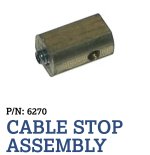
Try McFarlane. Query for "cable stop". I found part # 6270, looks like what came with their Vernier Assist assembly.
 
Try McFarlane. Query for "cable stop". I found part # 6270, looks like what came with their Vernier Assist assembly.
IMG_7250.jpeg
This type is what I was getting away from, they nick the cable then small adjustments are difficult. The one from McMaster Carr is good but $40 for two, I needed a project😂.
 
Back
Top