Van's Air Force

The definitive Van's Aircraft support community! Buying, building or flying an RV? Join our exclusive family of mentors and enthusiasts!

Rotax 912iS Regulator B wires melting

rcarsey

Well Known Member
I've posted this in the RV12 Facebook group, and by Rotax-Owner's request, also the Rotax-Owner FB group too.. sorry if you've already seen this.

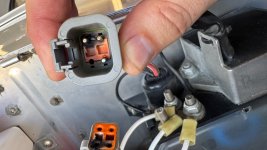
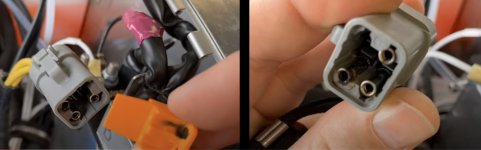
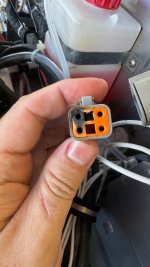
During my pre-Oshkosh oil change and inspections, I found that the connector from the generator to Regulator B (the one on the top of the fuse box) was overheating. This is apparently a common problem and Rotax had issued a Service Instruction (SI-912 i-024) about "optionally" replacing it. Of course, they didn't tell you that they undersized the connectors (TI's DT series; 7.5A).. all newer engines come with a different connector (Amphenol round connector mentioned in the SI).

IF you have a 912iS engine with the grey/square connector on Regulator B (top), then I suggest you take a closer look. There were no obvious symptoms other than light/intermittent radio noise that could easily be ignored. The SI will have you change to Rotax-provided parts for $500 (the round Amphenol connector), but I decided to stick with similar square connector (Amphenol ATP series) (similar to TI's DTP series.. just a bigger size that handles 25A).

For those interested, the Digi-Key shopping cart ($13) is here: https://www.digikey.com/short/tj93p0jd
Crimper tool for 12-gauge wire ($32): https://www.amazon.com/dp/B07V1V6HJ4/?th=1

And of course, if anyone wants to borrow the crimper tool ($5 shipping each way), you're more than welcome to.

*Note: I haven't received these parts yet, so I can't say anything about implementing this particular fix, but it seems easy enough and there's plenty of slack on both ends of the wires
 

Attachments

  • 451648118_10102522017319159_6139183954517836305_n.jpg
    451648118_10102522017319159_6139183954517836305_n.jpg
    536.9 KB · Views: 55
  • 451623998_10102522017234329_7131409020882381887_n.jpg
    451623998_10102522017234329_7131409020882381887_n.jpg
    494.1 KB · Views: 61
  • 451543228_10102522017284229_6597578851522958725_n.jpg
    451543228_10102522017284229_6597578851522958725_n.jpg
    450.6 KB · Views: 58
  • 451330836_10102522017229339_5740200105448712948_n.jpg
    451330836_10102522017229339_5740200105448712948_n.jpg
    466.1 KB · Views: 63
I've posted this in the RV12 Facebook group, and by Rotax-Owner's request, also the Rotax-Owner FB group too.. sorry if you've already seen this.

During my pre-Oshkosh oil change and inspections, I found that the connector from the generator to Regulator B (the one on the top of the fuse box) was overheating. This is apparently a common problem and Rotax had issued a Service Instruction (SI-912 i-024) about "optionally" replacing it. Of course, they didn't tell you that they undersized the connectors (TI's DT series; 7.5A).. all newer engines come with a different connector (Amphenol round connector mentioned in the SI).

IF you have a 912iS engine with the grey/square connector on Regulator B (top), then I suggest you take a closer look. There were no obvious symptoms other than light/intermittent radio noise that could easily be ignored. The SI will have you change to Rotax-provided parts for $500 (the round Amphenol connector), but I decided to stick with similar square connector (Amphenol ATP series) (similar to TI's DTP series.. just a bigger size that handles 25A).

For those interested, the Digi-Key shopping cart ($13) is here: https://www.digikey.com/short/tj93p0jd
Crimper tool for 12-gauge wire ($32): https://www.amazon.com/dp/B07V1V6HJ4/?th=1

And of course, if anyone wants to borrow the crimper tool ($5 shipping each way), you're more than welcome to.

*Note: I haven't received these parts yet, so I can't say anything about implementing this particular fix, but it seems easy enough and there's plenty of slack on both ends of the wires

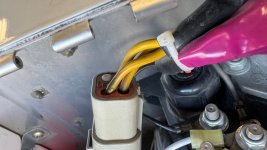
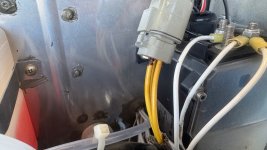
(1)Agree... all RV-12iS owners should add this connector to their 'close inspection' check list. The attached photos are from a recent inspection of the B regulator connector on a 912iS Sport engine with 550 hobbs. This connector is Ti's high current version (DTP). (2)Another item you might consider adding to add to your 'close inspection' check list is the fuel pressure regulator. The third photo is inside the fuel pressure regulator on the same engine as the connector . This engine has run 95% of its life on 100LL with Decalin additive. The screen was clean but the rubber seat had an abundance of soft white specs on it that wiped off easily... no idea of the cause (suspect Decalin) and will report back when I know more.
 

Attachments

  • IMG_2842[1].JPG
    IMG_2842[1].JPG
    766.6 KB · Views: 53
  • IMG_2844[1].JPG
    IMG_2844[1].JPG
    2.6 MB · Views: 54
  • IMG_2848[1].JPG
    IMG_2848[1].JPG
    1 MB · Views: 52
Last edited:
During my pre-Oshkosh oil change and inspections, I found that the connector from the generator to Regulator B (the one on the top of the fuse box) was overheating.
In this condition and Lane B did not fault? I will be going to the hanger tomorrow morning first thing and inspect this!
 
I had no faults. But, looking back to some really old e-mails, during Phase 1 testing, I did notice a problem.. the engine had < 10 hours on it. Those photos are below.

In my notes I wrote "Repaired them with new female connectors and a new orange pin separator." So I'm assuming all other components (like the pins) weren't changed. Perhaps the original pins were providing enough resistance to increase the temperature inside the housing enough to melt the wire and connector insulation. I dismissed this occurrence though because I was having other wiring problems in Phase 1 and attributed this to those problems.

Ernie's photos with the Ti DTP connectors are not encouraging.. since the Amphenol AT connector that I'm about to try is essentially a replica of the DTP connector. Maybe there is just so much current going through these 12 gauge wires that the enclosed housing is keeping in enough heat to make things all melty.. in which case, now I understand why Rotax went with this circular, more open-air connector in their current design. This makes me want to put eyeballs on the entire length of the yellow wires, which on our RV-12's, the excess is coiled up and sandwiched with other wires in front of the fusebox.
 

Attachments

  • Engine_10Hours_RegB.jpg
    Engine_10Hours_RegB.jpg
    241.2 KB · Views: 67
I had no faults. But, looking back to some really old e-mails, during Phase 1 testing, I did notice a problem.. the engine had < 10 hours on it. Those photos are below.

In my notes I wrote "Repaired them with new female connectors and a new orange pin separator." So I'm assuming all other components (like the pins) weren't changed. Perhaps the original pins were providing enough resistance to increase the temperature inside the housing enough to melt the wire and connector insulation. I dismissed this occurrence though because I was having other wiring problems in Phase 1 and attributed this to those problems.

Ernie's photos with the Ti DTP connectors are not encouraging.. since the Amphenol AT connector that I'm about to try is essentially a replica of the DTP connector. Maybe there is just so much current going through these 12 gauge wires that the enclosed housing is keeping in enough heat to make things all melty.. in which case, now I understand why Rotax went with this circular, more open-air connector in their current design. This makes me want to put eyeballs on the entire length of the yellow wires, which on our RV-12's, the excess is coiled up and sandwiched with other wires in front of the fusebox.


Cause and Effect... and the importance of maintaining your EarthX ETX900 (or any lithium based battery). Owners of the Rotax iS series engine are blessed with a substantially increased charging capacity over the ULS series. Enough so, that it removes the limits on the amount of avionics we can install in our aircraft and it still has enough reserve capacity to charge a lithium (ETX900) battery. Thank you Rotax!

Examination of the B (high current) regulator connectors pictured in the posts above together with Rotax' move to a new stator (#14 to #12 wire) and from the Deutch DT to DTP to a CPC power connector, indicates that the original connectors were inadequate to handle alternator B's maximum output current of 32 amps. An RV-12 with a fully loaded panel only draws about half that so why the high current failure at the connector? The charging curve on a lithium battery is significantly different from that of a lead acid battery. A lithium battery (ETX900) will draw all available current until it reaches full charge and the time required is dependent on battery age and beginning charge state. In our RV-12iS aircraft, I believe extended (high current) battery charging time by the B regulator is the Cause of the connector failures.

To mitigate the problem of a B regulator connector failure, always start the engine with a fully charged battery and replace it at the first sign that it's taking longer to charge. If you've had the panel turned on for any extended period (software update, demo to a friend, etc.) without a charger on the battery, fully charge the battery before starting the engine. Just my 2 cents.
 
Last edited:
That is a good point. One other thing you can do is leave the lights off until the battery gets topped off and the amps come down.
 
I have recently heard that failure of the connector could be an indication of a partial failure of the stator that was the subject of a previous Service Instruction.
 
Update. Apparently I was working off of some incorrect information on Rotax-Owner.com's forums. The original connector was a Deutsch DTP connector (25A), not one of the smaller ones (DT = 13A; DTM = 7.5A). Perhaps the initial batch of engines (long before the RV-12iS came to be) had smaller sizes, but mine from 2019/2020 did not. I opened up the connectors and found that one pin on the regulator side had some green corrosion inside. This was likely due to rain making its way through the top pilot-side cowl hinge and down onto the connector.. which is located immediately under the hinge. Although there are orange seals on the connector, they're never 100% sealed, always.

I cut off the old pins and stripped back some insulation. The copper wire didn't look nice and shiny.. but I'm limited as to how much wire I can cut off.. so .. I used an ohm meter to see if this dull-looking copper had any resistance to it.. I wasn't seeing what I wanted, so I used some 220-grit sandpaper and electronics cleaner to get a nice coppery shine on the strands.. then crimped them.

2 hour test flight.. connector still looks fine. Will check again in 50 hours.

Regarding Scott's post about the stator failure -- that is a possibility. I still see 13.9-14.0v in cruise these days which appears to be the same as when my engine was new.. I think decreased voltage was another symptom too.. Definitely going to keep my eye on this though.
 
Rob, the crimper has an adjustment for crimping penetration. It comes set at #3 position. Is that the position you used?
 
Rob, the crimper has an adjustment for crimping penetration. It comes set at #3 position. Is that the position you used?
From what I’ve read, the default setting is fine. I gave it a real good tug and it was OK for me.
 
Back
Top