Van's Air Force

The definitive Van's Aircraft support community! Buying, building or flying an RV? Join our exclusive family of mentors and enthusiasts!

ROTAX 912iS Maintenance, Condition Inspection Tips, Set Idle, Sync, Compression, Diagnostics Dongle

jackking123

Well Known Member
Patron
I am helping a friend do his condition inspection. I am very familiar with care and feeding of a (I)O-360 Lyc not a Rotax. I understand the basics of the 912iS, but a few tips would be appreciate. Maintenance

1) Idle too low and engine will stall on ground with full idle throttle. I assume this is ONE mechanical cable stop on the "throttle body" or does it require diagnostic tool (see #4)?​
[I don't have a Rotax manual in front of me. Want to bump it up a few 100 RPM.]​
2) Compression test, I'm going to do this on his engine, as is standard practice on Lycoming's. I found the 12mm x 1.25mm adapter. 80 psi in correct?​
[He did not do one at his last condition inspection which he did solo nor was he really shown how at the weekend course to get his repairman.]​
3) Unlike the 912UL I assume there is no SYNC with the Rotax 912iS?​
[If there are some checks, inspections, adjustments, maintenance please let me know. Again don't have the Rotax book in front of me. ]​
4) Do we need a special diagnostic tool called BUDS to pull/check fault codes and clear them every Condition Inspection?​
[About $1000. He is selling plane so buying this is out. Tips, not needed?]​

My friend has repairman cert, took the weekend wonder course. I was not impressed with what they covered, at least with Rotax. The airframe is a piece of cake, but no Rotax 912iS expert. I know basic maintenance, operations and limitations, but not much advanced maintenance or diagnostics familiarity. What is a comprehensive condition inspection on a Rotax 912iS, 2 yrs in service, 110 hrs TT. Note oil pump/flow issue does not apply to his engine.
 
I am helping a friend do his condition inspection. I am very familiar with care and feeding of a (I)O-360 Lyc not a Rotax. I understand the basics of the 912iS, but a few tips would be appreciate. Maintenance

1) Idle too low and engine will stall on ground with full idle throttle. I assume this is ONE mechanical cable stop on the "throttle body" or does it require diagnostic tool (see #4)?​
[I don't have a Rotax manual in front of me. Want to bump it up a few 100 RPM.]​
2) Compression test, I'm going to do this on his engine, as is standard practice on Lycoming's. I found the 12mm x 1.25mm adapter. 80 psi in correct?​
[He did not do one at his last condition inspection which he did solo nor was he really shown how at the weekend course to get his repairman.]​
3) Unlike the 912UL I assume there is no SYNC with the Rotax 912iS?​
[If there are some checks, inspections, adjustments, maintenance please let me know. Again don't have the Rotax book in front of me. ]​
4) Do we need a special diagnostic tool called BUDS to pull/check fault codes and clear them every Condition Inspection?​
[About $1000. He is selling plane so buying this is out. Tips, not needed?]​

My friend has repairman cert, took the weekend wonder course. I was not impressed with what they covered, at least with Rotax. The airframe is a piece of cake, but no Rotax 912iS expert. I know basic maintenance, operations and limitations, but not much advanced maintenance or diagnostics familiarity. What is a comprehensive condition inspection on a Rotax 912iS, 2 yrs in service, 110 hrs TT. Note oil pump/flow issue does not apply to his engine.
Start with downloading the Rotax Line Maintenance Manual from flyRotax.com. https://www.flyrotax.com/p/service/technical-documentation . It will answer alot of your questions include differential leak down pressure testing (87psi) as well as what and how to service on intervals.
 
1) Idle too low and engine will stall on ground with full idle throttle. I assume this is ONE mechanical cable stop on the "throttle body" or does it require diagnostic tool (see #4)?​
[I don't have a Rotax manual in front of me. Want to bump it up a few 100 RPM.]​


You do not need a diagnostic tool to adjust the idle. It's a stop on the throttle body. See the Van's KAI, PAP, and 912i Line Maintenance Manual.

2) Compression test, I'm going to do this on his engine, as is standard practice on Lycoming's. I found the 12mm x 1.25mm adapter. 80 psi in correct?​
[He did not do one at his last condition inspection which he did solo nor was he really shown how at the weekend course to get his repairman.]​

Standard compression tester with an .040 orofice and the 12mm adapter. 87 psi is more technically correct. Either was the compression drop will be almost immeasurable. Don't feel confused if you have to squint to see 1 psi.

3) Unlike the 912UL I assume there is no SYNC with the Rotax 912iS?​

Correct

4) Do we need a special diagnostic tool called BUDS to pull/check fault codes and clear them every Condition Inspection?​

Oh boy. Here we go.

This is always a controversial question, and honestly presents some practical challenges for a lot of owners. I'm not going to comment at all based on guidance from Rotax or anyone else. Based on the history you have described I would encourage you to find a way to borrow a dongle, download the zip file, and have someone take a look at it. That said, IF the idle genuinely needed correction and that was the only tuning problem the BUDS file step would be mostly a formality.

Rotax documentation is outstanding. With few exceptions, every single step is described for every procedure. Go to flyrotax.com and scroll to the bottom of the page and click Technical Documentation. Select the 912is Sport, then Maintenance Manual (Line). Go to the Scheduled Maintenance section for the appropriate checklist items based on engine time.
 
Went out today and fixed taxi issue (nose gear pivot too tight, tire pressures all too low) on friends plane, another thread. It taxied badly could not steer it. Success.

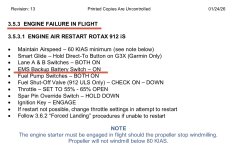
Tried to go to idle and sure enough engine just STOPPED as it has been. Here is the odd thing. YOU CAN NOT JUST RESTART. You have to cycle ignition "lanes A&B" off AND Master. Than you can crank. EFIS has to re-boot as well. That is a little disturbing. Anyone have a comment on RESTART procedures of the Rotax 912iS?

Idle Setting Procedure:
After our taxi test, engine warm, plane tied down, top cowl off, owner started plane. Standing next to cowl on airplane right, screw driver in my hand, adjusted it to 1780 rpm. It was that easy. Took about 30 seconds yelling at each other under cracked canopy. Now that I think of it, we should have put our headsets on. Ha ha. Tip Use Your Headsets. This is also a two person job in my opinion. If you try it yourself be very careful, have plane tied down with chocks.

We can fine tune later. Easy fix with TWO PEOPLE, single set screw on cable actuated throttle, simple. Fancy all EFI yes but not throttle by wire... throttle by push pull steel cable. *

* My new 2026 motorcycle has true throttle by wire, fully electronic fuel injection and digital cruise control I never knew I couldn't live without. Kind of cool technology, as long as it does not break. I still like mechanical things and why my RV-7 has a O=360 Lycoming. No electrons required to keep it running, well except two P-Mags.
 
Tried to go to idle and sure enough engine just STOPPED as it has been. Here is the odd thing. YOU CAN NOT JUST RESTART. You have to cycle ignition "lanes A&B" off AND Master. Than you can crank. EFIS has to re-boot as well. That is a little disturbing. Anyone have a comment on RESTART procedures of the Rotax 912iS?
I know you don't have access to a BUDS dongle, but you should be able to see some of the simpler error codes on the EFIS/MFD. Might be helpful. Restart procedure is covered in the POH. Sudden stoppage as described is not normal and Rotax ECU should be spitting out error codes. Resetting lane switches is a process to reset/restart ECU and clear sensor conflict issues. A common issue is loose MAP sensor plug. I would start by making sure all plugs on harness are well seated, particularly those on the rear of the airbox. Check generator outputs, battery condition.
 
Don’t know how long your friend has had their 12iS, but he needs to understand the emergency procedures. Hopefully he’s got an emergency checklist in the cockpit, but you don’t cycle the master for a restart in the air; that’s where the EMS Backup Battery switch comes in. And recommend ground idle speed is 1550-1650. If it’s too high you may have trouble getting landing speeds low enough. Also, there should be a backup battery on the PFD, so it should remain powered for a minute even if the master is turned off; if it's not staying on, that needs checked too.
 

Attachments

  • IMG_3020.jpeg
    IMG_3020.jpeg
    264 KB · Views: 29
  • IMG_3019.jpeg
    IMG_3019.jpeg
    464.4 KB · Views: 28
Last edited:
Don’t know how long your friend has had their 12iS, but he needs to understand the emergency procedures. Hopefully he’s got an emergency checklist in the cockpit, but you don’t cycle the master for a restart in the air; that’s where the EMS Backup Battery switch comes in. And recommend ground idle speed is 1550-1650. If it’s too high you may have trouble getting landing speeds low enough. Also, there should be a backup battery on the PFD, so it should remain powered for a minute even if the master is turned off; if it's not staying on, that needs checked too.
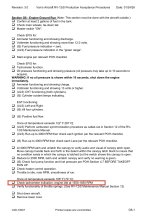
Thanks for tips. Yet to fly since RPM change... I will keep that in mind and review this with owner. We need to dial RPM back. The info on the idle is conflicting all over the web. However I agree if too high and it extends your landing distance it needs to come back, may be 1650 RPM. The emergency check list is interesting. The part about "SPAR PIN OVERIDE - HOLD DOWN" opened my eyes. :oops: I hope not to accidently push the WING Eject Switch. 😁😊

When it was quitting what was the RPM idle set to? NOT SURE... the exact RPM but it was under 1550 I am sure of that.

I do read that for the GEAR box right after start 2200 RPM is called out. Others say taxi 1800 RPM is best for gear box happiness. Of course you can control that with the throttle lever, does not have to be min idle. Bottom line your point, too high idle during landing may cause extended landing distance.
 
Last edited:
I know you don't have access to a BUDS dongle, but you should be able to see some of the simpler error codes on the EFIS/MFD. Might be helpful. Restart procedure is covered in the POH. Sudden stoppage as described is not normal and Rotax ECU should be spitting out error codes. Resetting lane switches is a process to reset/restart ECU and clear sensor conflict issues. A common issue is loose MAP sensor plug. I would start by making sure all plugs on harness are well seated, particularly those on the rear of the airbox. Check generator outputs, battery condition.
His RV-12iS is coming up to 2nd anniversary, and going in for the second Condition inspection in a month. He is going to have help this time. I found when I finished my first RV, transition from builder into operating and maintaining, was a new set of skills. His RV-12iS has over 100 hours, not a lot. However I find first 100 hrs always requires more checks, adjustments, corrections, modifications, repairs as things shake out so to speak. The Phase 1 on E-LSA is only 5 hours. On EAB's it is 40 hours.
 
The info on the idle is conflicting all over the web.

Welcome to the internet. Especially the internet as enhanced by AI slop. This is why you should use documentation published by the manufacturers of the equipment for specifications like idle speed.

The 912is installation manual explains the idle adjustment procedure and refers you to the Operators Manual for a value. The value given in the Operators Manual is a minimum of 1400. This minimum is intended to allow for airframe specific settings at or above 1400. We still don't have a recommended value, so refer to the Maintenance Manual for the RV-12is. This is where the recommendation of 1600-1650 lives. 1600-1650 is not in conflict, being the recommended airframe idle RPM that is above the engine manufacturers minimum of 1400.
 
Welcome to the internet. Especially the internet as enhanced by AI slop. This is why you should use documentation published by the manufacturers of the equipment for specifications like idle speed.

The 912is installation manual explains the idle adjustment procedure and refers you to the Operators Manual for a value. The value given in the Operators Manual is a minimum of 1400. This minimum is intended to allow for airframe specific settings at or above 1400. We still don't have a recommended value, so refer to the Maintenance Manual for the RV-12is. This is where the recommendation of 1600-1650 lives. 1600-1650 is not in conflict, being the recommended airframe idle RPM that is above the engine manufacturers minimum of 1400.
Slop can be conflicting, but not all bad. Just have to read references and sources, then experiment, thus the E in front of LSA. AI or really LLM's large language models uses VAF Forum answers to RV questions, and can have noise. Reddit and other sites might be OK or not. I You do have to be careful.

Right now RPM is at 1740. Not too far off the 1650 RPM. It will be iterated and lowered as required. I still have PTSD of involuntary prop stoppage on the ground. Not good. I would rather a 50-75 RPM extra, to assure smooth operations and no chance engine will stall. I think we have in under control.

Just flew it 2 hours ago... 1.5 hrs TT. Very windy and turbulent below 4500. Went up to check roll servo torque and sensitivity settings and do AOA Cal. Smooth above 4500.

Landing Rwy 36, winds 8kts, gusting 20 from 060 degrees, PIREP gain loss of 10 kts by a Cessna 172. RPM did not cause an issue landing (or at least I could tell in those conditions).
 
Right now RPM is at 1740. Not too far off the 1650 RPM. It will be iterated and lowered as required. I still have PTSD of involuntary prop stoppage on the ground. Not good. I would rather a 50-75 RPM extra, to assure smooth operations and no chance engine will stall. I think we have in under control.
For most things RV 12 related, no experimenting is required. I’m pretty sure every single question you have posted up to this point was related to details that are well documented in the construction manual and / or maintenance manual

Isn’t 1650 rpm, 50 extra added to the minimum specified by the manufacturer of the kit, and the one that did a LOT of flight testing in order to come up with that specified range.
I assure you, adding an additional 90 rpm over and above the maximum recommended, will have an impact on the flight dynamics when the throttle is set at idle.

This information was not AI generated….
 
Last edited:
For most things RV 12 related, no experimenting is required. I’m pretty sure every single question you have posted up to this point was related to details that are well documented in the construction manual and / or maintenance manual

Isn’t 1650 rpm, 50 extra added to the minimum specified by the manufacturer of the kit, and the one that did a LOT of flight testing in order to come up with that specified range.
I assure you, adding an additional 90 rpm over and above the maximum recommended, will have an impact on the flight dynamics when the throttle is set at idle.

This information was not AI generated….
I don't want to get into an argument.... There is a RANGE of RPM's.... I have been around aviation 40 yrs, have technical back ground. We can get dogmatic and do it exactly.... Well I can tell you that the RPM does vary from time to time when cold, hot, different ATMO conditions. I do not think it is super critical. in my opinion (unless it is too low and engine stops on the ground). There is a trade off...

The gear box does not like to be lugged down at low RPM... due to harmonics or whatever. I have not deep research this , but makes sense. I have a background in engineering and understand gear box design. What I can say subjectively, if I feel or sense the engine idles a little better, smoother at a little faster RPM, I am setting that. The landing distance claim is well and good, but it's an LSA landing at slow speed, light weight plane. Not concerned about runway.
 
I don't want to get into an argument.... There is a RANGE of RPM's.... I have been around aviation 40 yrs, have technical back ground. We can get dogmatic and do it exactly.... Well I can tell you that the RPM does vary from time to time when cold, hot, different ATMO conditions. I do not think it is super critical. in my opinion (unless it is too low and engine stops on the ground). There is a trade off...

The gear box does not like to be lugged down at low RPM... due to harmonics or whatever. I have not deep research this , but makes sense. I have a background in engineering and understand gear box design. What I can say subjectively, if I feel or sense the engine idles a little better, smoother at a little faster RPM, I am setting that. The landing distance claim is well and good, but it's an LSA landing at slow speed, light weight plane. Not concerned about runway.
You are correct…. The idle speed needs to be set when the oil is at normal operating temperature ( if not it, the rpm will be higher at higher temp).

Idle speed rpm, and what rpm the pilot operates/controls the engine at in any particular situation are entirely unrelated so an argument for setting the rpm higher in order to keep a pilot from “lugging” the engine is irrelevant.
 
I don't want to get into an argument.... There is a RANGE of RPM's.... I have been around aviation 40 yrs, have technical back ground. We can get dogmatic and do it exactly.... Well I can tell you that the RPM does vary from time to time when cold, hot, different ATMO conditions. I do not think it is super critical. in my opinion (unless it is too low and engine stops on the ground). There is a trade off...

The gear box does not like to be lugged down at low RPM... due to harmonics or whatever. I have not deep research this , but makes sense. I have a background in engineering and understand gear box design. What I can say subjectively, if I feel or sense the engine idles a little better, smoother at a little faster RPM, I am setting that. The landing distance claim is well and good, but it's an LSA landing at slow speed, light weight plane. Not concerned about runway.
You do know who Scott is….right? He literally wrote the book when it comes to the 12!
 
You do know who Scott is….right? He literally wrote the book when it comes to the 12!
Scott who? Is he the Guru, Sherpa and Sensei of all RV-12iS knowledge? Ha ha. I am teasing you. Thanks for the tip. However you will have to be more spacific who Scott is and title of his book, where to buy or download? Vic Syracuse, books I have on RV maintenance and RV pre-purchase. I do call Van's and ask questions. I started building RV's in 1989... but RV-12iS's I am no expert. Involved in Aviation for 40 yrs, love learning from experts, Scott, Vic... As an EAA Tech councilor I try to help other builders, like this RV-12iS owner. Thanks again.
 
Scott who? Is he the Guru, Sherpa and Sensei of all RV-12iS knowledge? Ha ha. I am teasing you. Thanks for the tip. However you will have to be more spacific who Scott is. Did he wrote a book like Vic Syracuse, whose books I have on RV maintenance and RV pre-purchase. I do call Van's and ask questions. I started building RV's in 1989... but RV-12iS's I am no expert on RV-12iS. Involved in Aviation for 40 yrs, and love learning from experts. As an EAA Tech councilor I am trying to help this RV-12iS owner and learn so I can help others. Thanks again.

To give you a clue, look at this video from over 18 years ago:


The guy doing all the work is Scott.

If that is not enough of a clue, he was instrumental in the development of the RV-12 and other models.

Bottom line…..listen to him, he knows what he is talking about.
 
To give you a clue, look at this video from over 18 years ago:


The guy doing all the work is Scott.

If that is not enough of a clue, he was instrumental in the development of the RV-12 and other models.

Bottom line…..listen to him, he knows what he is talking about.
Thanks for giving me "a clue". What book? Scott who? What is his last name? Do you know Scott? To name drop I do personally know Richard "Dick" VanGrunsven, Ken Krueger, both the designers of the RV-12iS. Do I win the name dropping, appeal to authority contest? Ha ha.

OK. So "Scott" is the RV-12iS man. I look forward to reading his "Book" you said he wrote. However I am not taking the RV-12iS wings off anytime soon or ever. However I will "experiment" with an experimental aircraft. I will set the idle RPM I feel best and choose. I hope "Scott" approves. If not I am OK with that. Have a nice day.
 
Thanks for giving me "a clue". What book? Scott who? What is his last name? Do you know Scott? To name drop I do personally know Richard "Dick" VanGrunsven, Ken Krueger, both the designers of the RV-12iS. Do I win the name dropping, appeal to authority contest? Ha ha.

OK. So "Scott" is the RV-12iS man. I look forward to reading his "Book" you said he wrote. However I am not taking the RV-12iS wings off anytime soon or ever. However I will "experiment" with an experimental aircraft. I will set the idle RPM I feel best and choose. I hope "Scott" approves. If not I am OK with that. Have a nice day.
Two of his books are RV-12 Pilot's Operating Handbook and RV-12 Maintenance Manual.

There is a distinction between advice and approval. As you pointed out, you are free to experiment as you see fit with your experimental aircraft (within the approval of only the FAA), but you have no obligation to follow anyone's advice. Conversely, no one has an obligation to follow any advice of yours.
 
Two of his books are RV-12 Pilot's Operating Handbook and RV-12 Maintenance Manual.

There is a distinction between advice and approval. As you pointed out, you are free to experiment as you see fit with your experimental aircraft (within the approval of only the FAA), but you have no obligation to follow anyone's advice. Conversely, no one has an obligation to follow any advice of yours.
Got both of those, POH (handbook VAD-10003) and maintenance manual (VAD-10005) by Van's Aircraft. These are prime references. Agree. You say Scott wrote them. Good to know. However 100% sure others were involved, and Scott has no authorship of them noted in the manuals I saw? I am fairly savvy, engineering degree, worked for Boeing, CFI, Airline, so I value manuals and teach them. Savvy enough to read the manual's and understand them. In short I am a gear head since I was 13 yrs old. Just because I ask questions does not mean I have no clue. However the ROTAX is kind of new to me. I respect my own limitations and ask questions. I got it now, thanks to you and others that gently guided me. Cheers.

As far as your advice on internet, got it. However it is a tool. The vast large language model databases and "AI" searches has expanded in the last 5 years more than I have ever seen. Remember Google searches? 29,000 returns, with first few were sponsored, may be one or two relevant (may be) and the rest irrelevant. You had to dive into links and may be find the info you needed or not. They were dumb searches. Now a plain language full sentence text, full sentences, will result in a robust and meaningful result, often with a great summary with references (read back to you). I see vast improvement in plain language summaries and relevant references. Do you trust them with your life? Well medicine is doing robotic surgery and X-rays are being read by AI not Doctors. Horse buggy whips were a big thing once. I am not as cynical or luddite as you in regard to internet. I'm not gellable. I learned in school programing computers, garbage in garbage out. Still true.

As far as RPM, RV-12iS (injected series), despite fancy dual electronic fuel injection and ignition (like every passenger car made in last 2 decades), the RV-12iS has a farm tractor throttle, a push pull cable with a set screw for idle. This is not "rocket surgery" or "brain engineer" (see what I did there, ha ha). The cable can stretch, setting screw can change, ATMO conditions super cold or hot, engine cold or hot, can effect the idle RPM. This is not FADEC, Full Authority Digital Engine Control (like modern jet aircraft). My freaking motorcycle has full authority electronic fuel injection with throttle by (electrical) wire. Never tried or needed to adjust my motorcycle's idle, but pretty sure I might need a computer. That not a fan of to be honest, but it may work flawlessly and never need adjustment. That is goodness. We shall see. Big difference is motorcycle I can pull over to side of the road, airplane in flight not so much. I do appreciate Rotax using some farm tractor tech, like my beloved Lycoming. My point is I will adjust idle RPM to be in a happy place based on ALL information, my experience and (as I said) "experimentation". This is not unreasonable, and I thank you for your understanding.
 
Back
Top