Van's Air Force

The definitive Van's Aircraft support community! Buying, building or flying an RV? Join our exclusive family of mentors and enthusiasts!

Return fuel line fitting location on the tank

idubrov

Well Known Member
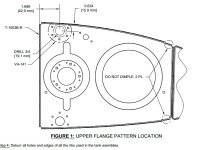
Is #3 a good location for the return fuel line (for an electronic fuel injection system)?

I think I saw all three variants (marked #1, #2 and #3) used by different builders, and looking at the plans there doesn't seem to be much difference to me. In terms of plumbing, it will be routed aft to enter the fuselage somewhere around the fuel supply line. In the fuel tank, it will terminate at the second bay from the last (the outboard one).

I was thinking straight union fitting AN832. An anti-rotation bracket inside the fuel tank, then AN 6D spacer and AN924 nut outside. Seems like there should be enough space between the wing and the fuselage for a 90° tubing bend (though it's going to be more like an S-shaped bend).

Alternatively, I can use an AN833 elbow, but I my (zero-experienced) thinking is that it will be 1) might be a bit harder to torque the coupling nut due to the orientation 2) nothing other than sealant prevents fitting from loosening (but shouldn't be an issue due to the coupling nut torque orientation).

Thoughts?
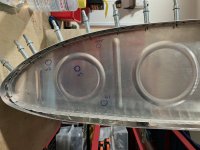

IMG_8636.jpeg
 
I would position the return line as far away from the fuel pick up as possible, Maybe go so far as to plumb the line all the way to the far side of the tank, similar to the vent.

A friend of mine with an RV-12 and fuel system of his own design, had a return line placed above the fuel pickup; this caused air/vapor bubbles to become entrained in the fuel stream under the right (or wrong) conditions.
 
I would position the return line as far away from the fuel pick up as possible, Maybe go so far as to plumb the line all the way to the far side of the tank, similar to the vent.
Yes. That's what I meant by "In the fuel tank, it will terminate at the second bay from the last (the outboard one).".

Why second from the last? I don't know what kind of "return flow" there will be, but wanted to keep it away from the vent line. Probably, doesn't matter.
 
Is #3 a good location for the return fuel line (for an electronic fuel injection system)?

I think I saw all three variants (marked #1, #2 and #3) used by different builders, and looking at the plans there doesn't seem to be much difference to me. In terms of plumbing, it will be routed aft to enter the fuselage somewhere around the fuel supply line. In the fuel tank, it will terminate at the second bay from the last (the outboard one).

I was thinking straight union fitting AN832. An anti-rotation bracket inside the fuel tank, then AN 6D spacer and AN924 nut outside. Seems like there should be enough space between the wing and the fuselage for a 90° tubing bend (though it's going to be more like an S-shaped bend).

Alternatively, I can use an AN833 elbow, but I my (zero-experienced) thinking is that it will be 1) might be a bit harder to torque the coupling nut due to the orientation 2) nothing other than sealant prevents fitting from loosening (but shouldn't be an issue due to the coupling nut torque orientation).

Thoughts?


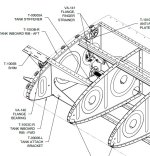
This is where Van's placed it for the 14, works fine:

Screenshot 2024-12-02 135431.jpgScreenshot 2024-12-02 135359.jpg

This is where Van's placed it on the 14, works fine.
 
This is where Van's placed it on the 14, works fine.
Yes, I have plans for RV-14, and I considered that approach as well.

I like the RV-14 bung idea because it is a more permanent attachment than an AN fitting, but I don't like that it is located in the same bay as the supply line (for the reasons mentioned above). From what I found searching on this forum (and it might have been an opinion of one of the EFI vendors?), with enough separation it shouldn't be a problem, but still. I'm not sure I can place it directly above the supply line (like in RV-14) due to the large access panel in RV-7 tanks.

If there is a permanent fixture similar to VA-141 part that will allow extending the return line to at least to the second bay, I would consider (in which case I would still place it at #3, probably).

P.S. FWIW, SDS EFII documentation specifies "Return fuel should enter the tank(s) at least 4 inches from where the fuel feed exits."
 
I have mounted the return line fitting about 4" forward of the fuel pickup fitting, centered vertically height wise. Have done this on 1 Rocket & 2 RVs. Another Rocket had a flop tube so the return was mounted lower to not interfere with that. All SDS installations. No issues.
 
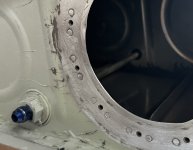
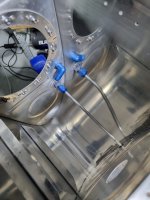
I have SDS EFI and my return line is at the same level as your position #1 but further aft. It goes into the next bay to return the fuel (see pic). It’s worked great for the last 340 hrs.

I’m installing Cies fuel senders right now so I happen to have a good pic.

1733269175671.jpeg
 
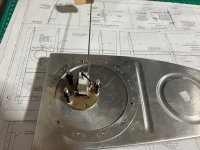
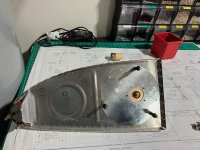
I installed my vent and return last night.
Vent is in the recomended spot.
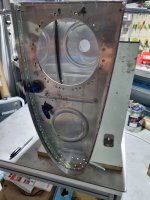
The advice I got from TS was to put the return somewhat directly above the supply port near the top of the rib, so the hoses are symetrical.
So I've put it above, but slightly forward due to the space available. Inside, I'll attach some tubing and run it forward to the tip of the tank
.20241203_214131.jpg20241203_214122.jpg
 
Most aircraft fuel injection systems do not require a return line.
If you have a AFP system with a purge valve consider returning to a feed pipe, so purge on left tank only with return fuel flowing back to right tank.
If you need a full return flow system then use the advice above.
 
Most aircraft fuel injection systems do not require a return line.
If you have a AFP system with a purge valve consider returning to a feed pipe, so purge on left tank only with return fuel flowing back to right tank.
If you need a full return flow system then use the advice above.
We chose to use the RV14" position for a couple of reasons. 1) we could use the VA141 Vans tank bung in it stock position. The 14 rib was already drilled to accept it. The RV10 uses the same rib, so that was easy. Since we do more SDS/EFII installs on 10s and 14s, it just made since to use whats there. 2) for the RV7/8/9 tanks we incorprated the same idea in its ribs. The actual bung doesnt need to be a VA141, it can be a AN832-6D bulkhead fitting installed near the top of the rib. Obviously some prior planning is needed so you can install the fitting in the rib as you are building.
We like it to be positioned above, near the top, and somewhat inline with the supply port, mainly for the 7/8/9 tanks to make the supply and returns more or less the same lengths. The ports dont have to be, but to me it just made since to return the fuel under pressure to a location away from the supply. My thought was less turbulence of fuel near the supply port, so maybe less possible chance of fuel cavitaition. I looked at it like sticking a garden hose under pressure in a bucket and watching the turbulent water. Only thing I see thats cause for caution, is when running a low fuel state. With the return pressure being equal or almost equal to the supply (40-45 PSI), thats rather significant I think. Just seems to me that the farther away you can get the port, the less chance of 'under fuel' turbulence--like underwater turbulence.
 
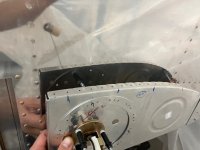
Okay, so I think what I hear is that there is also Option #4 that allows to keep the hoses about the same length. I was concerned that there might be some conflict with the fuel sender, but looks like it should be okay.

But how would return hose be routed in this case? The supply line goes straight into the fuselage, as per plans. However, the return line would need to make some relatively sharp S-turn to go a bit lower and a bit aft? It won't be the same length then?

IMG_8658.jpegIMG_8660.jpegIMG_8662.jpeg
 
The return fuel will be warmest fuel in the tank.
The coolest part of the tank will be leading edge.
piccolo tube distribution to leading edge...
One tiny spot that wouldn't ice over, hah hah
 
Back
Top