Van's Air Force

The definitive Van's Aircraft support community! Buying, building or flying an RV? Join our exclusive family of mentors and enthusiasts!

Removing seized in tailspring.

bhaiduk

Member
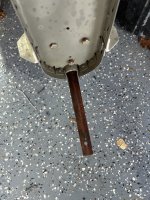
When I purchased my partially completed RV8 it would not fit in the moving truck I showed up with. My original plan was to unbolt the tail spring and slide it out but it was seized so tightly in that we couldn’t remove it with the tools we had, so I opted to cut the tailspring so I could shut the door and get on the road. Now back at my shop I’m stuck trying to figure out how to remove the old one. I’ve tried penetrating oil. I broke a pipe wrench trying to rotate it. I drilled a hole to attach a chain to try and yank it out. None of the have worked and I worry about trying harder and bending some part of the airframe. Does anyone have any other ideas or suggestions?IMG_9388.jpeg
 
If it is like my RV7, the spring extends through the bulkhead in the picture, and is mounted to a bulkhead further forward, it affixed to a 4130 steel plate there.
 
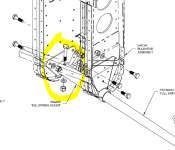
I assume this is the bolt that you removed and you are not able to slide out the tail spring.

can you drill out rivets in the aft bulkhead and remove the tailwheel assembly? It seems it is a much easier way to unstuck the tailspring without damaging the fuselage. There aren't that many rivets to drill out.

1767397437253.png
 
Unbolt everything, squirt it with penetrating oil, the put your rivet gun on it and see if you can get it to move. Put a screwdriver through the bolt hole and apply twisting motion as you hit it with the rivet gun.

After that, you're down to more time, more penetrating oil, and real work.
 
I assume this is the bolt that you removed and you are not able to slide out the tail spring.

can you drill out rivets in the aft bulkhead and remove the tailwheel assembly? It seems it is a much easier way to unstuck the tailspring without damaging the fuselage. There aren't that many rivets to drill out.

View attachment 106271
Yes I removed that bolt. I originally looked at that picture and thought that was all that was needed. I like the idea of taking the bulkhead off.
 
Yes I removed that bolt. I originally looked at that picture and thought that was all that was needed. I like the idea of taking the bulkhead off.
You might try a couple shots with a rivet gun from the cut off end after letting some penetrating oil soak for a couple days. It may just be enough to crack the rust bond. We have decent success on the big jet frozen bolts that way. Twisting torque just never does it. Otherwise, start removing parts as mentioned..
 
This thread has some suggestions:
 
This thread has some suggestions:
First off - I sent you a DM
My post (#12) on this thread shows a tool that I made for removing an "uncut" RV-4 tail spring, yours would be a bit different, but the whole "crux" of the matter is you want to push against the trailing edge of the tail spring weldment when applying force to the tail spring through the extension of 2 or 3 threaded rods of suitable size to carry the compression loads.

Also, when getting "ready" for the Big Push, a lot of penetrating oil, a good dose of heat with an industrial heat gun (12-1500 watts) and a pneumatic muffler "hammer" which has a more significant energy transfer when operated. As an aside, in the old days, before we knew any better, we used them for riveting - the results were not pretty (and we got "religion" pretty fast ...).

HFS - Been There, Done That

YMMV - But always against the part resisting removal (weldment) with the part needed to be removed (spring) - that way you take the fuselage structure completely out of the equation.
 
Last edited:
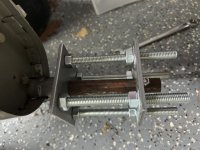
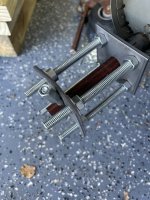
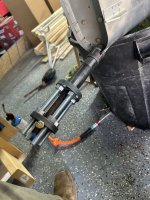
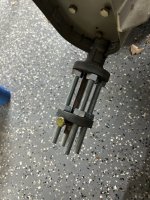
I made up this device with pieces from Atwood’s to try and pull it out but still no luck. The first version sheered off the 1/4” bolt I had through the tailspring. The second version I drilled the hole larger to take a 3/8” bolt which bent but didn’t break. I ended up bending the plate and it still didn’t budge. I’m trying to decide if I should find a way to make a stouter version or give up and drill out the bulkhead. IMG_9391.jpegIMG_9393.jpeg
 
Take the tail fairing off. You should be able to reach in from the access holes. See if you can get your rivet gun in there and hit the end of the spring. Should be able to knock it out.
 
Reminds of pulling a rusted in lower control arm bolt on a Toyota truck. In my experience, working on autos in the rust belt, you are going to need either heat (a lot of it) or significant impact force (like 4 or 8 lb sledgehammer) or possibly both to get that out. Rust creates expansion, so a slip fit becomes a very tight interference fit.

can’t think of any ideas that do not put the surrounding aluminum structure at risk of losing their hardness or otherwise damaging it.

Be sure to use grease or anti seize on the new one.
 
Last edited:
Take the tail fairing off. You should be able to reach in from the access holes. See if you can get your rivet gun in there and hit the end of the spring. Should be able to knock it out.
In my experience, if 4 3/8 bolts won’t pull it out, a rivet gun won’t touch it.

To the op, I would have used at least 3/8” plates and welded it to the rod.
 
I made up this device with pieces from Atwood’s to try and pull it out but still no luck. The first version sheered off the 1/4” bolt I had through the tailspring. The second version I drilled the hole larger to take a 3/8” bolt which bent but didn’t break. I ended up bending the plate and it still didn’t budge. I’m trying to decide if I should find a way to make a stouter version or give up and drill out the bulkhead. View attachment 106472View attachment 106473
A couple of suggestions (based on some assumptions - which are usually wrong) -

Use thicker plate - 1/2" min.

For the pin - use an Grade 8 ( or >) bolt. Six "hash" marks on the head. Yellow cad plating with 170,000 psi ultimate yield tensile strength - typically not available in the aviation aisle of HD. Cut off the head and have the bolt long enough so when installed the threaded portion is outside the diameter of the spring.

Put the holes (for the bolts) as close together (towards the center hole) as interference from the nuts will allow - this is about shortening the moment arm of the "lash up" to make the plate thickness more effective.

Use B-7/Gr8 1/2 - 20 UNF all thread for maximum performance - again, not a big box store quality, (McMaster-Carr, MSC or ...) & equivalent hex nuts.

The largest battery powered "roto" hammer you can get a hold of (think jackhammer) from a rental yard, and see if they have a flat faced point with which to contact the end of your spring (when the time comes). If they don't have one to rent, cut one of theirs off and pay for it ...

All the heat you can muster (in that confined space) for a long time prior to separation force being applied.

It will probably take two people for the job, one, incrementally increasing the force in a cross "hatch" pattern; and, the other periodically applying the "jackhammer" to the offending spring.

Have the holes in the plate(s) be just large enough to slip over the spring at each location to insure a better "shear" loading of the plate.

I would give some (all) of these a try (just me) before giving up and drilling out the aft bulkhead, because even when you do that you might you have to drill out the next one forward in order to get to the weldment bolts on it (I think it's bolted both front & rear).

YMMV - But a bit of fine tuning may do it.

HFS

 
I made up this device with pieces from Atwood’s to try and pull it out but still no luck. The first version sheered off the 1/4” bolt I had through the tailspring. The second version I drilled the hole larger to take a 3/8” bolt which bent but didn’t break. I ended up bending the plate and it still didn’t budge. I’m trying to decide if I should find a way to make a stouter version or give up and drill out the bulkhead. View attachment 106472View attachment 106473
Good job on the "slotted" pipe coupling to keep the load off the Aluminum skin and onto the weldment - just make sure the "clearance" is such that there is very little wiggle room there as the last thing you would want is for the coupling to over run the weldment and "booger" up badly the taillcone skin there ...

HFS
 
As I recall and its been a long time ago I had the same issue with the tail spring on my RV4. I ended up cutting off the tail spring a little shorter than what you have there. I drilled down the center of the tail spring and tapped the hole for a bolt. I used a socket and washers to pull the spring out. Adjusting with different length bolts and washers as I went. I would guess mine was stuck every bit as much as yours. It worked well.
With that said it looks like what you have should work. Maybe a thicker plate and the hole in the spring closer to the weldment, or a combo of all the above.
 
That sleeve is a long way for the oil to wick. It may take a few days before your puller works. I like the ideal of tapping the tail spring for a bolt and using a socket which removes potential for any side loading on the spring. A piece of pipe would also work and you wouldn’t have to shorten the spring leaving you less to work with.

My initial thought was use a slide hammer. If it didn’t budge, give the oil more time to wick. Wait and try again. Repeat as many times as needed.

However, since you have a puller, I would use the puller and slide hammer together.
 
Believe it or not, the best rust remover is what caused it in the first place...WATER. Of course once you've applied penetrating oil, water cannot get in there.
For water to work, it has to be tried before anything else. We learned this trick with an old Model T that had been sitting on the ground for years. The front axle was buried and covered with so much rust that you couldn't even recognize the bolts. We soaked it in water for a few days and everything came loose easily.
 
Last edited:
A lot of good ideas here, but I would give consideration before using impact forces on the weldment in place. It only sits in two doubled Al bulkheads. It should be strong in shear (up & down forces of the arm), but not necessarily in lateral (in and out) forces. Too much force that is parallel to the tube creates a risk of bending that Al. Not an ME, just an observation, so could be all wet on this, but worth asking.
 
Somehow there is a difference between manual hammer blows and the rapid blows from a rivet gun. I've found the rivet gun more effective, even at lower settings.

But I would definitely use heat. Use a torch to heat the spring to near dark red (make sure to point torch away from alum or use a heat shield).

Edit: Heating the spring well away from the weldment socket will still work -- the heat will propagate through the spring into the rusted section if you get it hot enough.

As others have said, it may take several days for the penetrating fluid to make it all the way, and probably several heat cycles.
 
Last edited:
I think the big issue is that there is no way for the penetrating oil to get to the front of the weldment. The weldment has a sleeve at the front and back ends where the machined surfaces of the tail spring contact. Both are about 1 1/4" long. The center doesn't contact the tail spring. If you can get a drill with a long bit to drill a 3/16" hole in the center of the weldment you could then fill the cavity with Kroil, or my favourite, Mouse Milk. Keep the pressure on with your puller and let it sit for a while, occasionally using the rivet gun on the end of the spring. I think it would be tough to get a torch in there to heat things without damaging the aluminum structure but a small heat gun, like the ones for RC aircraft covering, could fit between the bulkheads to apply heat to the weldment. Just thinking out loud but worth a shot and easier than removing the rear bulkhead.
 
Somehow there is a difference between manual hammer blows and the rapid blows from a rivet gun. I've found the rivet gun more effective, even at lower settings.

But I would definitely use heat. Use a torch to heat the spring to near dark red (make sure to point torch away from alum or use a heat shield).

Edit: Heating the spring well away from the weldment socket will still work -- the heat will propagate through the spring into the rusted section if you get it hot enough.

As others have said, it may take several days for the penetrating fluid to make it all the way, and probably several heat cycles.
While I agree that heat is the way to go, as I mentioned, but I would NOT do so in place. VERY HIGH likelihood of annealing the alum structure via heat transfer, significantly reducing its strength. Those bulkheads take a lot of abuse and not a place I would want to reduce strength.

In order for heat to work, it must also expand the outer tube. If you put a heatsink on the outer tube, just heating the rod, you just make things worse. If the outer tube gets to 1000*, no way it doesn't transfer that to the Al structure.
 
Last edited:
While I agree that heat is the way to go, as I mentioned, but I would NOT do so in place. VERY HIGH likelihood of annealing the alum structure via heat transfer, significantly reducing its strength. Those bulkheads take a lot of abuse and not a place I would want to reduce strength.

In order for heat to work, it must also expand the outer tube. If you put a heatsink on the outer tube, just heating the rod, you just make things worse. If the outer tube gets to 1000*, no way it doesn't transfer that to the Al structure.
Yes, red hot may be too much. Heat gun much safer than a torch. Multiple cycles of heat/cooling may allow the fluid to penetrate.
 
Believe it or not, the best rust remover is what caused it in the first place...WATER. Of course once you've applied penetrating oil, water cannot get in there.
For water to work, it has to be tried before anything else. We learned this trick with an old Model T that had been sitting on the ground for years. The front axle was buried and covered with so much rust that you couldn't even recognize the bolts. We soaked it in water for a few days and everything came loose easily.
Water & Vinegar
 
I keep wondering if the previous builder/owner didn’t add a second retaining bolt somewhere! 😉
That was the case on my -4 project. The correct location bolt was missing the nut. I think he got frustrated trying to get the nut on and just drilled another haha.
 
Success!
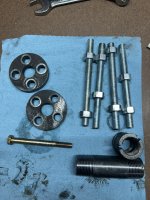
I rebuilt my tailspring puller to be significantly stouter and finally had success. I order two 1/2” thick hardened steel plates from sendcutsend. They were designed to use 1/2” all thread as close to the center as possible. For the pin I used a longer grade eight bolt so I could press across the width of the plate. I ended up needing to add another piece of black pipe to use as a spacer once I had it pulled past the first ‘knuckle’.
It took a ton of force to break it loose the first time. I thought it was going to just slide out once it broke loose but I ended up using the tool to pull it all the way out. I was surprised that it was tapered between the two ends that made contact with the weldement. That’s not the shape of the tailspring in the drawing, but it makes sense once I saw it.
Thanks for all the suggestions!

IMG_9413.jpegIMG_9412.jpegIMG_9408.jpeg
 
Great job on the removal! Make sure and clean all the rust out of the weldment and use light oil on the new stinger when installing so it will be easy to remove if ever needed.
 
The stinger is a very tight fit and I have found most of anything heavy gets wiped out as it is slid in place. I removed a stinger from a 4 after 15 years by hand, which was installed using light oil. YMMV.
 
Back
Top