Van's Air Force

The definitive Van's Aircraft support community! Buying, building or flying an RV? Join our exclusive family of mentors and enthusiasts!

Relationship between CHT, ICP, OAT

Narwhal

Member
Hello,

I have a cold climate (AK) aitplane with a 9:1 lyc. io-360 & lightspeed ignition, 570 & 3 years SNEW. I typically run it between 65 and 75% at 100F-150F ROP which results in ~340/340/320/320 CHT. The surface OAT is rarely over 60F, so at cruise I’m usually 40F to -10F OAT. It probably spends about half its life in the pattern at full rich though.

My question is: do I need to run this engine in the red box to get the CHT higher and is there any risk of detonation or high internal cylinder pressure despite CHT being suppressed by the cold OAT? Do I need to be leaning while performing closed traffic at sea level?

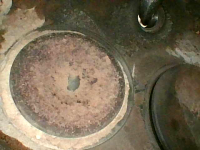
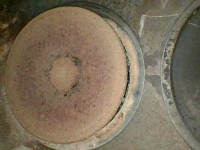
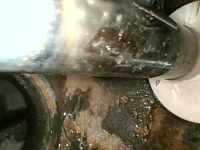
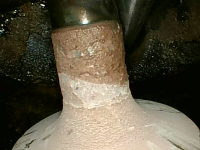
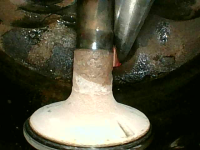
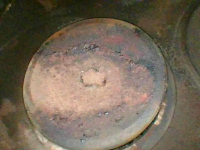
Recently I had the #1 cylinder fail compression with a 50/80 at 560 tach SNEW after getting a 74 at last Cond. Insp 200 hours prior. It was an exhaust leak. I lapped the valve in-situ and it came back to 75. I had to purchase a borescope for this. I was also getting morning sickness on cold starts despite using MMO in fuel and it corresponded with a slow to rise #2 EGT. I reamed that #2 valve guide with a 320 grit 12.7mm ball hone and lapped the valve on #2 as well. Here are my exhaust valves in order, before the lapping. The compressions are all between 74 and 78 now after lapping #1 and lapping/honing #2.
 

Attachments

  • IMG_5248.png
    IMG_5248.png
    377 KB · Views: 31
  • IMG_5249.png
    IMG_5249.png
    385.3 KB · Views: 26
  • IMG_5242.png
    IMG_5242.png
    364.5 KB · Views: 26
  • IMG_5252.png
    IMG_5252.png
    386.1 KB · Views: 29
Many today would say lean when you can, and watch CHT, keep less then 420F on a lycoming (my Dakota O-540 in TX will get slightly over that in the heat of the summer at initial takeoff, then cool right down to under 400F, which is about as good as I can do, then I lean to stay a little under 400F). At 65-75% the "red box" is almost nonexistent, so lean away. At least that's my opinion from reading many books, and my own aircraft.
 
Hello,

My question is: do I need to run this engine in the red box to get the CHT higher

Your CHT's are fine. And the whole red box thing is a bit overblown for a normally asperated parallel valve Lycoming.

and is there any risk of detonation or high internal cylinder pressure despite CHT being suppressed by the cold OAT?

Assuming 100LL as the fuel, certification design standards place detonation onset beyond your conditions. The caveat is 9:1 compression, which does reduce margin.

Read this: https://www.faa.gov/documentLibrary/media/Advisory_Circular/AC_33_47-1.pdf

High ICP tends to be a practical function of ignition timing. The Lightspeed system has a demonstrated failure mode which defaults timing to full advanced. I think Lightspeed timing should be checked with a timing light at every annual, or any time the CHT's appear to have risen from past normal.

Do I need to be leaning while performing closed traffic at sea level?

Like Brian said, lean when you can. Re detonation, full rich or very lean offers the least risk, while (ballpark) 50 to 100 ROP offers the most risk.
 
Your CHT's are fine. And the whole red box thing is a bit overblown for a normally asperated parallel valve Lycoming.


Assuming 100LL as the fuel, certification design standards place detonation onset beyond your conditions. The caveat is 9:1 compression, which does reduce margin.

Read this: https://www.faa.gov/documentLibrary/media/Advisory_Circular/AC_33_47-1.pdf

High ICP tends to be a practical function of ignition timing. The Lightspeed system has a demonstrated failure mode which defaults timing to full advanced. I think Lightspeed timing should be checked with a timing light at every annual, or any time the CHT's appear to have risen from past normal.


Like Brian said, lean when you can. Re detonation, full rich or very lean offers the least risk, while (ballpark) 50 to 100 ROP offers the most risk.
What Dan said!

I have personal experience on LightSpeed failing and going to 40+ degrees advance (regardless of MP or RPM). Anyone still running LightSpeed MUST check timing with a timing light at least at each Condition Inspection.

The other suggestion is to run LOP the majority of time. CHTs go down and your help mitigate against stuck exhaust valves.

Carl
 
Ok, thanks all. Some folks on another forum were telling me I was running too rich and that was the cause of my #2 sticky ex. valve and #1 leaky ex. valve. I did often run about 30-50 LOP at 60-70% for the first 400 hours or so until the sticky valve, then I ceased doing that out of concern for low CHT (they stayed around 290-310 and even lower at low power or below 0F OAT). Savvy says low CHT can impede lead scavenging and cause the morning sickness. I’m trying to determine if my operating practices were responsible for this or if it’s just life with Lycoming. The IA that helps me sometimes told me it was just the way the engines are and there wasn’t anything I could’ve done, but I couldn’t tell if he was just being nice. This could partially be a cold climate cowling problem I need to address with some air restrictors too.

Although I’ve never tried it I would suspect even running at 25/25 cruise which is about 78% power and 50 ROP, no CHT would be much higher than 380 on most days up here when the OAT would only be 40F or so at 3000 MSL where that power is possible. When I do cruise at high power like that I generally run it at 150 ROP resulting in CHT no higher than 360. That nets about a 12-13 GPH fuel flow.
 
Last edited:
When I do cruise at high power like that I generally run it at 150 ROP resulting in CHT no higher than 360. That nets about a 12-13 GPH fuel flow.
Just as a data point, that fuel flow is higher than the RV-10 IO-540 in LOP cruise at ~170kts TAS.

Carl
 
Given scavenging is a function of gas temperature, I've never understood the focus on CHT.
I’m not sure but it sounds like maybe you guys are advocating for me going back to lean of peak like I used to before the sticky valve morning sickness. I would love to, I can fly at 9 GPH instead of 12 at 70% and get the same airspeed as long as my CHT’s being a cool 290-310 aren’t considered a problem for the valve guides.
 
My guess is someone like Mike Busch would say to richen a little to keep cht temps up a bit, but that's just my guess.

I can see both sides of the argument, that the cooler cht is indicative of cooler internals (thus deposit condensation/formation), even with high egt, but is that actually correct is the other side.

My two cents is that I think the cht is more indicative of the internal metal guide temps, as the metal does not warm and cool as fast as the gas, due to the difference in thermal conductivity and mass. So I would say lean it enough to keep a warmer cht (maybe you can get 350F?) vs down at 300F. But I'm not an engine guru, only a chemical engineer trying to build and fly airplanes. In AK flying, that might mean you are more peak, so will just have to watch for signs of issues, cht runaway of course and borescope for signs of detonation, valve guide checks etc. The cooler OAT (cooler inlet air increases detonation margin) helps you in my opinion. Maybe others have thoughts.
 
Lycoming incorporates sodium filled exhaust valves, which is good for valve life. The downside is a stem temperature (ballpark 400C) above the coking point of conventional petroleum oil. Coke formation increases rapidly as lube temperature goes above 300C. Some of the literature calls the coke deposition rate increase exponential in a dynamic application.

Note we're talking about two different contaminants, lead byproducts and oil coke. An argument which says high gas temperature and high surface temperatures are good in terms of not accumulating the lead byproducts appears to have merit, and seems to be the basis of the Busch/Kollin theory...but it's counter to the problem of oil coking.
 
Dan is right there isn’t a one size fits all, it’s a which way is the combined minimum for your engine’s conditions, and there seems to be too many variables to get a definitive answer in all cases. Hence why it seems for every case one way there is another counter to it.

I’m a fan of a little warmer vs cooler, my theory is that byproduct deposits start cooler and then coke is forming faster because of the deposit points to adhere to, vs deposits for the coke to start are lessened a little warmer, but correct that if too hot coke still continues no matter what.

We are talking burning fuel/oil and severe oxidation no matter what, so it’s not “clean” at all.

Wish there was a total solution, but at this point those options are too expensive or not available.

Just my thoughts.
 
I tried cruising at peak EGT and 65% power and my CHT was 360/370/340/340 with OAT 50F at 2500 ft. Full disclosure this is a carbon cub FX-3 not a VANS. Going about 20F lean of peak all CHT’s went down 20 degrees also, 8 GPH.

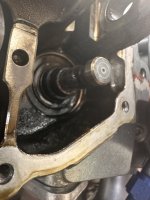
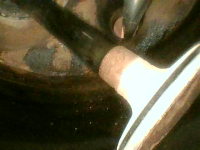
Here’s a bunch of a pictures of my sticky #2 valve stem. I don’t supposed there’s any way to tell what kind of deposits it might be getting without lab analysis.
 

Attachments

  • IMG_5428.jpeg
    IMG_5428.jpeg
    1.4 MB · Views: 27
  • IMG_5434.png
    IMG_5434.png
    334 KB · Views: 27
  • IMG_5443.png
    IMG_5443.png
    366.3 KB · Views: 25
  • IMG_5442.png
    IMG_5442.png
    338.5 KB · Views: 23
  • IMG_5441.png
    IMG_5441.png
    334.8 KB · Views: 28
Last edited:
Back
Top