Van's Air Force

The definitive Van's Aircraft support community! Buying, building or flying an RV? Join our exclusive family of mentors and enthusiasts!

Rattlecan paint?

Steve Crewdog

Well Known Member
Patron
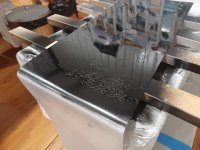
Got a small non-structural fairing to paint that the radio antennas attach top on top of/between the wings, white on bottom that has a feathered edge of black from the top. Used some Rustoleum Paint's Touch 2x ultracover (because Rustoleum is what Johnny Bench said to use!!), the white came out perfect but the black orange peeled. Let is dry overnight, sanded and washed it off this morning, same problem. Slightly humid today, temps in the mid-50s. Did an internet search and apparently Rustoleum is known for it's orange peeling, I must have gotten lucky with the white. Going to let it dry overnight and try again tomorrow.

It's on the top of a high wing airplane so people will only see a bit of the front, but.... it's not right, y'know?

Any ideas? TIA.
 

Attachments

  • orange peeling (1).jpg
    orange peeling (1).jpg
    261.9 KB · Views: 186
  • orange peeling (2).jpg
    orange peeling (2).jpg
    243.7 KB · Views: 186
  • orange peeling (3).jpg
    orange peeling (3).jpg
    226.9 KB · Views: 185
Got a small non-structural fairing to paint that the radio antennas attach top on top of/between the wings, white on bottom that has a feathered edge of black from the top. Used some Rustoleum Paint's Touch 2x ultracover (because Rustoleum is what Johnny Bench said to use!!), the white came out perfect but the black orange peeled. Let is dry overnight, sanded and washed it off this morning, same problem. Slightly humid today, temps in the mid-50s. Did an internet search and apparently Rustoleum is known for it's orange peeling, I must have gotten lucky with the white. Going to let it dry overnight and try again tomorrow.

Any ideas? TIA.
That looks like an incompatibility with the substrate underneath. Is the part primed? Was it thoroughly solvent-cleaned and allowed to fully dry?
 
That looks like an incompatibility with the substrate underneath. Is the part primed? Was it thoroughly solvent-cleaned and allowed to fully dry?

Previously painted with Polyfiber Aerothane several years ago (quickie job on the last day I had the paint booth), then painted yesterday at the same time and with the same Rustoleum White I did the bottom with, both top and bottom white dried fine.

Prior to shooting the black I wet-sanded it with 320 and 400 grit, washed with water, then shot the black and got the orange peeling. Came back this morning, sanded, rinsed, repeated with the same results. Used some acetone on a small test section and the paint turned into gunk so I quickly stopped. Maybe I should have sued denatured alcohol?
 
Last edited:
Yep. Like Carl said. Rattle can will usually come off with lacquer thinner or acetone. Wear PPE. If not, pretty much any stripper will take it off. Pay one enough and she might do the job for you! 😁
Sorry. My sense of humor is out of my control.

Any suggestions for a simple rattle can paint?
 
Last edited:
I've had very good luck with Rustoleum 2X Paint/Primer.


Ironically, that is what I used. The white was fine over the Aerothane, but the black over the white caused the reaction. Same manufacturer but they didn't like each other. Must be family.
 
As others have said, the solvents in the Rustoleum didn’t get along with the OG paint. It stinks but it happens. The best course of action now is to strip to bare metal and start over. For just doing a small strip job the “Aircraft Stripper” from Kleen Strip that you can buy at Home Depot is probably the easiest to get. While you’re there buy a small roll of 4 mil plastic, a couple 1 quart paint mixing cups and some of those really cheap wood handle 2 inch paint brushes. Cut off a piece of plastic slightly bigger than your part and place your part on it. Pour a little bit of stripper in the mixing cups and and use one of the brushes to paint your part with stripper. Try and keep the mess on the plastic. Makes cleanup a lot easier when you are done.
 
I’d check out ‘sunset stripper….it’s a little more money, works like nothing I’ve ever seen better…and doesn’t eat holes in your skin like methylene chloride.

And it’s made for aircraft!
 
Got a small non-structural fairing to paint that the radio antennas attach top on top of/between the wings, white on bottom that has a feathered edge of black from the top. Used some Rustoleum Paint's Touch 2x ultracover (because Rustoleum is what Johnny Bench said to use!!), the white came out perfect but the black orange peeled. Let is dry overnight, sanded and washed it off this morning, same problem. Slightly humid today, temps in the mid-50s. Did an internet search and apparently Rustoleum is known for it's orange peeling, I must have gotten lucky with the white. Going to let it dry overnight and try again tomorrow.

It's on the top of a high wing airplane so people will only see a bit of the front, but.... it's not right, y'know?

Any ideas? TIA.
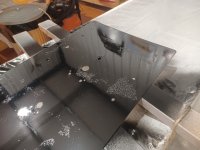
I have seen that before. Something on the surface reacts with the solvents (mostly naptha with rattle can), causing them to expand, become gaseous. Normally the solvents slowly work out over many days, but if they become gas, this happens. Notice that it is confined to specific areas where the contaminates were. Have also seen the same applying base coat in cold conditions. Base is mostly solvents.
 
Last edited:
I have removed rattle can paint with laquer thinner and paper towels. Takes a bit of time but fully removes it. Suggest agressive sanding after to remove contaminants.
 
I was kind of frustrated with the day so....

It's stripped back to the Aerothane paint, I'll call Polyfiber tech support in the morning and see what they recommend.

If they don't have have a solution, well, there a a couple holes I could have drilled better so maybe I'll just get a new piece of aluminum and do it all over again.

Thanks for all the help today.
 

Attachments

  • 20260322_175111.jpg
    20260322_175111.jpg
    1.7 MB · Views: 28
Last edited:
I was kind of frustrated with the day so....

It's dtripoed back to the Aerothane paint, I'll call polyfiber tech support in the morning and see what they recommend.

If they don't have have a solution, well, there a a couple holes I could have drilled better so maybe I'll just get a new piece of metal ad do it all over again.

Thanks for all the help today.
It is clearly not the aerothane paint that is the problem, as the problem was well isolated. Try sanding the aerothane well before the next attempt. Needs to be fully scuffed to get the stuff off.
 
It is clearly not the aerothane paint that is the problem, as the problem was well isolated. Try sanding the aerothane well before the next attempt. Needs to be fully scuffed to get the stuff off.


Thanks, Larry. I wet sanded with 320, maybe I should use something coarser?
 
You've got both crazing (the wrinkles) and solvent pop (the craters and bubbles). Crazing is caused by the paint softening the substrate and causing it to expand and debond. Solvent pop is from putting on too much at a time trapping in the VOCs.

You have the white rustoleum under the black? If I had to guess it was still tender and the black was applied too fast and/or too thick. Something like that I'd do around 4-6 cross coats with the first couple cross coat being a dusting. The last two would set the color and sheen.
 
Thanks, Larry. I wet sanded with 320, maybe I should use something coarser?
320 is a finishing grit and may not have got it off. I would suggest chemicals first, but did that already now. Given we are only goig through old paint now, I would hit the problem area with 150 and enough to be able to see that paint is being removed. Then finish it with 220. Two coats of rattle can should easilly cover or hit it with the 320 after the 220. 2nd coat should go on within 30 minutes of first coat. Generally recoats need to be several days after that.
 
I have some recent experience with this (unfortunately). Last week I was trying to finish a pedal plane for my grandson, using Rustoleum.
I got some lifting of the previous layer (same as the photo) that I let dry for a week. I looked it up on the the Rustoleum site and yes, if you sand Rustoleum, you must wait at least 24 hours before applying another coat. Rustoleum is oil-based and relies on oxygen to cure the paint. Sanding exposes fresh pant that is not fully cured and it will lift.
I HATE PAINTING and Rustoleum made me hate it more. The primer is not sandable and remains gums up the sand paper even after a week of drying.

Rustoleum is great for fences and lawn furniture; anywhere you can just blow it on and walk away. Try to get "professional" with it and it is frustrating.
I do use it to freshen up my tail wheel and tail spring after they get chipped and exhaust covered, but again I just spray one coat and walk away.
 
Ok, I just got off the phone with Greg at Polyfiber, who is not only a great guy to talk to, but an absolute geek about painting.

Long story short, nothing will stick to Aerothane except Aerothane. So I can either strip the Aerothane (soak the part in MEK for over an hour), or respray the Aerothane. I don't have access to a booth anymore, BUT what Greg tells people to do is mix whatever Aerothane you need, and use a Preval Spray system to make the spot repair. https://www.aircraftspruce.com/catalog/cspages/prevalspraygun.php

Because a couple holes weren't perfect, and why do it once when you can do it twice, I also ordered another piece of aluminum to cut a new piece. (Any suggestions for painting 2024t3?)


Thanks for everyone's help. I learned something.
 
Last edited:
I’d check out ‘sunset stripper….it’s a little more money, works like nothing I’ve ever seen better…and doesn’t eat holes in your skin like methylene chloride.

And it’s made for aircraft!
Back in the ‘90’s we had some stuff everyone just called Acid Stripper. Everything came off. Including your skin, lol. Methylene chloride was weak in comparison. Now days most strippers are hydrogen peroxide based. It gets the job done but takes a lot longer.
 
I have some recent experience with this (unfortunately). Last week I was trying to finish a pedal plane for my grandson, using Rustoleum.
I got some lifting of the previous layer (same as the photo) that I let dry for a week. I looked it up on the the Rustoleum site and yes, if you sand Rustoleum, you must wait at least 24 hours before applying another coat. Rustoleum is oil-based and relies on oxygen to cure the paint. Sanding exposes fresh pant that is not fully cured and it will lift.
I HATE PAINTING and Rustoleum made me hate it more. The primer is not sandable and remains gums up the sand paper even after a week of drying.

Rustoleum is great for fences and lawn furniture; anywhere you can just blow it on and walk away. Try to get "professional" with it and it is frustrating.
I do use it to freshen up my tail wheel and tail spring after they get chipped and exhaust covered, but again I just spray one coat and walk away.
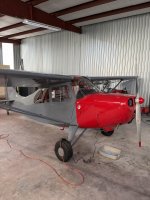
It does take time but can turn out OK (10 foot paint job :D) and is a lot cheaper to touch up, and it can be cut and buffed (wait a month or so), the red on my Champ is Rustoleum shot on top of the Stewart Systems primer, a few quick light coats and then a wait a few days for a couple of heavier coats. Also their color consistency between the brush can and aerosole is not bad.

For my RV the PPG matching single stage rattlecans for touchup are now around $50 each over twice what they used to be.


IMG_7362.JPG
 
Back
Top