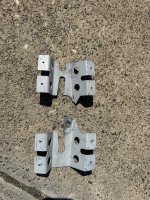
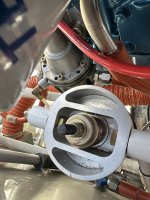
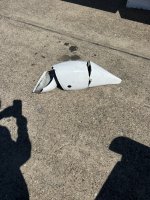
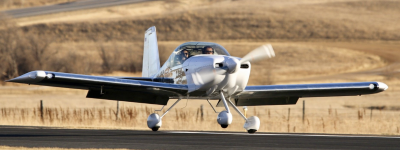
Looks like the EXP119...note cowl exhaust "bumps"
View attachment 112653
With that being the case, the described symptom sounds suspiciously similar to something that we experienced on the prototype while developing the EXP119 engine installation.
We were never able to reproduce the problem just running on the ground, but it sounds like the identical symptom in flight.
What it turned out to be was an extremely short duration shut down of the engine.
In this particular case, it would only happen at normal cruise power settings, or higher. If the engine was throttle back to a very low throttle setting, it didn’t occur, and as mentioned already, we weren’t ever able to reproduce the problem during ground runs.
This may get a little long, but some people may find it interesting to look inside what is involved with prototyping sometimes, and when things happen that don’t make sense during that process.
Because the EXP engine has the Airflow Performance throttle body which dimensionally is a bit different than the traditional Bendix/Precision version, a new induction snorkel design was needed for the installation of that engine.
I made an initial prototype for flight testing by cutting the lower section off of the original version and re-molding it to fit onto the new style throttle body, which requires it to just slip over the inlet of the throttle body, unlike the Bendix/precision style, which has a flange that bolts up to a flange on the throttlebody.
All of the initial flight testing was done with this modified/prototype snorkel and data was showing performance was really good.
While doing final preparations of the airplane for its reveal at Oshkosh with the new firewall forward design and pending release of the new firewall forward kit, all of the kit version parts were installed on the airplane, including the production version of the induction snorkel, which had been made from the new production mold that was developed based on the shape of the hand built production version.
We went back to flying the airplane and soon discovered that very occasionally there was a very disconcerting boom noise that initially none of us were able to zero in on a cause.
It didn’t take long though, for it to seem obvious that it was engine related, so we started trying a bunch of different things, including getting another throttle body from Don at airflow performance.
We made a lot of different changes and nothing we did made any difference, and the problem had seemed to be getting worse.
To the point that when doing flight tests, I was staying directly over the airport.
On one of those flight tests, I accidentally made an odd discovery….
I could make the problem stop anytime I wanted, by fully opening the cowl flap

Strange, but at least we now had something that was relatable.
The only thing that made any sense for having an influence on engine operation would be that varying the volume of airflow through the cowl was somehow having an influence on the airflow into the engine induction system.
So the most logical thing at this point was to put the prototype induction snorkel back on the airplane and do a test flight.
We probably should have done that as one of the other remedies since it was a part that was changed, but to the best we knew it was identical to the prototype version other than it being a bit more cleaned up on the interior surface since it was produced on a production mold.
You can probably guess at this point that the engine ran fine with the prototype induction snorkel.
So we immediately sent the production version off to Don for him to run on his flow bench. He reported back that it was not very good.
After some very detailed comparing between the prototype and the production version, it was found that the bend radius of the turn in the snorkel to redirect the flow aft into the throttle-body, was just very slightly a smaller radius than the prototype one was. I mean, very slight, though I don’t remember specific numbers at this point.
So some rework was done on the production mold, and another part sent off to Don for testing, which he said was a huge improvement.
A bit of a sidenote… the bend radius on the EXP snorkel is actually bigger than what it was on the legacy snorkel that was used for the Bendix/Precision style throttle body.
We came to realize in this whole process that because of the different air metering designs that each throttle-body has, one of them may work fine with a specific inlet flow, when the other just plain won’t. The airflow performance has a single Venturi type port (for a lack of any better way I can think of describing it, though I don’t think it is actually Venturi) centered in the middle of the inlet of the throttle body. So it is doing all of the inlet flow measurement at that one single point, and if there is a flow disturbance at that single point of the inlet, it will have an influence on the metering performance of the throttle body.
The Bendix/Precision style has four metering tubes distributed around the perimeter of the inlet. So it seems that if there is a flow disturbance on a portion of the inlet, the remaining metering tubes are still getting valid flow info and the throttle body still performs normally.
Having said all that, I have not heard of any other instance of an RV having the type of issue that we experienced, but maybe there is something about this particular airplane that is making it experience the same problem.
Perhaps something that the builder did with the induction snorkel, such as modifying the shape to clear a different starter motor or something they did for clearing the oil drain back tube, etc., that is causing a downstream flow disturbance.

I hope you figure it out. Believe me, I know very well how unnerving it is.