
I recently purchased an RV12 from the estate of the builder. It has the carbureted Rotac 912 engine. I am having a problem with static on the radio during reception. If I'm more than 10 miles from the ATCtransmitter I hear a ticking sound, tick tick tick tick, That as I travel farther away from the transmitting station makes it impossible to understand what is being said. Even at my home airport when I listen to the AWOS, I hear it faintly in the background. Today while in flight I turned off one mag at a time and as I did this the ticking sound became less pronounced. I'm not much of a technician or electronics expert but to me it sounds like spark plug noise. But that's just a guess. My panel consists of a Dynon Skyview HDX and a Garmin SL30. I also have the PS Engineering Audio Panel. Pretty basic panel. This problem makes it difficult for me even to get flight following as the ticking static in the background makes it difficult to hear the controller as I get any distance from his transmitter. Has anyone else experienced this and can offer any suggestions on where to start looking? Thank you.

Van's Air Force
You are using an out of date browser. It may not display this or other websites correctly.
You should upgrade or use an alternative browser.
You should upgrade or use an alternative browser.
Radio Noise Problem.... need some help.
- Thread starter glenadavis
- Start date



Mine were over drilledMake sure the insulating washers are installed on your headset sockets.
 . I've designed some 3d printable versions to adjust the dimensions and keep the jacks centered, just waiting to do them in something stronger than PETG. The barrel of the jack need to be fully isolated from any ground. This includes using the fiber washer on top so no mating surface can ground the barrel
I get some interesting noise which I think I have attributed to my Silent Hektik voltage regulator, but I could be wrong. I say interesting because the noise varies but not with the usual stuff like engine RPM and strobes. The Silent Hektik ramps up its charge rate over time. I believe as it ramps up and sometimes as load changes I get different kinds of noise.
AZSteve053
Well Known Member
Noise can be coming in from either Conduction or Radiated sources. Conduction means it's coming thought the power or ground paths, or another wired source which is generating noise. Radiated would most likely be coming in through the antenna coming from source of RF interference such as bad spark plug wires, spark plugs etc that are high voltage sources. In the automotive world most spark plugs now have a series resistors built-in to minimize the noise, and they actually do a real good job. Before spark plugs had internal resistors - the ignition leads had resistance build in doing the same job.
Do you have two different radios ? or a Handheld - see if the noise is on both, see if it's worse on some frequencies.
If your very comfortable with it - at a safe altitude and close to a runway if needed - shut both ignitions systems off allowing the engine to windmill for 5-10 seconds to see if the noise ceases.
As others have mentioned - try shutting down various electrical items one at a time, and take note of items like Tick rate vs strobe light rate - and are they synced ?
Can you reproduce the Ticking on the ground with or without engine running ?
Hope this helps.
Do you have two different radios ? or a Handheld - see if the noise is on both, see if it's worse on some frequencies.
If your very comfortable with it - at a safe altitude and close to a runway if needed - shut both ignitions systems off allowing the engine to windmill for 5-10 seconds to see if the noise ceases.
As others have mentioned - try shutting down various electrical items one at a time, and take note of items like Tick rate vs strobe light rate - and are they synced ?
Can you reproduce the Ticking on the ground with or without engine running ?
Hope this helps.

rcarsey
Well Known Member
I recently had an issue with my 1300hr 912iS engine. The noise was both on the aircraft radio and also a handheld -- so I was able to rule out the noise being on the audio side of things. It turns out that they didn't use any dielectric grease where the spark plug boot screws onto the spark plug wire (theres like a wood screw in there that digs into the center of the spark plug wire when it gets screwed on to the wire).
Eventually the ECU threw an error which pointed me to 2 possible spark plugs -- I found corrosion/rust inside the spark plug boot on the wire side (the other side that actually connects to the spark plug looked OK). After replacing the boot and wire, all the noise went away. The noise itself was not ticking, but was more like a "sparking electrical noise"
Eventually the ECU threw an error which pointed me to 2 possible spark plugs -- I found corrosion/rust inside the spark plug boot on the wire side (the other side that actually connects to the spark plug looked OK). After replacing the boot and wire, all the noise went away. The noise itself was not ticking, but was more like a "sparking electrical noise"
It is - the resistor is part of the spark plug "boot" at the end of the wire.Gonna date myself, but this used to be a thing with not using resistor type plugs too. Might be worth just checking to make sure that the right sparkplugs are installed. I think that is electronic ignition?


Fffflats
Well Known Member
Is ignition system grounded to engine block? Tach too?
How about radios, ICS, other electronics, do they ground to a common point prior to that point grounding to the frame or wherever else such subsequently grounds?
Chased some similar issues myself recently and here is what a friend sent me:
Good article describing our problem I found.
"Quite a few forum threads and articles have at various times addressed ground loops, and their potential to cause noise or other interference in your avionics system. Simply put, a ground loop occurs when different paths to ground are used. The difference in resistance, or impedance, on those paths can cause oscillations that result in noise in your data or audio systems. As a result, considerable effort should be applied to ensure common grounds are used whenever possible, and you’ll see that mentioned in aviation forums with some regularity, especially those associated with homebuilt aircraft. But not all ground loops are created equal, and all situations and systems do not always require the same common ground. Not only are there different types of ground loops, but how they affect your systems, and how that effect manifests itself, can vary quite a bit. It can get very confusing.
One source of confusion is the oft repeated mantra that everything should use the same ground. That isn’t strictly true, but it is widely applicable. And it’s very important. The power system for your avionics will use a common ground on your avionics bus. Your audio system will use a common ground typically on your intercom or audio panel. Your data distribution systems, such as your serial bus, will usually use a different common ground. They aren’t all in the same place in most aircraft, because the path they may use to induce noise, and the manner in which they may do it, are different. But, while they don’t necessarily have to be grounded at the same location, they certainly can be. And if they are, it reduces the potential for ground loops
Another source of confusion is the different manner in which different systems cause noise. Power distribution systems typically cause noise simply by virtue of the ground potential difference, the ground loop. They’re also very susceptible to carrying engine electrical system noise, usually from alternators, into your other systems. Those are usually identifiable because they change with engine RPM.
Audio and data systems are also prone to ground loops, but they can also get induced noise caused by the wiring itself. That’s usually an issue with improper shielding, or improperly grounded shielding. Both ground loops and induced noise are affected by grounding and shielding. Grounding and shielding are actually two different things, but are sometimes shared by the same wires, depending on the grounding scheme used. There are differing grounding and audio routing standards and practices in the aviation world, and different equipment manufacturers will often advocate different practices.
In the early days of using electricity in aircraft, simple straight wires were used. When audio was introduced, noise was rampant, and generally considered a necessary evil by those who just didn’t know any better. It just went with the territory. But as avionics technology advanced, noise become more than just a simple irritant. It often made installed equipment unusable. The concept of ground loops had been understood early on in the electrical power systems of aircraft, so the first mitigation efforts using common grounds were often limited to the main electrical bus. It wasn’t until later than noise reduction efforts within the avionics systems themselves began in earnest. That’s how the common ground schemes mentioned above came about. There wasn’t always complete agreement on where the common ground should be, but it was agreed there should be one, or at least one for each subsystem. Unfortunately, efforts to reduce induced noise in wiring weren’t so easily accomplished, and often did not yield the desired results.
Induced noise in wiring is simply a signal in one wire ‘coupling’ into an adjacent wire or wires, sometimes referred to as crosstalk. It’s the same principle as an antenna receiving radio signals. But obviously we don’t want our avionics wiring acting as antennas. Efforts to mitigate this problem have varied over the years. Some simply twisted the audio and data wiring to reduce or eliminate the potential for induction. Ethernet data cables still use that method today. But that method has more limited ability when it comes to reducing audio noise. That has to do with frequencies involved and the differences between analog and digital signals, but I’m not going to delve deep into that here.
The next step in the noise reduction process was using shielded cable. The audio or data transmission wire was wrapped in a metallic shield that protected it from outside signals. The first iterations of this method usually involved one wire inside, audio high, being wrapped in a metal mesh that was used as the audio low path. This is what’s known as unbalanced wiring or cables. The most commonly seen example of that is the RCA cables used to connect home audio equipment for many years, and still used today. The problem with unbalanced cables is the audio lo in the shielding, although less susceptible than audio hi, can still pick up induced noise. If the audio shielding was also connected to ground at multiple points, ground loops could come into play, sometimes even if you use a common ground scheme. The best method generally available today is balanced cabling, where both the audio hi and audio lo wires are contained within a separate shield. This also applies to data lines. But we see more problems with audio noise in aircraft, so I’m addressing it in that context.
While different manufacturers may have different philosophies on types of audio cables and how to route audio lo lines, the shielding in your audio system should always ground at the same location. That’s an audio panel if you have one, and your intercom if you don’t have an audio panel. If you have neither, pick a common location within your audio distribution setup. I’d typically opt for a radio, or a mixer if you use one. I highly recommend you also use balanced cables, even if one of your equipment manufacturers doesn’t advocate it.
So ideally, we use balanced cabling, we have a common ground location for power, a common ground location for audio, and a common ground location for data signal wiring. We may even have a single common grounding point for all three. What about something that doesn’t fit into those categories? There are numerous wires in your aircraft that are not part of those systems, or that don’t fit into those categories. In an ideal world, you would use different wiring locations or bundles for those wires, to keep them apart and reduce the potential for inducing or coupling noise. That’s especially true for anything involving electric motors such as autopilot and trim systems. But a separate wiring location isn’t always possible. In that case, use shielded wire wherever possible, even for wiring that has nothing to do with audio or data, and ground that shield to the common point your audio or data wiring uses (preferably audio). Where cables cross, try to have them to do that at right angles rather than running parallel to each other. None of these practices are mandatory, hard and fast rules. Different situations and circuits present different potential for inducing noise into your avionics system. But you’ll likely save yourself a lot of grief if you follow these practices as if they are mandatory.
There will be some aspects of your system that don’t fit into a readily defined category, or that fit into more than one, and seem to present grey areas. Examples of this are autopilot disconnect or PTT switches. Although they may be closely related to power, audio or data systems, they don’t actually carry any of those signals. They are usually sense lines that connect to ground. You will commonly see manufacturers depict them as going straight to chassis ground. Since they carry no signals, you’ll probably be perfectly safe doing that. But one thing you’ll learn from working aircraft, especially homebuilt aircraft, is that noise can come from the strangest places, and in the strangest ways. If any wiring for these circuits travels within or along your data or audio wiring, you should follow the above shielding and common grounding practices just to be safe. PTT is a prime example of that, since it often routes with audio wiring. Even if none of this wiring routes alongside your audio or data wiring, you can still follow those practices out of an abundance of caution. In fact, I highly recommend it. And you’ll find that many others will insist on it.
Lastly, I’ll point out that none of this guarantees you won’t have noise, or that noise will be simple to troubleshoot, should you experience it. Noise can come from places completely unrelated to the wiring, even when individual pieces of equipment are operating properly. Impedance mismatches, line level outputs going to audio level inputs, units configured improperly, settings incorrect, bad antennas or antenna cables, etc., etc. The possibilities for problems are almost endless. You may also discover a solution that works perfectly on one aircraft doesn’t work at all on another aircraft, even one that’s seemingly identical. Audio is incredibly fickle that way. And if you encounter this situation on a homebuilt aircraft, welcome to experimental aviation!"
How about radios, ICS, other electronics, do they ground to a common point prior to that point grounding to the frame or wherever else such subsequently grounds?
Chased some similar issues myself recently and here is what a friend sent me:
Good article describing our problem I found.
"Quite a few forum threads and articles have at various times addressed ground loops, and their potential to cause noise or other interference in your avionics system. Simply put, a ground loop occurs when different paths to ground are used. The difference in resistance, or impedance, on those paths can cause oscillations that result in noise in your data or audio systems. As a result, considerable effort should be applied to ensure common grounds are used whenever possible, and you’ll see that mentioned in aviation forums with some regularity, especially those associated with homebuilt aircraft. But not all ground loops are created equal, and all situations and systems do not always require the same common ground. Not only are there different types of ground loops, but how they affect your systems, and how that effect manifests itself, can vary quite a bit. It can get very confusing.
One source of confusion is the oft repeated mantra that everything should use the same ground. That isn’t strictly true, but it is widely applicable. And it’s very important. The power system for your avionics will use a common ground on your avionics bus. Your audio system will use a common ground typically on your intercom or audio panel. Your data distribution systems, such as your serial bus, will usually use a different common ground. They aren’t all in the same place in most aircraft, because the path they may use to induce noise, and the manner in which they may do it, are different. But, while they don’t necessarily have to be grounded at the same location, they certainly can be. And if they are, it reduces the potential for ground loops
Another source of confusion is the different manner in which different systems cause noise. Power distribution systems typically cause noise simply by virtue of the ground potential difference, the ground loop. They’re also very susceptible to carrying engine electrical system noise, usually from alternators, into your other systems. Those are usually identifiable because they change with engine RPM.
Audio and data systems are also prone to ground loops, but they can also get induced noise caused by the wiring itself. That’s usually an issue with improper shielding, or improperly grounded shielding. Both ground loops and induced noise are affected by grounding and shielding. Grounding and shielding are actually two different things, but are sometimes shared by the same wires, depending on the grounding scheme used. There are differing grounding and audio routing standards and practices in the aviation world, and different equipment manufacturers will often advocate different practices.
In the early days of using electricity in aircraft, simple straight wires were used. When audio was introduced, noise was rampant, and generally considered a necessary evil by those who just didn’t know any better. It just went with the territory. But as avionics technology advanced, noise become more than just a simple irritant. It often made installed equipment unusable. The concept of ground loops had been understood early on in the electrical power systems of aircraft, so the first mitigation efforts using common grounds were often limited to the main electrical bus. It wasn’t until later than noise reduction efforts within the avionics systems themselves began in earnest. That’s how the common ground schemes mentioned above came about. There wasn’t always complete agreement on where the common ground should be, but it was agreed there should be one, or at least one for each subsystem. Unfortunately, efforts to reduce induced noise in wiring weren’t so easily accomplished, and often did not yield the desired results.
Induced noise in wiring is simply a signal in one wire ‘coupling’ into an adjacent wire or wires, sometimes referred to as crosstalk. It’s the same principle as an antenna receiving radio signals. But obviously we don’t want our avionics wiring acting as antennas. Efforts to mitigate this problem have varied over the years. Some simply twisted the audio and data wiring to reduce or eliminate the potential for induction. Ethernet data cables still use that method today. But that method has more limited ability when it comes to reducing audio noise. That has to do with frequencies involved and the differences between analog and digital signals, but I’m not going to delve deep into that here.
The next step in the noise reduction process was using shielded cable. The audio or data transmission wire was wrapped in a metallic shield that protected it from outside signals. The first iterations of this method usually involved one wire inside, audio high, being wrapped in a metal mesh that was used as the audio low path. This is what’s known as unbalanced wiring or cables. The most commonly seen example of that is the RCA cables used to connect home audio equipment for many years, and still used today. The problem with unbalanced cables is the audio lo in the shielding, although less susceptible than audio hi, can still pick up induced noise. If the audio shielding was also connected to ground at multiple points, ground loops could come into play, sometimes even if you use a common ground scheme. The best method generally available today is balanced cabling, where both the audio hi and audio lo wires are contained within a separate shield. This also applies to data lines. But we see more problems with audio noise in aircraft, so I’m addressing it in that context.
While different manufacturers may have different philosophies on types of audio cables and how to route audio lo lines, the shielding in your audio system should always ground at the same location. That’s an audio panel if you have one, and your intercom if you don’t have an audio panel. If you have neither, pick a common location within your audio distribution setup. I’d typically opt for a radio, or a mixer if you use one. I highly recommend you also use balanced cables, even if one of your equipment manufacturers doesn’t advocate it.
So ideally, we use balanced cabling, we have a common ground location for power, a common ground location for audio, and a common ground location for data signal wiring. We may even have a single common grounding point for all three. What about something that doesn’t fit into those categories? There are numerous wires in your aircraft that are not part of those systems, or that don’t fit into those categories. In an ideal world, you would use different wiring locations or bundles for those wires, to keep them apart and reduce the potential for inducing or coupling noise. That’s especially true for anything involving electric motors such as autopilot and trim systems. But a separate wiring location isn’t always possible. In that case, use shielded wire wherever possible, even for wiring that has nothing to do with audio or data, and ground that shield to the common point your audio or data wiring uses (preferably audio). Where cables cross, try to have them to do that at right angles rather than running parallel to each other. None of these practices are mandatory, hard and fast rules. Different situations and circuits present different potential for inducing noise into your avionics system. But you’ll likely save yourself a lot of grief if you follow these practices as if they are mandatory.
There will be some aspects of your system that don’t fit into a readily defined category, or that fit into more than one, and seem to present grey areas. Examples of this are autopilot disconnect or PTT switches. Although they may be closely related to power, audio or data systems, they don’t actually carry any of those signals. They are usually sense lines that connect to ground. You will commonly see manufacturers depict them as going straight to chassis ground. Since they carry no signals, you’ll probably be perfectly safe doing that. But one thing you’ll learn from working aircraft, especially homebuilt aircraft, is that noise can come from the strangest places, and in the strangest ways. If any wiring for these circuits travels within or along your data or audio wiring, you should follow the above shielding and common grounding practices just to be safe. PTT is a prime example of that, since it often routes with audio wiring. Even if none of this wiring routes alongside your audio or data wiring, you can still follow those practices out of an abundance of caution. In fact, I highly recommend it. And you’ll find that many others will insist on it.
Lastly, I’ll point out that none of this guarantees you won’t have noise, or that noise will be simple to troubleshoot, should you experience it. Noise can come from places completely unrelated to the wiring, even when individual pieces of equipment are operating properly. Impedance mismatches, line level outputs going to audio level inputs, units configured improperly, settings incorrect, bad antennas or antenna cables, etc., etc. The possibilities for problems are almost endless. You may also discover a solution that works perfectly on one aircraft doesn’t work at all on another aircraft, even one that’s seemingly identical. Audio is incredibly fickle that way. And if you encounter this situation on a homebuilt aircraft, welcome to experimental aviation!"
Lots of good suggestions. Spark interference would have a frequency too high to be described as "tick, tick, tick". My first guess would be strobes, if you have them. If that proves to be correct, you might be able to correct it by disconnecting the wires to the strobe power unit at the strobes and then twisting them (e.g. with a drill, not too much) to make a long helix, so the radiated signals cancel each other out.
Fffflats
Well Known Member
My first guess would be strobes
but before putting in the work here, you can test the hypothesis by simply flying with the strobes turned off.

If the source is the strobes, make sure the noise filter capacitors (ES-00103) for the strobe wires are correctly installed at the wing electrical connectors.Lots of good suggestions. Spark interference would have a frequency too high to be described as "tick, tick, tick". My first guess would be strobes, if you have them. If that proves to be correct, you might be able to correct it by disconnecting the wires to the strobe power unit at the strobes and then twisting them (e.g. with a drill, not too much) to make a long helix, so the radiated signals cancel each other out.
a single plug fires once per 2 crank revolutions. So, at idle 1 plug fires 350 time per minute or about 6 times per second. So if an individual plug or wire is causing the noise, I believe your ear can detect the ticks. I have pulled plugs and observed the sparking at 300 RPM (cranking) and you can hear the snapping cadence very easilly.Lots of good suggestions. Spark interference would have a frequency too high to be described as "tick, tick, tick".
Glen's getting a lot of good advice here, but folks need to remember he's dealing with a 912 Rotax engine, which has an electrical system much different from Lycomings (etc.) -- much higher rpm, no magnetos, etc. Some steps for diagnosis that would be useful for Lycomings would steer him in the wrong direction for his Rotax.
Not with a Rotax. Two spark plugs are in series. One fires dry at the top of the exhaust stroke.a single plug fires once per 2 crank revolutions.
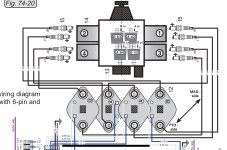
I had static issues on my 2010 RV12, I had found the headset shielded cables were not grounded due to a bad splice where the ground wires all come together at the intercom, they pulled out of the splice. After making a new connection it works perfectly, no static...
Norman CYYJ
Well Known Member
If the sound you are hearing is a ticking at cruise it is not ignition problems. As suggested check your strobes. Ignition sounds like static and alternator sounds like a whine.

I agree. We had a loose mag-side ignition wire boot and it caused a really obvious ticking sound (although pretty high frequency) that interfered with radio comms in exactly the way the OP described. The in-flight mag check was the diagnostic tool of significance to debug. New high tension leads solved it.a single plug fires once per 2 crank revolutions. So, at idle 1 plug fires 350 time per minute or about 6 times per second. So if an individual plug or wire is causing the noise, I believe your ear can detect the ticks. I have pulled plugs and observed the sparking at 300 RPM (cranking) and you can hear the snapping cadence very easilly.

The capacitor on our RV-12 failed and caused a large amount of noise, but not a tic-tic-tic.there's a "filter" capacitor on the fuel pump lead also ... have no idea if that could cause ticking in the comm but audibly the pump certainly does make noise
