Van's Air Force

The definitive Van's Aircraft support community! Buying, building or flying an RV? Join our exclusive family of mentors and enthusiasts!

Question on CHTs....

Reflex

Well Known Member
Friend
I've been fighting a cool #4 cylinder since day 1. I've gone through GAMI testing and have replaced multiple injectors on two cylinders. Seems no mater what I do, #4 is always the coldest in cruise.

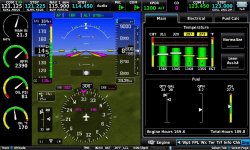
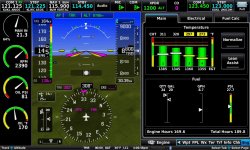
The reason for this post is to ask about the CHT delta. As you can see from the pictures below, in cruise the delta is 47 degrees F. This is getting very close to the maximum of 50 degrees F that Lycoming "recommends". I have seen the delta go to 52 degrees on occasion.

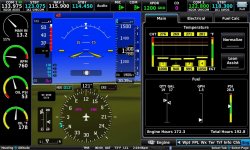
The second picture is the CHT delta at idle. This picture is on the ground before takeoff on the same flight. Note the CHT delta of 12 degrees F.

Additional Info:
  • Lycoming IO-390 210 hp
  • RV-14
  • Picture in cruise is running 20 degrees LOP
  • Delta running 100 degrees ROP = 38 degrees F.
  • Temps appear to be very consistent at various OAT and altitudes
  • GAMI injectors
  • 1 P-Mag & 1 Slick Mag
Is this something to be concerned about. If so, recommendations on a solution?

Screenshots below:

In cruise:

LOP Cruise 1.jpg

At idle on same flight:
Idle.jpg
 

Attachments

  • LOP Cruise.jpg
    LOP Cruise.jpg
    302.8 KB · Views: 14
Swap probes if you can, just to make sure it isn't an instrumentation error. Second, if it bothers you, you can add extensions to the cylinder wraps on the cold cylinders to restrict airflow around the >presumably< problematic cylinder(s).
 
I don’t know if you have made any modifications to the air dam(s) at the cowl inlet. Reducing the size of the air dam will generally increase cooling on the front cylinder and reduce cooling on the rear one. I would remove the air dam completely on cylinder #2 annd test fly. You can add back using silver air duct tape until you get the best result you can, then modify the air dam accordingly. I ended up removing all but a tab in front of the fuel injector on #2.
 
I don’t know if you have made any modifications to the air dam(s) at the cowl inlet. Reducing the size of the air dam will generally increase cooling on the front cylinder and reduce cooling on the rear one. I would remove the air dam completely on cylinder #2 annd test fly. You can add back using silver air duct tape until you get the best result you can, then modify the air dam accordingly. I ended up removing all but a tab in front of the fuel injector on #2.
+1

Note, I did not understand your comment on replacing injector nozzles to manage CHTs (perhaps I have this wrong). You replace injector nozzles to balance the cylinders, the goal being to achieve 0.0 or 0.1 GPH GAMI spread.

Carl
 
+1

Note, I did not understand your comment on replacing injector nozzles to manage CHTs (perhaps I have this wrong). You replace injector nozzles to balance the cylinders, the goal being to achieve 0.0 or 0.1 GPH GAMI spread.

Carl
Carl,

My wording was poor and you are correct to point that out. No, I didn't change injectors to balance CHTs although my verbiage makes it look that way. I only added that data to avoid the "clogged injector(s)" solutions.

Thanks for taking an interest.

Fred
 
Do a Compression test. If a valve is not fully closing (usually debris stuck on face), compression goes down and if bad enough, so does heat production.
 
As Kyle stated swap CHT probes between #2 and #4 as the leads should reach. If a bad CHT probe your problem will move to #2 and you know you have a bad probe.

My suggestions is first step is always to verify you have good data coming in before changing anything physically. You might not have anything wrong. Once you verify good data and you are having an issue, then troubleshoot. For example I once had an oil pressure fluctuating all over in flight responding to changes to RPM - really seemed real and was scary. Turned out nothing was wrong other than a break in the oil sensor ground wire. Good sensors and valid data first!
 
Make sure the CHT probe is seated with some compression on it. My #4 was quite cool until I adjusted the spring tension on the probe, now it's nice and even with the others.
+1 on this.

However, in answer to your original question asked in your post:
Is this something to be concerned about. If so, recommendations on a solution?
The answer is : NO
 
Both of my angle valve (IO-360-A1B6) equipped RV-7's exhibit this behavior -- the #4 jug is ~30F cooler than the rest in cruise. I chased this for a while, adjusting the risers in front of #2 and then #1, but it didn't make a difference.

As to compression checks, etc. etc. all of the jugs are 78/80 cold, 80/80 warm. So that wasn't it.

@hgerhardt experienced this also, for him I think it came down to adding a diverter/splitter in front of the oil cooler inlet behind #4. In the -14, the oil cooler air inlet is behind #3 -- so that's probably not the source.

I am interested in @rmartingt Bob's suggestion; gotta give that a try.

edit: not a concern -- unless there's evidence/data of something else amiss (bad vibration, pieces with part numbers visible in the oil filter, etc.)
 
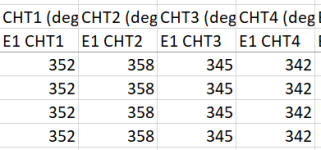
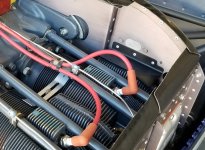
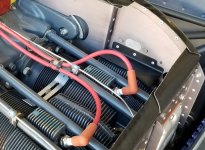
IO-360 AV, like @bjdecker. My #4 has always been cooler than the rest, so I built a dam over the exhaust side of #4 which helped a bit. My oil cooler offtake is behind #3. Typical 23/23 cruise in cool-ish weather:
1777062614438.png
1777063109581.jpeg
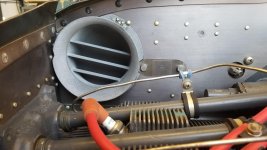
Before I reworked my OC duct, #3 was closer in temp to 1 & 2, but with the bellmouth and better duct (more airflow to the cooler), #3 is now ~10F cooler than before (as seen in the table above).

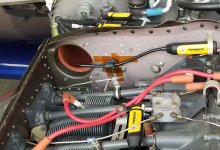
Oil cooler offtake before mod (instrumented to get a baseline):
1777062940659.jpeg
After mod (which also cools the cylinder better than above):
1777063003771.jpeg
 

Attachments

  • 1777063092577.jpeg
    1777063092577.jpeg
    586.3 KB · Views: 22
Many thanks for your replies/solutions. I'm going to work though some of them over the weekend.

Fred
 
The throttle plate position with less than full throttle makes the front two cylinders run at a different mixture than the rear cylinders. Try wide open throttle and lean to 20 LOP on the last cylinder to go over peak. See if that changes the spread. If the percentage of power is higher than you want ; go more lean.
 
The throttle plate position with less than full throttle makes the front two cylinders run at a different mixture than the rear cylinders. Try wide open throttle and lean to 20 LOP on the last cylinder to go over peak. See if that changes the spread. If the percentage of power is higher than you want ; go more lean.
I am having difficulty visualizing this scenario - especially in an IO, with the fuel metering and delivery independent of the air mass flow…
 
I don’t know if you have made any modifications to the air dam(s) at the cowl inlet. Reducing the size of the air dam will generally increase cooling on the front cylinder and reduce cooling on the rear one. I would remove the air dam completely on cylinder #2 annd test fly. You can add back using silver air duct tape until you get the best result you can, then modify the air dam accordingly. I ended up removing all but a tab in front of the fuel injector on #2.
This ^^
 
I am having difficulty visualizing this scenario - especially in an IO, with the fuel metering and delivery independent of the air mass flow…
Perhaps I should have said : airflow to the front cylinders versus the rear cylinders is different at throttle plate positions less than wide open. The result of having more or less air between front and rear cylinders would affect a difference in air fuel ratio (assuming similar injector orifice sizes on all 4 cylinders).
 
Perhaps I should have said : airflow to the front cylinders versus the rear cylinders is different at throttle plate positions less than wide open. The result of having more or less air between front and rear cylinders would affect a difference in air fuel ratio (assuming similar injector orifice sizes on all 4 cylinders).
I'm still not “getting it”. The air mass entering the intake plenum/sump is quite diffuse (the pressure field distribution is the same at each intake runner). Not seeing/understanding how the throttle plate (which is in front of the sump/plenum) would change distribution to front vs rear jugs…
 
Last edited:
Boyd seems to be thinking of an updraft carb.

While I agree it's possible to vary distribution with various dams and diverters on top of the cylinder(s), actually changing the mass flow around any given cylinder means changing the exit area of that individual cylinder head. Simply reduce the area to reduce the mass flow. The bonus is a slightly increased deltaP, which will increase mass flow through the oil cooler.

EDIT: a caveat...shrink the exit enough, and flow very near the CHT probe will increase, which may result in a decreased indication of CHT.

Cyl Exits.jpg
 
Last edited:
I'm still not “getting it”. The air mass entering the intake plenum/sump is quite diffuse (the pressure field distribution is the same at each intake runner). Not seeing/understanding how the throttle plate (which is in front of the sump/plenum) would change distribution to front vs rear jugs…
I have flown a multitude of airplanes that exhibited this phenomena, some with carbs and some with Bendix FI. What I have noticed is cylinders 1&2 run close parameters to each other, as do the cylinders 3&4 however, the delta between the front cylinders and the rear cylinders is usually wide, but that delta is less at WOT. I'll let you guess the physics as to why!
 
I have flown a multitude of airplanes that exhibited this phenomena, some with carbs and some with Bendix FI. What I have noticed is cylinders 1&2 run close parameters to each other, as do the cylinders 3&4 however, the delta between the front cylinders and the rear cylinders is usually wide, but that delta is less at WOT. I'll let you guess the physics as to why!
I’m thinking it’s a cooling air distribution issue and not combustion - WOT is usually associated with a higher TAS, from here it’s easier to see how higher inlet pressures would effect the CHT’s fore & aft…

I think the answer lies at the bottom of a glass of IPA ;)
 
Back
Top