Van's Air Force

The definitive Van's Aircraft support community! Buying, building or flying an RV? Join our exclusive family of mentors and enthusiasts!

Prop cycle on run up

larrys

Well Known Member
Just a thought, on my RV14A with about 200 hours, a Lycoming 390 thunderbolt and Hartzell CS prop; On the run up the typical call out is to cycle the prop 3 times at 1800.
My thought is, over time would this wear out the CS prop quicker then needed? Why 3 times?
Any thoughts?
Thanks, Larry
 
In Montana, when it's butt-a** cold out, we will cycle the CS prop about three times, nice and easy, to move the cold gelled oil out of the hub and replaced with warm oil from case. It won't hurt the mechanism or wear it out early.

When it's warm, a single cycle to verify operation is a good idea at the least...
 
I do it twice (last item on my run-up, other than looking for everything in or near "the green"). Somewhere I remember hearing that you shouldn't bog down the engine too much while cycling the prop. Made sense to me, so I just do it (twice), fairly quickly and just enough to ensure the prop is moving per the blue knob (by sound).
 
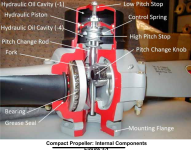
The 3 prop cycles is to move oil through the prop so that the oil in the pitch change cylinder doesn’t get stagnant and to help reduce sludge collection. I do the 3 cycles first flight, then one to verify control operation on subsequent flights on the same day. The pic shows the oil cavity that is dead ended and benefits from the oil cycling.
1755648822951.png
 
The three times thing is kind of a holdover from the training environment. The idea is that you watch one engine parameter for the correct change each time the prop is cycled. 1) Oil pressure should drop 2) Manifold pressure should go up 3) RPM should drop. With time you should be able to verify all these with one cycle. As others have said though, you're not going to hurt anything by cycling it that many times or more.
 
I was taught by old-time mechanics that excessive “deep-cycling” is hard on bearings….but to live up to what I preach (“show me where it says that in the manual!”), I can’t point you to any documentation that tells me that, so it’s hear-say. However, I don’t know what good deep-cycling does, so I have no reason to do it. I agree that if an engine/prop has been sitting a long time, or it is very cold, then cycling a few times to get some oil exchanged isn’t a bad idea (although I don’t know what t takes to actual move oil through instead of just varying the pressure….). But what bugs me are these student/instructors setting at the run-up pad, running the engine at high RPM for several minutes with these multiple deep “waaaa-waaa-waaaa’s” that they are only doing because the instructor was taught that way, and doesn’t know why. High RPM while sitting still is one good way to kick up gravel and sand, tearing up prop tips!

My personal method for normal flying, where the airplane is used regularly, is one quick prop cycle, just to make sure that the governor is working - I restore the lever to full forward as soon as I see an RPM drop, and it rarely drops more than 100 rpm if I‘m quick. That proves the system is controlling - you can’t tell if it is actually governing until you try it in flight! A check that both mags are working with no fouled plugs takes about five seconds, a prop cycle another three, and I’m back to idle.

 
I know nothing so don't beat me up too bad. I still need CS training.

Quick cycle and the prop and engine function as described in your posts.
Slower cycle and the engine bogs way down like it's going to die. Is that normal?
Do you ever have the prop control full out?
If not, why is there so much control travel?
 
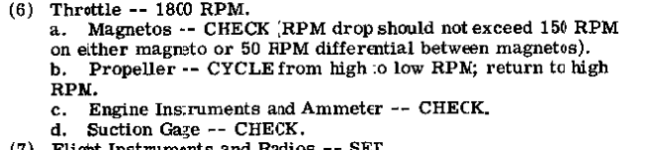
Haven't flown CS since I sold the 177RG, but I rember being taught 3 cycles. I just reviewed the POH and it does not mention any number of cycles.

Another possible example of the law of primacy?

1755704805298.png
 
Just a thought, on my RV14A with about 200 hours, a Lycoming 390 thunderbolt and Hartzell CS prop; On the run up the typical call out is to cycle the prop 3 times at 1800.
My thought is, over time would this wear out the CS prop quicker then needed? Why 3 times?
Any thoughts?
Thanks, Larry
some books say 3 times, some say once. I was taught 3 times and that's the way I do it. I don't see it wearing anything out quicker and I use the cycles for something. 1, did the rpms return to the same number, 2, did the oil pressure behave as expected, 3, is anything spraying out when I cycle the prop
 
I know nothing so don't beat me up too bad. I still need CS training.

Quick cycle and the prop and engine function as described in your posts.
Slower cycle and the engine bogs way down like it's going to die. Is that normal?
Do you ever have the prop control full out?
If not, why is there so much control travel?
There is more travel than you will need. I cycle my WW 300 twice with about a 150 rpm drop each time. I don't load the engine down more than that when cycling. It takes quite a bit of travel to cycle but not much travel in flight to get to 2400 ish.
 
My whole run up takes less than 15 seconds. Cycle the prop once to make sure it works (about 100-150 rpm drop) and through each ignition system to check them independently…I have one Lightspeed EI and one magneto.
 
Fact or fiction? I was told cycling the prop ensures warm oil has flowed through so the prop will work properly on takeoff.
 
Fact or fiction? I was told cycling the prop ensures warm oil has flowed through so the prop will work properly on takeoff.
I'm sure it's a fact your were told that. As to whether it is an old wive's tail or reality I cannot say. But it matches my CS training circa 2004.
 
OMG...I don't cycle mine at all :oops:
(back to 2600 at 500' then 2500 turning DW)
I don’t either. A quick glance at the tach during initial TO run proves that it is working. I do cycle it once in freezing conditions. I also don’t wait for oil to reach 100*. A real heretic
 
I know nothing so don't beat me up too bad. I still need CS training.

Quick cycle and the prop and engine function as described in your posts.
Slower cycle and the engine bogs way down like it's going to die. Is that normal?
Do you ever have the prop control full out?
If not, why is there so much control travel?
Don’t let your engine bog down. No help and stresses the engine. If you feel it is important to test, pull the knob all the way back. As soon as you hear the rpm begin to drop, shove it back in rapidly. You have just proven that the system is working as designed. You need all that travel to get the prop to cycle all the way down at 1800 rpm.
 
Fact or fiction? I was told cycling the prop ensures warm oil has flowed through so the prop will work properly on takeoff.
Fill a ballon with one pint of water. Add two more ounces to expand the ballon a bit. Then squeeze out the 2 ounces a second later. That is pretty much what happens during the cycling. There is one way in and out for the oil, so cycling pushes in a little then it flows right back. It is not flowing through the hub. Just like your brakes. Pint of fluid in the system, but only 1/4 oz goes into the calipar when you step on the pedal and that sam 1/4 oz goes back to the tube when you let off the pedal.

These systems usually drain back a majority of their oil after shut down, so the first application will push warm oil into the system whether that is a cycling event or your take off.
 
Last edited:
These systems usually drain back a majority of their oil after shut down, so the first application will push warm oil into the system whether that is a cycling event or your take off.

Probably true, based solely on observation. My Hartzell has a lag in response to the first pull of the week, no lag on the second cycle.

There is no value in allowing the RPM to drop more than a couple hundred. If it responds to the knob, it's ready.
 
Randy “Monk” Richmond (our 52F RV whisperer) convinced me to not pull full or deep cycles on the prop but, instead, pull the blue knob just enough to get the RPM to drop ever slightly. Just enough to make the prop drop a touch, then push it back to full RPM. 3 cycles.
He reasoned that full cycles puts unnecessary strain on the oil system, prop, and engine. Fine by me.
 
Probably true, based solely on observation. My Hartzell has a lag in response to the first pull of the week, no lag on the second cycle.

There is no value in allowing the RPM to drop more than a couple hundred. If it responds to the knob, it's ready.
I have pulled the prop on my 540 twice now. Both times the inner crank bore was mostly empty. never really examined the chamber inside the hub though. Have heard that cycling the prop on a new installation has more lag, implying some oil is held in there.
 
If it has been more than a couple weeks, I notice a 3-4 second lag. If it has only been a week, no lag. I do as many others have suggested - first hint of rpm drop I shove it back in, one time only.
 
Randy “Monk” Richmond (our 52F RV whisperer) convinced me to not pull full or deep cycles on the prop but, instead, pull the blue knob just enough to get the RPM to drop ever slightly. Just enough to make the prop drop a touch, then push it back to full RPM. 3 cycles.
He reasoned that full cycles puts unnecessary strain on the oil system, prop, and engine. Fine by me.

Yeh, I have a cadence which is smoothly pulling the blue knob out about halfway, then smoothly pushing it back in. One time, one motion. I don’t wait for any RPM drop before pushing it back in but I do expect there to be one. If not, more investigation would be required.
 
Back
Top