I don’t.
I thoroughly inspect the whole system for seeps & leaks with fuel after everything is hooked & powered up. I can see & smell any problems that might need addressing, rather than chasing air pressure/temp fitting/leaking balloon/shrader valve false results.
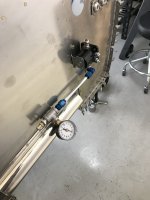
A pressure leak down test is so easy and so revealing to do. Combined with a bubble test and leak test fluid you can find every significant leak. It doesn’t take much pressure. Even 15 psi will work it just takes longer for bubbles to form or the pressure to fall on the gauge. I used this technique on every pressure line and found several leaks. Even one in the boost pump. At startup I had zero fluid leaks. I used 25 psi. The maximum tested pressure of an Imperial fuel valve is 30 psi.
Ken--as Mike says below, 25 psi is ok for a leak test for both tube and hose. A leak test is not necessarily a proof test at the working pressure the hose or tube, or the system will see. Typically a standard mechanical injection system will see 25-30 PSI on the discharge side. In our hose assemblies, we use the rated working pressure of the HOSE--in the case of -6 teflon its 3000 psi. Yep thats overkill, so we use 2000 for all sizes of teflon we use. Lower pressures take longer for leaks to potentially develop. We use the higher pressures to test the integrity of both the hose to fitting integration, and the fitting to adapter connection.