


Van's Air Force

The definitive Van's Aircraft support community! Buying, building or flying an RV? Join our exclusive family of mentors and enthusiasts!

Possible False Torque-Brake Mount Weldment (U-403) To Axil (RV-3,4,6,6A,7,7A,8A,9,9A)

Pmerems

Well Known Member
Advertiser
After 14 yrs and 500+ hours on my RV-7A (I know that is not a lot of hours in 14 yrs), I came across an issue during my condition inspection. This issue may effect RV-3, 4,6,6A,7,7A,8A,9,9A builders and owners.

This issue may have been addressed on the forum or by updates to the plans in the past, but I am not aware of it.

The issue is that during the inspection and removal of both of my main wheels, I discover some rotational movement of the U-403 Brake Flange Weldment (that is the Brake Caliper welded mount that is bolted to the Axil. I recall that when I installed the Weldment some 18 yrs ago there was no play. I assumed the play was a result of the nut losing some preload and I tightened it more. However when I tightened it did feel right. I decided to take the Shoulder Screw out and look more closely at the situation. I found that the Shoulder Screw shoulder was longer than the combined stack of the Washers (installed per print) and the U-403 Weldment outer diameter. I also noticed the washers under the head of the Should Bolt and the Washer that contacted the other end of the shoulder were embossed (gouged into) with either the head of the Should Bolt or the diameter of the Shoulder (nut side Washer). Additionally I measured the hole in the U-403 Weldment and fortunately I didn’t see any elongation of the hole.

This means that when tightening the Shoulder Screw the resistance felt during torqueing was the tightening on should of the Shoulder Screw and not clamping the U-403 Weldment to the axil.

The fix is simply to install an AN960-516L (thin washer) either under the head of the Shoulder Bolt or the Nut side. And make sure the shoulder is not protruding beyond the nut side AN960-516 Washer when installing the AN960-416 (1/4) Washer and Nut.

I believe this is not a flight critical issue but excess movement over time (due to braking or vibration) will enlarge the hole in the U-403 Weldment. I recommend upon your next conditional inspection or tire change, whichever comes first, remover the Shoulder Screw, inspect the washers for the evidence of the embossment (Gouge) and if required add the additional washer.

Please let the forum know if you find this issue.
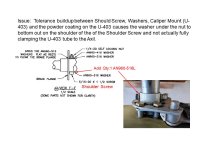
Shoulder Screw Issue.jpg
 
Yes, it's an area where you need to be very careful as it's very easy to jamb the washer on the end of the bolt which results in the nut tightening against the washer pushing against the step in the bolt and not securing the entire assembly.

On my own machine both of the brake flange collars came loose within the first 50 hours however I believe it was due to two things:

1. Possible insufficient torque on the nuts. I checked the washers for the above issue and they were clear of the bolts. There is also the possibility there were insufficient washers as you need to be sure to allow a little room for bolt stretch and everything crushing up. Its a fine line between getting it right and having enough safety on the nut.

2. I had an incident early in the life of the aircraft when the right wheel dropped into a large rabbit hole. Thankfully I was stopped and the hole collapsed under the weight of the aircraft however the aircraft came to rest on the wheel spat and this streched the hole in the brake flange collar. I replaced both collars as well as the bolts. So far (+150 hours later) all is good.
 
I believe some time ago I also was looking for some looseness in the wheel pant and found this same shoulder bolt issue to be the problem. The wheel pant bracket is also attached to the axle through this weldment via the shoulder bolt connection to the gear leg. An additional thin washer on the shoulder bolt along with new hardware seem to tighten everything up. I operate off a turf field and wheel pants take a beating. Got 980hrs TTAF.
 
Last edited:
I may be wrong, but I don't think the goal is to lock U-403 to the axle, but rather to be an anti-rotation bolt/assembly.
 
  • Like
Reactions: HFS
One thing I did was to use all metal locknuts instead of the nylock nuts on the collar bolt and on the bolts holding the wheel fairing brackets. They have not come loose in 7 yrs and 800 hrs. I had read once that the nylock nuts tend to loosen due to the braking heat generated.
 
One thing I did was to use all metal locknuts instead of the nylock nuts on the collar bolt and on the bolts holding the wheel fairing brackets. They have not come loose in 7 yrs and 800 hrs. I had read once that the nylock nuts tend to loosen due to the braking heat generated.
I started out with nylock nuts on the wheel pant brackets because that's what I had when building, that's what was called out on the drawing, and I figured I'd check and replace them of they loosened up. Eventually they did loosen up, somewhere around 1300 hours and probably 2000 landings later. Six metal 1/4-28 locknuts later, problem solved.
 
I was looking at this the other day as I was doing maintenance on the tires.
I was going to remove the whole brake assembly to clean it, but I am having troubles finding replacement 1/4-20 nylock at spruce.
Where are you guys sourcing yours?
 
I was looking at this the other day as I was doing maintenance on the tires.
I was going to remove the whole brake assembly to clean it, but I am having troubles finding replacement 1/4-20 nylock at spruce.
Where are you guys sourcing yours?
I don't believe you'll find UNC hardware at ACS. Try Home Depot, Lowes, ACE, etc. for 1/4-20 Nyloc Nuts...
 
I may be wrong, but I don't think the goal is to lock U-403 to the axle, but rather to be an anti-rotation bolt/assembly.

That's an interesting perspective, Walt. I'd not previously considered that and looking at the whole "shouldered close tolerance bolt" design you raise a good point. On the other hand, having any slop in the installation can only be detrimental as movement will accelerate wear on the collar, the bolt and eventually the leg. That bolt and that collar are instrumental in having brakes that work and wheelpants that don't rattle around.
 
After 14 yrs and 500+ hours on my RV-7A (I know that is not a lot of hours in 14 yrs), I came across an issue during my condition inspection. This issue may effect RV-3, 4,6,6A,7,7A,8A,9,9A builders and owners.

This issue may have been addressed on the forum or by updates to the plans in the past, but I am not aware of it.

The issue is that during the inspection and removal of both of my main wheels, I discover some rotational movement of the U-403 Brake Flange Weldment (that is the Brake Caliper welded mount that is bolted to the Axil. I recall that when I installed the Weldment some 18 yrs ago there was no play. I assumed the play was a result of the nut losing some preload and I tightened it more. However when I tightened it did feel right. I decided to take the Shoulder Screw out and look more closely at the situation. I found that the Shoulder Screw shoulder was longer than the combined stack of the Washers (installed per print) and the U-403 Weldment outer diameter. I also noticed the washers under the head of the Should Bolt and the Washer that contacted the other end of the shoulder were embossed (gouged into) with either the head of the Should Bolt or the diameter of the Shoulder (nut side Washer). Additionally I measured the hole in the U-403 Weldment and fortunately I didn’t see any elongation of the hole.

This means that when tightening the Shoulder Screw the resistance felt during torqueing was the tightening on should of the Shoulder Screw and not clamping the U-403 Weldment to the axil.

The fix is simply to install an AN960-516L (thin washer) either under the head of the Shoulder Bolt or the Nut side. And make sure the shoulder is not protruding beyond the nut side AN960-516 Washer when installing the AN960-416 (1/4) Washer and Nut.

I believe this is not a flight critical issue but excess movement over time (due to braking or vibration) will enlarge the hole in the U-403 Weldment. I recommend upon your next conditional inspection or tire change, whichever comes first, remover the Shoulder Screw, inspect the washers for the evidence of the embossment (Gouge) and if required add the additional washer.

Please let the forum know if you find this issue.

View attachment 77807
Nailed it --- but it's not a new finding; There was some discussion about this issue and the various resolutions back in 2008 or 9 IIRC. In fact, one gentleman suggested J.B. Weld to prevent the bolt from moving ( eye-roll ).

The root cause, as you suggested, is correct -- the nut "bottoms out" on the shoulder screw and the U-403 doesn't "see" the necessary torque, so it will rotate against the U-403 upon application of the brake. Given enough time, the holes in the U-403 will "wallow-out" and the wiggle of the wheel pants will be unacceptable.

The addition of an "L" washer is just enough to achieve the desired torque.

Also, consider removing the powder coating around the contact area -- It's possible that the PC can crush and deform over time, reducing the torque yield on the joint.
 
That bolt and that collar are instrumental in having brakes that work and wheelpants that don't rattle around.

AGREE!
 
I found this very same issue in reverse on my RV6A nose leg to motor mount BOLT. The bolt was just short enough that the shoulder on the nut side did NOT pass through the socket causing 100% shear load to be applied to only one side of the bolt and socket hole. This situation will cause the head side of the hole in the mount to wear and cause side play in the nose gear.

I went one size longer than the stock bolt and then added a washer so the shoulder then extended through the nut side of the socket and the nut can be torqued.
 
I started out with nylock nuts on the wheel pant brackets because that's what I had when building, that's what was called out on the drawing, and I figured I'd check and replace them of they loosened up. Eventually they did loosen up, somewhere around 1300 hours and probably 2000 landings later. Six metal 1/4-28 locknuts later, problem solved.
I don’t think in the long-term you solved the problem by using all steel Lock nuts
I believe the nuts are shielded from heat enough that it is not having an effect on the nylon nuts and allowing them to back off

What the actual problem is is the use of aluminum spacer bushings between the bracket and the brake flange. There is a lot of shaking and vibration on the wheel pan, which translates into the bracket and through these bushings and bolt hardware.
Overtime the dimensional length of the aluminum bushings becomes less through plastic deformation.
At some point a few years ago, these parts were changed to steel bushings.
If you do that, even with Nyla nuts, things will no longer get loose.
 
I don’t think in the long-term you solved the problem by using all steel Lock nuts
I believe the nuts are shielded from heat enough that it is not having an effect on the nylon nuts and allowing them to back off

What the actual problem is is the use of aluminum spacer bushings between the bracket and the brake flange. There is a lot of shaking and vibration on the wheel pan, which translates into the bracket and through these bushings and bolt hardware.
Overtime the dimensional length of the aluminum bushings becomes less through plastic deformation.
At some point a few years ago, these parts were changed to steel bushings.
If you do that, even with Nyla nuts, things will no longer get loose.

Scott,

You're referring to the other issue with the U-408 spacers (DWG C2, Zone D-6).
They WERE supposed to be replaced in 2019 or so with Steel; this didn't happen AFAIK. U-408 is still called out as a make-it-yourself from aluminum tube.

OP is referencing the issue with the U-403 and the hair-too-long shoulder screw.

B
 
I don’t think in the long-term you solved the problem by using all steel Lock nuts
I believe the nuts are shielded from heat enough that it is not having an effect on the nylon nuts and allowing them to back off

What the actual problem is is the use of aluminum spacer bushings between the bracket and the brake flange. There is a lot of shaking and vibration on the wheel pan, which translates into the bracket and through these bushings and bolt hardware.
Overtime the dimensional length of the aluminum bushings becomes less through plastic deformation.
At some point a few years ago, these parts were changed to steel bushings.
If you do that, even with Nyla nuts, things will no longer get loose.
I would agree with you Scott, except for what I found in this case when investigating loose wheel pants. Loose pants turned out to be caused by the 3 bolts holding each pant bracket being loose….both sides. While tightening the bolts, I discovered the nylock nuts could be turned on the bolts with two fingers…..no wrench on the nut was required. There was essentially zero friction drag from the nylock nuts. The nylon insert on the nuts had taken enough heat up / cool down cycles (or just got too hot one time) that it lost almost all ability to provide any nut retention friction. And, the wheel pants brackets were likely never removed from the landing gear once installed during aircraft final assembly…..so the nuts didn’t get worn out that way.

While I haven’t personally run into the aluminum spacers annealing and taking a compression set, causing the bolts to loose clamping load, I know it is entirely possible. Don’t remember if my spacers are aluminum or steel.
 
Scott,

You're referring to the other issue with the U-408 spacers (DWG C2, Zone D-6).
They WERE supposed to be replaced in 2019 or so with Steel; this didn't happen AFAIK. U-408 is still called out as a make-it-yourself from aluminum tube.

OP is referencing the issue with the U-403 and the hair-too-long shoulder screw.

B
I know the issue the OP posted about is different, but the thread drifted into other issues as well.
I was responding to one of those posts.
Yes there were supposed to change and I thought they had.
 
I would agree with you Scott, except for what I found in this case when investigating loose wheel pants. Loose pants turned out to be caused by the 3 bolts holding each pant bracket being loose….both sides. While tightening the bolts, I discovered the nylock nuts could be turned on the bolts with two fingers…..no wrench on the nut was required. There was essentially zero friction drag from the nylock nuts. The nylon insert on the nuts had taken enough heat up / cool down cycles (or just got too hot one time) that it lost almost all ability to provide any nut retention friction. And, the wheel pants brackets were likely never removed from the landing gear once installed during aircraft final assembly…..so the nuts didn’t get worn out that way.

While I haven’t personally run into the aluminum spacers annealing and taking a compression set, causing the bolts to loose clamping load, I know it is entirely possible. Don’t remember if my spacers are aluminum or steel.
If the buts were that loose, then that definitely was a problem.
Dimensional change of the spacers is as well.
 
From an engineering perspective, shouldn't this be a 100% shear load case? The fit of the bolt through all parts should be reamed and interference fit resulting in zero slop. The nut is only there to prevent the bolt from backing out. If one needs to crush the bracket onto the axle to keep it from moving then the holes were not prepared correctly.
 
From an engineering perspective, shouldn't this be a 100% shear load case? The fit of the bolt through all parts should be reamed and interference fit resulting in zero slop. The nut is only there to prevent the bolt from backing out. If one needs to crush the bracket onto the axle to keep it from moving then the holes were not prepared correctly.
Yes I agree, but these were all pre-drilled holes so not a builder error and most that I’ve seen, including my own have a small amount of play.
 
Yes I agree, but these were all pre-drilled holes so not a builder error and most seem to have a small amount of play.
Good to know... I just bought a set of these brackets and assumed they were drilled undersized for a ream to fit. I guess I'll weld the holes up and start from scratch or plan to go oversize on the fastener. I still stand by "holes not prepared correctly" - but direct it to the factory.
 
Good to know... I just bought a set of these brackets and assumed they were drilled undersized for a ream to fit. I guess I'll weld the holes up and start from scratch or plan to go oversize on the fastener. I still stand by "holes not prepared correctly" - but direct it to the factory.
Not sure it's worth the effort, mine have had the same amount of play since new. I've never had any wheel pant issues, and I tend to use my Grove brakes pretty heavily if needed.
 
If the buts were that loose, then that definitely was a problem.
Dimensional change of the spacers is as well.
Regardless if those were nuts or buts that were loose, the results could be the same with either! You need to be sure your nuts and buts are all snug prior to flight!
 
From an engineering perspective, shouldn't this be a 100% shear load case? The fit of the bolt through all parts should be reamed and interference fit resulting in zero slop. The nut is only there to prevent the bolt from backing out. If one needs to crush the bracket onto the axle to keep it from moving then the holes were not prepared correctly.

I agree.
The purpose of a shoulder bolt is to not be able to torque it down tight. If the designer wanted it torqued, the fastener would have been an AN or similar. If there is slop in the hole, Clamping it tight will do very little to hold it tight against the sheer load of application of brakes. Clamping on a round tube is very ineffective.
I had revisited all this recently, including changing the spacers to steel as Scott mentions in post #16, due to gear shimmy that suddenly appeared. I put in a modified washer (ground flat on one side) to keep the bolt head and nut off the radius of the weld (per the plans) and to keep the shoulder bolt from having any slop axially in and out. I made sure I was not clamping it together.
 
Last edited:
Back
Top
