Van's Air Force

The definitive Van's Aircraft support community! Buying, building or flying an RV? Join our exclusive family of mentors and enthusiasts!

Plane Power Alternator Failure - Redux...Redux...

Balance is always two planes for best result, but the rpm is not the rated or max. Turbocharger wheels are balanced on the same type machine and it would be impossible to spin them anywhere near operating speeds due to the power required. I dont know what the machines are but i have had and see many turbocharger wheels and they worked fine in operation. The compressor is balanced with two planes separately from the turbine wheel with integral shaft.

Wheels with tires are a different matter relative to the RPM. It is common that internal belt separations and other weird expansion shapes of the tire take place at speed. My professor in engineering worked for a famous tire company and while working on a problem had 100 tires x-rayed. Not a single tire had the belt aligned in the fused tire. Funny, said I, I never found one that was close to being balanced and recommended customers use another brand. Not so with metal parts.
I hadn't considered the dynamic-dynamics of the tire -vs- stable-constant mass distribution within a rotor. Good point.

So - all things being equal - Care to hazzard a guess as to why the B&C rotors have sooooo much more work done -vs- the Plane Power/Unipoint?
 
.

So - all things being equal - Care to hazzard a guess as to why the B&C rotors have sooooo much more work done -vs- the Plane Power/Unipoint?
I think that would be difficult to do and still be nice and civil. The question alone should be screaming at our community on which product they should not be purchasing.
 
I think that would be difficult to do and still be nice and civil. The question alone should be screaming at our community on which product they should not be purchasing.
A better question still is why vans has continued to sell them for so long. The uninformed builder would count that as an endorsement of suitability, reliability and (perhaps) value for money.
 
A better question still is why vans has continued to sell them for so long. The uninformed builder would count that as an endorsement of suitability, reliability and (perhaps) value for money.
Humans seem to have an innate resistance to change. My guess is that vans always assumed this was a quality product and likely has not received much feedback that this assumption may be incorrect. If you share some of your frustration with replacing $1600 Alternators every 200 hours, I suspect they may respond with changes.
 
Humans seem to have an innate resistance to change. My guess is that vans always assumed this was a quality product and likely has not received much feedback that this assumption may be incorrect. If you share some of your frustration with replacing $1600 Alternators every 200 hours, I suspect they may respond with changes.
Happy to give them the benefit of the doubt. But I also find it hard to believe they are oblivious to the issue when there’s a new thread here every few weeks. Are you suggesting that none of these owners mentioned it to them? Seems a stretch but not impossible I suppose.

One thing that is clear though is that the majority of builders trust vans to provide a suitable alternator in their FWF kits without doing any research. Even the most superficial research would not only suggest that there are cheaper, but also more reliable alternatives.
 
It's an older unit - so It may not have any of the "improvements" that Hartzell has (claimed to have) made.

1. Stator Retention -- HET claims to have improved upon the retention mechanism of the stator in the DE bracket. The ND stock unit holds the stator in place with 2 flanged studs. The HET/PP unit is a 100mm O.D. Lam-stack stator but I can't figure out how it's held in place beyond the flanged-studs...maybe glue? I've heated it to 400°F, frozen it, hit it with a hammer, spoken harsh words, etc., still hasn't come apart. Going to split it apart with a cut-off tool this morning...will report back.

2. SRE bearing -- Older units appear to have a 32x9x15mm bearing with expansion compensation (i.e. outer race of bearing has two machined channels with elatomeric/plastic compound pressed in). Newer units ones use a plain bearing (6002). ND base (101211-2130/3030) uses a 32x11x15mm bearing; custom size "W"ide 6002 series.

3. Rotor balance -- No claims here, but the rotor shows evidence of at least static balancing. There are a couple of videos on YouTube that show various machines balancing rotors at speeds far less than what we operate (max 9327RPM) . E.g.
-- stop video at 0:00:13. Again, I'm not a mech-E, but it seems to me the rotors should be dynamically balanced, at least 2 planes, at the intended speed of operation.
I guess I'll budget for a new B&C unit, then. Based on previous posts I've seen on VAF, I get the impression Hartzell isn't interested in supporting their products outside their warranty period. Which is too bad. I would have been willing to shell out a bit of coin to have them refurb my unit to incorporate the latest improvements. Oh well...
 
"At receipt unit rectifier assembly is damaged. Various washers and single rectifier to stator connection screw missing. Appears customer has been inside unit. Unable to determine if led to failure."

Because he added a blast tube retention of his own design to the rear housing, and then, subsequent to the failure, he removed the rear cover to ascertain the extent and nature of the failure, they denied his claim.

Reach out to him for further details. PM if you need his contact information for RMA/Record details.
Freaking ridiculous. A basic FMEA should easily reveal the failure mode was not attributable to the removal of the back cover. The "new and improved" Hartzell is just grasping at straws looking for excuses to deny warranty claims.
 
Happy to give them the benefit of the doubt. But I also find it hard to believe they are oblivious to the issue when there’s a new thread here every few weeks. Are you suggesting that none of these owners mentioned it to them? Seems a stretch but not impossible I suppose.

One thing that is clear though is that the majority of builders trust vans to provide a suitable alternator in their FWF kits without doing any research. Even the most superficial research would not only suggest that there are cheaper, but also more reliable alternatives.
I doubt anyone from vans spends much time here. When builders have issues, they call PP as well as post here. Why would someone call Vans when their alternator dies a year or two after completing their build. I could easilly be wrong on this, but my guess is that vans gets little feedback on this issue.
 
Here's the stator freed from the DE bracket.

View attachment 89852

I had to use the cut-off tool. As I mentioned earlier, even the careful application of profanity along with a hammer couldn't do the job...

I'm pretty confident that the issue (?!) of the stator slipping & moving within the DE bracket has been resolved with the use of flanged studs, and whatever adhesive they applied to the outside of the lam-stack.
When you reassemble this unit are you going to use stainless gear clamps. If so place some insulation between the clamp and the aluminum housing to prevent corrosion. Stainless steel and aluminum don't party well together.
 
When you reassemble this unit are you going to use stainless gear clamps. If so place some insulation between the clamp and the aluminum housing to prevent corrosion. Stainless steel and aluminum don't party well together.

Just reminded me of a line from the movie "Short Circuit (1986)."

"Number 5 is alive! No disassemble!"

In this case, #5 is quite dead - and on its way to the metal recyclers...
 
Freaking ridiculous. A basic FMEA should easily reveal the failure mode was not attributable to the removal of the back cover. The "new and improved" Hartzell is just grasping at straws looking for excuses to deny warranty claims.
I'll bet Hartzell's "basic FMEA" revealed that the failure was directly attributable to the owner's failure to properly torque the "back cover" screws.

As I reported yesterday, those screws do not just hold the cover. They complete the ground circuit to the rectifier bridge, and if you leave them loose, you'll get high resistance and eventually a meltdown.

Warranties never cover owner negligence. This is like you installing an aftermarket stereo in your car, and your wiring job caused an electrical short, and you then trying to get warranty coverage to get it repaired.
 
Last edited:
I'll bet Hartzell's "basic FMEA" showed that the failure was directly attributable to the owner's failure to properly torque the "back cover" screws.

As I reported yesterday, those screws do not just hold the cover. They complete the ground circuit to the rectifier bridge, and if you leave them loose, you'll get high resistance and eventually a meltdown.

Warranties never cover owner negligence. This is like you installing an aftermarket stereo in your car, and your wiring job caused an electrical short, and you then trying to get warranty coverage to get it repaired.

It actually didn't -- "Unable to determine if [missing screw(s)] led to failure."

However, I am in complete agreement with you -- if those three screws were loose and there was the slightest gap between the cover, the rectifier ferrules, and the SRE bracket, it would have ( and appears to have ) caused all manner of arcing as the 14.5V @ ~60A worth of charge carriers made their way back into the rectifier.

I won't say that he didn't install them, he's a darn good builder (Bronze Lindy winner) after all -- but it's entirely possible that they weren't torqued and the glue (blue loktite) wasn't put on the threads. It's just a matter of time (~248 hours) before they backed out and everything went pear shaped...
 
I won't say that he didn't install them, he's a darn good builder (Bronze Lindy winner) after all --
As I figured out fairly recently, 'fabricator' and 'mechanic' are different skill sets and both rarely possessed by one person. I worked in a wind tunnel model shop for 20 years and could never understand why some excellent fabricators had no clue about screw spacing, appropriate screw diameter, and feel for torque; whereas some good mechanics were terrible at fabrication.
 
Oh I am...but I think cutting the case in half made the unit beyond economic repair. It served its purpose.
Looking at the case it looked like a couple of cheap hose clamps would hold it together, could be saved though for a demo unit for the class room.
 
As I figured out fairly recently, 'fabricator' and 'mechanic' are different skill sets and both rarely possessed by one person. I worked in a wind tunnel model shop for 20 years and could never understand why some excellent fabricators had no clue about screw spacing, appropriate screw diameter, and feel for torque; whereas some good mechanics were terrible at fabrication.
I suspect this is part of the reason modern automotive engine bays are designed such that things that were considered relatively moderate maintenance now require dropping the entire engine from underneath the vehicle to be able to put a wrench on some of the screws.
 
So, that was a DRP on my part - apologies.

Noteworthy, the automotive test tools (D&V electronics, ALT-198) show a maximum of 6000 RPM. For complete accuracy, we would need to find the spec that Stellantis (nee Chrysler) and Toyota wrote in 1960.

The bearings in the HET/PP (NTN) are spec'd to 20,000 RPM.
I have typically seen 10,000 to 12,000 RPM ratings, but I suspect the manufacturer made that based on the bearing rating. When looking at bearing ratings, sideloads (radial loads) are important. The sideloads typically are from the belt tension. Over tension the belt, and the bearings can have higher rotational loads and overheat. All spell a shorter life for the bearing.
 
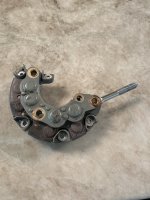
Another member of our VAF community sent me his Plane Power AL12-EI60 to autopsy -- I don't think this one is much of a mystery; Clearly Colonel Mustard did it, in the library, with the candlestick :)

J'accuse le redresseur!

IMG_7532.jpg

Whipping out the good old Fluke 87 Mark 5, I measured all the diodes and found that all but 2 had failed -- one of the stator windings and the center node of the stator windings -- so this alternator was down to 1 phase (out of 3) rectified DC, and a bunch of AC being put out onto the buss; ugly...

As to root cause -- not a clue. There's no scorching or burns anywhere on the cover, all of the stator and rotor windings measure the correct Ohms, the copper slip rings and brushes show almost no wear (not detectable with my calibrated Mark 1 eyeballs and fingernail). The rotor, pulley are secure, stable and no "wobble" is evident. The only indication of over temperature is the high side rectifier plate.

From a progressive failure signature, I suspect that the amount of "whine" heard in the headsets was pretty severe, and ultimately the OV-crowbar protection in the regulator kept tripping (this was confirmed by the owner.)
 
Another member of our VAF community sent me his Plane Power AL12-EI60 to autopsy -- I don't think this one is much of a mystery; Clearly Colonel Mustard did it, in the library, with the candlestick :)

J'accuse le redresseur!

View attachment 90167

Whipping out the good old Fluke 87 Mark 5, I measured all the diodes and found that all but 2 had failed -- one of the stator windings and the center node of the stator windings -- so this alternator was down to 1 phase (out of 3) rectified DC, and a bunch of AC being put out onto the buss; ugly...

As to root cause -- not a clue. There's no scorching or burns anywhere on the cover, all of the stator and rotor windings measure the correct Ohms, the copper slip rings and brushes show almost no wear (not detectable with my calibrated Mark 1 eyeballs and fingernail). The rotor, pulley are secure, stable and no "wobble" is evident. The only indication of over temperature is the high side rectifier plate.

From a progressive failure signature, I suspect that the amount of "whine" heard in the headsets was pretty severe, and ultimately the OV-crowbar protection in the regulator kept tripping (this was confirmed by the owner.)
This just confirms that even when all of the known issues are absent, the auto self destruct feature of the PP still kicks in. Given their no repair stance, i am beginning to think this is a marketing driven thing. What a great way to drive revenue.

I think we can save you a whole bunch of time if we all just agree that these things are just a sub par implementation of an alternator.
 
Good thing the Denso alternators work so good, no stupid STC needed and doesnt brake your bank, work good last long time
 
My thing I repeat like a Parrot:
Balance Your Prop (vibrations wears everything out)
Reduce heat - Provide cooling Air and Heat Shields from radiant heat off exhaust pipes.
Remove, Inspect, Repair - Every condition inspection, brushes and as DanH said bearing Play.


To bjdecker, OP. Not saying you did anything wrong with your installation or maintenance. Thank you for posting this teardown. I have seen alternator failures, but this was nasty. Glad you are OK. PP not accepting warranty, I 2nd your comment.......Boo Hartzell, Boo...

Thanks Jack - I just did the autopsy, I didn't experience the failure first hand. The owner of this unit experienced "badness" inflight, but was able to land successfully.

and keep on Parroting -- reduce heat, reduce vibrations, inspect-inspect-inspect...
 
If I had to pull off the alternator every annual to inspect, I'd be looking for a better product.
(never pulled my B&C and never had one fail, guess I'm just lucky)
Might as well pull the mags and inspect them while you're at it, of course then you wouldn't be able to complain about checking them every 500 hrs.
 
If I had to pull off the alternator every annual to inspect, I'd be looking for a better product.
(never pulled my B&C and never had one fail, guess I'm just lucky)
Might as well pull the mags and inspect them while you're at it, of course then you wouldn't be able to complain about checking them every 500 hrs.
Think of the additional business that would drive! $$$$
 
If I had to pull off the alternator every annual to inspect, I'd be looking for a better product.
(never pulled my B&C and never had one fail, guess I'm just lucky)
Might as well pull the mags and inspect them while you're at it, of course then you wouldn't be able to complain about checking them every 500 hrs.
Aviation safety requires inspections…. Rather find a noisy bearing at annual than lose an alternator in flight. Just loosen the tensioner so you can turn and feel the pulley buy hand. Aerotech, B&C, PP I don’t care what alternator you have that’s an easy check.
 
Another member of our VAF community sent me his Plane Power AL12-EI60 to autopsy -- I don't think this one is much of a mystery; Clearly Colonel Mustard did it, in the library, with the candlestick :)

J'accuse le redresseur!

View attachment 90167

Whipping out the good old Fluke 87 Mark 5, I measured all the diodes and found that all but 2 had failed -- one of the stator windings and the center node of the stator windings -- so this alternator was down to 1 phase (out of 3) rectified DC, and a bunch of AC being put out onto the buss; ugly...

As to root cause -- not a clue. There's no scorching or burns anywhere on the cover, all of the stator and rotor windings measure the correct Ohms, the copper slip rings and brushes show almost no wear (not detectable with my calibrated Mark 1 eyeballs and fingernail). The rotor, pulley are secure, stable and no "wobble" is evident. The only indication of over temperature is the high side rectifier plate.

From a progressive failure signature, I suspect that the amount of "whine" heard in the headsets was pretty severe, and ultimately the OV-crowbar protection in the regulator kept tripping (this was confirmed by the owner.)
How many hours on this one? How old was it?
 
Aviation safety requires inspections…. Rather find a noisy bearing at annual than lose an alternator in flight. Just loosen the tensioner so you can turn and feel the pulley buy hand. Aerotech, B&C, PP I don’t care what alternator you have that’s an easy check.
So, why don’t you also pull all of the cylinders and check that the rod bolts are still tight each year? Some items are trustworthy and don’t need to be checked every year and some are not. How often do you pull off your accessory case and check the oil pump? Arguably the most safety critical component in your engine. Decisions have to be made. If I had a pp, i am sure i would check it at least every year, as they cannot be trusted. In reality , I would NEVER have one on my plane. My ND alternator has already given 1400 hours of service with no bearing issues, so why check it every year. When it finally dies, it will probably not be from failed bearings or the sre housing eating itself to death.
 
So, why don’t you also pull all of the cylinders and check that the rod bolts are still tight each annual. Some items are trustworthy and don’t need to be checked every year and some are not. How often do you pull off your accessory case and check the oil pump? Arguably the most safety critical component in your engine. Decisions have to be made. If I had a pp, i am sure i would check it at least every year, as they cannot be trusted. In reality , I would NEVER have one on my plane. My ND alternator has already given 1400 hours of service with no bearing issues, so why check it every year.
Because it takes 3 minutes. I don’t follow your oil pump and connecting rod checks…. Why even do a pre-flight with your logic?
 
Because it takes 3 minutes. I don’t follow your oil pump and connecting rod checks…. Why even do a pre-flight with your logic?
You said “aviation safety requires checks.” Why is the alternator so important but not the other things i mentioned. My primary point was that all alternators do not need checks, just like oil pumps don’t need checks because their history is solid. That is not the case with pp, so THEY need checks, not necessarily all alternators.
 
You said “aviation safety requires checks.” Why is the alternator so important but not the other things i mentioned. My primary point was that all alternators do not need checks, just like oil pumps don’t need checks because their history is solid. That is not the case with pp, so THEY need checks, not necessarily all alternators.
Im gonna respectfully disagree. Inspection items that are easy to do at annual can catch a bad problem before it gets worse. We don’t “inspect” the oil pump…. But we do cut open filters, and use that information to determine if we need to inspect or IRAN an engine. And we do that filter check much more frequently than at annual because it is critical as you say.
 
Get a B&C and you won't have this problem again.
That's what I did when my PP failed with only 226 hours. PP covered it under warranty with a new one but I opted to sell it and offset the cost of the B&C. When I spoke to a guy at PP (prior to Hartzell), he admitted the design of the internally regulated PP alternators were not the best.
 
Good thing the Denso alternators work so good, no stupid STC needed and doesnt brake your bank, work good last long time
Why would you need a STC for experimental certified aircraft? They are only for type certified. Maybe I am missing your point...
 
Aviation safety requires inspections…. Rather find a noisy bearing at annual than lose an alternator in flight. Just loosen the tensioner so you can turn and feel the pulley buy hand. Aerotech, B&C, PP I don’t care what alternator you have that’s an easy check.
I don't believe it's the bearing itself that fails; (see post #1) the bearing starts to rotate in the case which then leads to a multitude of failures.
Simply turning the pully won't find that problem.
 
I don't believe it's the bearing itself that fails; (see post #1) the bearing starts to rotate in the case which then leads to a multitude of failures.
Simply turning the pully won't find that problem.
You have to apply a side load while you’re turning to check for end play. Just rotating the shaft with no side load won’t catch bearing problems
 
Hard to say without breaking it open -- the older serial number implies that it is a pre-Hartzell unit -- < 2014 or so.
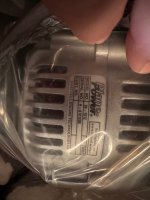
This is mine. The ID plate states pretty clearly that it’s a Hartzell unit. Does this help?
 

Attachments

  • IMG_4464.jpeg
    IMG_4464.jpeg
    1.5 MB · Views: 22
Back
Top