

Van's Air Force
You are using an out of date browser. It may not display this or other websites correctly.
You should upgrade or use an alternative browser.
You should upgrade or use an alternative browser.
Phillips 66 Aviation Anti-Rust Oil 20W50
- Thread starter Joe Jet
- Start date

Quote:Because it’s mineral oil, does not have AD additives . It’s assumed that you’re running Ashless Dispersant oil regularly.
You can use up to 10% as a supplement your oil change.
| Phillips 66 Aviation Antirust Oil is a rust preventive oil specially formulated to help protect aircraft piston engines against rust and corrosion during extended periods of inactivity. Airframe manufacturers have used it for many years as “Fly Away Oil” for new or rebuilt aircraft engines that are expected to sit idle for extended periods of time. Aviation Antirust Oil may be used as “break-in oil” where an all-mineral oil is desired, and is particularly suited for situations where the engine to be broken in may not be immediately put into regular service. When preparing an aircraft for storage, drain the used engine oil and refill with Aviation Antirust Oil. Start the engine and warm it up to normal operating temperature to ensure that the new oil is fully circulated throughout the engine and allowed to coat all engine parts. For best results, fly the aircraft prior to storage. Covering exhaust and intake ports is recommended to minimize exposure to moisture during storage. Aviation Antirust Oil is not designed to be an everyday operational engine oil in aircraft that are flown frequently. It does not contain ashless dispersant additives. Operation time on this oil should not exceed 10 hours. When returning the plane back to normal operation after storage, this oil should be replaced with regular operational engine oil such as Phillips 66 X/C® 20W-50 Aviation Oil. Aviation Antirust Oil is compatible with our other aviation engine oils, and may be used as a “supplement” to those products to enhance rust and corrosion protection when used in infrequently flown aircraft, particularly where high humidity is a concern. When used as a supplement, we recommend replacing up to 10% of the crankcase volume with Aviation Antirust Oil in place of the normal operational engine oil. |
That is not the reason. Philips sells straight mineral oil without AD and carries no limits. Perfectly safe, just allows for sludge buildup. The anti corrosion additives are not well suited to lubrication and will create wear problems if used too long. Think adding a quart of corrosion X or wd-40 to your engine oil.Because it’s mineral oil, does not have AD additives . It’s assumed that you’re running Ashless Dispersant oil regularly.
You can use up to 10% as a supplement your oil change.

About a decade ago, I replaced my engine because of a cracked crankcase when I lived and was based in Pennsylvania. I was able to "break-in" the engine part way (maybe all the way) but did not want the new engine to sit without running for weeks at a time. (would be more than a month) I used Phillips 20W50 Anti-Rust in late fall right before the possibility that the airplane may sit and not fly for weeks. I did fly the airplane a few times before spring. In the spring when I knew I would be flying more often, I drained the 20W50 Anti-Rust and went back to Phillips 20W-50M. After I had 50 hours on the engine, I then used Phillips X/C 20W50.
Last edited:
That’s what I read says it in their own literatureThat is not the reason. Philips sells straight mineral oil without AD and carries no limits. Perfectly safe, just allows for sludge buildup. The anti corrosion additives are not well suited to lubrication and will create wear problems if used too long. Think adding a quart of corrosion X or wd-40 to your engine oil.
Aviation_Anti-Rust_Oil.pdf
Attachments

From the horses mouth, non-AD oil isn’t considered everyday oil. See attached screenshot reply from Phillips.That is not the reason. Philips sells straight mineral oil without AD and carries no limits. Perfectly safe, just allows for sludge buildup. The anti corrosion additives are not well suited to lubrication and will create wear problems if used too long. Think adding a quart of corrosion X or wd-40 to your engine oil.
Attachments
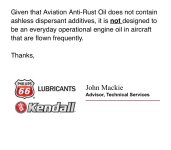
Well that may be true and I agree that AD oil should be used, but some do not.. However, simply leaving out the AD additive does not add any anti corrossion properties. They are also adding something to this oil to provide the anti corossion properties and pretty sure it doesn't have the same lubricating properties as the oil itself. So, I suggest there is another reason that it is not recommended for general use, even if they didn't chose to put it in the warning.From the horses mouth, non-AD oil isn’t considered everyday oil. See attached screenshot reply from Phillips.
Philips already sells an oil that simply leaves out the AD; They call it break in oil. They wouldn't re-label the same thing and call it anti-corossion oil with a promise to prevent corossion.
Just ask philips if they put something else in the oil to provide these properties.
Phillips already listed it in the PDF posted in post # 7.Well that may be true and I agree that AD oil should be used, but some do not.. However, simply leaving out the AD additive does not add any anti corrossion properties. They are also adding something to this oil to provide the anti corossion properties and pretty sure it doesn't have the same lubricating properties as the oil itself. So, I suggest there is another reason that it is not recommended for general use, even if they didn't chose to put it in the warning.
Philips already sells an oil that simply leaves out the AD; They call it break in oil. They wouldn't re-label the same thing and call it anti-corossion oil with a promise to prevent corossion.
Just ask philips if they put something else in the oil to provide these properties.
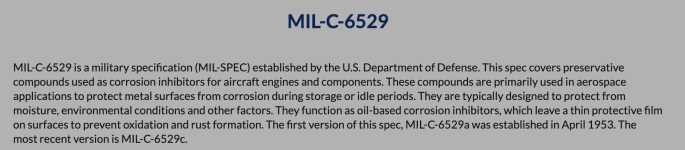
U.S. Military Specification MIL-C-6529C

I did a simple experiment with Coretech’s oil preservative and Aeroshell 15-50.
I put a couple fo tablespoons of each in the bottom of a plastic container and set them out in the rain.
The preservative immediately reacted to each drop of rain forming odd white pustules, for lack of better description.
The 15-50 seemed to “absorb”’the rain drops.
After a few minutes, I took each sample and whipped it with a stir stick. The preservative did nothing. The white pustules held together.
The water in the Aeroshell emulsified and turned the oil cloudy, as I would expect oil to do.
Not scientific, just an observation. There is definitely something different going on with the preservative and I wouldn’t want that stuff circulating around inside a running engine for long.
Draw your own conclusions, if you wish.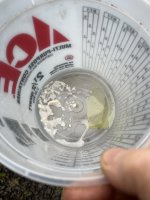
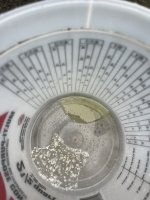
I put a couple fo tablespoons of each in the bottom of a plastic container and set them out in the rain.
The preservative immediately reacted to each drop of rain forming odd white pustules, for lack of better description.
The 15-50 seemed to “absorb”’the rain drops.
After a few minutes, I took each sample and whipped it with a stir stick. The preservative did nothing. The white pustules held together.
The water in the Aeroshell emulsified and turned the oil cloudy, as I would expect oil to do.
Not scientific, just an observation. There is definitely something different going on with the preservative and I wouldn’t want that stuff circulating around inside a running engine for long.
Draw your own conclusions, if you wish.
Thanks for that and adding some experimentation to the point. Preservative oil is good at keeping water away from metal and engine oil is good at lubricating parts and preventing contact wear. Two completely different things that can’t really be done at the same time. If that were possible, the industry would have made us that product and we would have been using it for the last 50 years. Corrosion in engines has been around since engines were developed..
Not scientific, just an observation. There is definitely something different going on with the preservative and I wouldn’t want that stuff circulating around inside a running engine for long.
Draw your own conclusions, if you wish.
