Van's Air Force

The definitive Van's Aircraft support community! Buying, building or flying an RV? Join our exclusive family of mentors and enthusiasts!

PCU5000X Lever Arm Travel

Karetaker

Well Known Member
Howdy Everyone. I am getting ready for first flight and am doing the static RPM checks. I was able to get static RPM up to 2580 - 2600 by adjusting the governor lever arm. (Ran out of travel on the low pitch stop adjustment screw.) I want to tweak it more but I noticed that when I pull the propeller control all the way back, the lever arm is no where near the high pitch stop. My question is, how close do I need the governor lever arm to the high pitch stop? Or, will the RPM get low enough in flight long before the stop is reached?

Another question: when moving the governor lever from stop to stop, how far does the mounting hole for the cable move? (what is the total throw of the arm at the connecting rod hole?) I wonder if my cable needs more travel...

I believe I may have to do a combo of loosening the 6 screws, rotate the cap assembly and re-clock the arm. I want to be sure static RPM is limited by the prop stops and not the governor.

Much obliged.
 
Howdy Everyone. I am getting ready for first flight and am doing the static RPM checks. I was able to get static RPM up to 2580 - 2600 by adjusting the governor lever arm. (Ran out of travel on the low pitch stop adjustment screw.) I want to tweak it more but I noticed that when I pull the propeller control all the way back, the lever arm is no where near the high pitch stop. My question is, how close do I need the governor lever arm to the high pitch stop? Or, will the RPM get low enough in flight long before the stop is reached?

Another question: when moving the governor lever from stop to stop, how far does the mounting hole for the cable move? (what is the total throw of the arm at the connecting rod hole?) I wonder if my cable needs more travel...

I believe I may have to do a combo of loosening the 6 screws, rotate the cap assembly and re-clock the arm. I want to be sure static RPM is limited by the prop stops and not the governor.

Much obliged.
Do NOT reclock that arm on the splined shaft without making sure you understand what you're doing. When it rotates, the shaft moves in/out which is what adjusts RPM. if you reclock the arm it's possible to get it to hit the stops before you get appropriate full movement on the shaft, which will cause all kinds of havoc on achievable rpm. It's also possible to damage the o-rings that are installed on the shaft if you get it wrong. There is a min & max dimension for shaft in/out travel called out in the assembly manual, but that's typically something that's set up for you at the prop shop when they put the governor together so if you don't screw around with taking the arm off the shaft you don't have to worry about it.

You need to figure out the linkage and throw. Yes, the RPM will get low enough that you won't be hitting that stop in flight, but you should rig it so that the lever hits the stops on both ends before you run out of travel on the blue knob. Just like mixture and throttle.

Loosen the 6 screws and the inner assembly, which includes the splined shaft, arm and stops all rotate as a unit. That's how you clock it. There's also a torque spec in the manual for those 6 screws. Easy to overdo it and strip them out, but friction is the only thing keeping everything where you want it, so make sure you get them tightened back up appropriately.
 
In general:

Yes = The PCU/Jihostroj prop gov's lever orientation can be adjusted as you describe by loosening and rotating the inner assmebly.

Don't know = Mounting hole cable movement but that value is not independent. There are other parameters that could be in play like throttle type (its related throw), cable routing, etc.

Obviously, the kinematics are off. Any actuation should be limited at the device vs the control. Orient the prop gov arm to its optimal position; ~ equal angle at stops versus neutral/perpendicular to cable. Then measure the throw there A, versus the prop control throw B. If B is less than A, then some massaging will be needed. If no other mounting holes are available in either arm, you wouldn't be the first to have to add one. If using vernier controls, you may have to order one with a longer actuation length.
 
Thanks for the feedback. I understand how the governor works: I would not jack with it if I did not. The distance between the end of the speed adjusting shaft and the case body is .45" minimum, otherwise, as noted, O-ring damage is possible. Desert Rat you described what was happening: I ran out of travel at the governor lever before full RPM. Once I re-clocked the lever, the speed adjusting shaft allowed the pilot valve plunger to un-cover the ports in the driver gear shaft and as a result I gained around 500 RPM. But now I noticed I can't pull back and get near the high pitch stop. I can measure the throw of the arm from stop to stop and figure out if I need to drill a new hole on my quadrant; I was asking if anyone knew that number so I can do some math now while away from the hangar.

I will plan to start from scratch and go through the entire control system. My gut tells me I need to add a new hole in my quadrant arm and reposition the governor control lever and re-clock the control head.
 
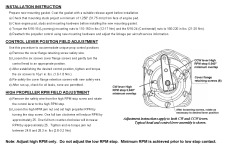
This is on my mind since I too have been tweaking my PCU5000 governor stop recently. In my airplane, the arm on the governor hits the high-RPM stop when the blue lever on my quadrant is just short of running out of travel, which is all well and good. When my quadrant lever is all the way back, the governor arm is only about halfway between stops, about like the drawing below.

In practice this works fine, as the difference in quadrant lever position between 2700 RPM and 2300 RPM is about 50% of the possible travel, which means the governor arm only moves through about 25% of its possible travel. And I still have enough travel left to govern to much lower RPMs, as low as I care to go.

So in my case, the instructions' guidance that "Minimum RPM is achieved prior to low stop contact" is definitely applicable to my installation.

1752157554362.png
 
Last edited:
Thanks Matt. What you describe is exactly what is happening with my current setup. Quadrant arm all the way forward, the governor lever arm is at the low pitch stop. Quadrant lever arm all the way back, governor lever arm about half way between the stops. That is why I was asking how close to the high pitch stop we need to be.

Maybe I should leave it and see how it acts in flight.
 
My prop control knob and lever relationship is like Matt explained - and it has never been an issue for me. I’ve pulled my prop down to 2000 rpm in flight and still had a lot of travel left. Mike, I agree with your last post - fly it first and see if it’s an issue for you.
 
The only reason that High pitch/low rpm stop it there is because the Certified units and the FAA said it must be there to be a PMA. The stop is good as far as a cable failure, however the adjustment of the high pitch/low rpms adjustment screw is is really irrelevant on experimental aircraft.
On most Piper applications, for instance, the limit is the cable and/or throttle quadrant range of movement. There is no reason that the high stop/low rpm adjustment screw needs to contact the arm as long as the prop achieves the pitch change necessary. In the governors I run on the test bench normally I never get to even half of the lever travel to achieve max pressure. Max output pressure on the certified PCU5000 is rated at 320±10 @ 1750 rpm. That is normally checked as any lever position past the high rpm stop.
Feel free to call me at the shop on my cell and I'll help you out.
Joe
847 6O9-2612
Desk
224 676 6906
 
Back
Top