Van's Air Force

The definitive Van's Aircraft support community! Buying, building or flying an RV? Join our exclusive family of mentors and enthusiasts!

Panel ignition switch location

Ben Ellis

Well Known Member
Sponsor
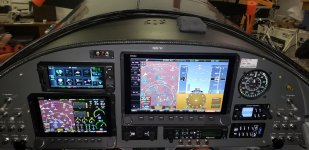
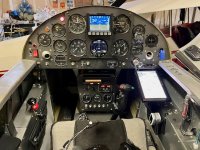
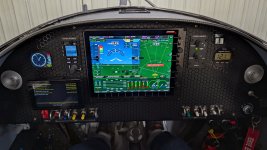
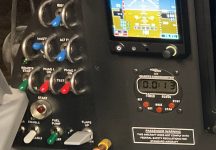
I'm trying to finalize the panel layout on my RV-8 and am thinking about where to put the ignition switches and starter button. Almost every RV-8 panel I've seen has the starter and ignition switches on the right side, so I'm thinking there must be a reason for that, but I'm also wondering if it makes more sense to be on the left side.

The only taildraggers I have flown have carbureted engines--I hold the stick back with one hand and use the other hand to start with no need to immediately adjust the mixture on start. My -8 has a fuel injected engine, so I will need to hold the stick back, push the starter, and then push the mixture forward. Unless I hold the stick back with my legs or grow another arm, it sounds like I will need to very quickly move my hand from the starter button to the mixture control. If the starter is on the left side then there is very little distance between the starter and mixture control. I'm also thinking about engine out scenarios. If the fuel pump and ignition switches are on the left side then I can fly the plane with my right hand and use my left hand to make sure the throttle, fuel valve and ignition switches are set appropriately and flip on the fuel pump without having to switch hands or reach over the cockpit.

Is my thinking off and is there a good reason that most people put the ignition on the right side?
 
I'm trying to finalize the panel layout on my RV-8 and am thinking about where to put the ignition switches and starter button. Almost every RV-8 panel I've seen has the starter and ignition switches on the right side, so I'm thinking there must be a reason for that, but I'm also wondering if it makes more sense to be on the left side.

The only taildraggers I have flown have carbureted engines--I hold the stick back with one hand and use the other hand to start with no need to immediately adjust the mixture on start. My -8 has a fuel injected engine, so I will need to hold the stick back, push the starter, and then push the mixture forward. Unless I hold the stick back with my legs or grow another arm, it sounds like I will need to very quickly move my hand from the starter button to the mixture control. If the starter is on the left side then there is very little distance between the starter and mixture control. I'm also thinking about engine out scenarios. If the fuel pump and ignition switches are on the left side then I can fly the plane with my right hand and use my left hand to make sure the throttle, fuel valve and ignition switches are set appropriately and flip on the fuel pump without having to switch hands or reach over the cockpit.

Is my thinking off and is there a good reason that most people put the ignition on the right side?
Good thinking! Like you said, "...hold the stick back with your legs"
  • Left hand on throttle
  • Right hand engages the starter
If you place the boost pump and flap switch just ahead of the throttle, they can easily be reached with a finger when your hand is on the throttle.
 
Last edited:
I have a -4, so basic same as -8. I like my key/ignition on the R/H side, as the L/H side has the throttle quadrant, primer button, fuel boost pumps and that takes quite a bit of area in itself. The key is alone and out of the way on the right. Starts are uneventful and , though I'm carbureted, a flood start can pop the RPM, BUT, my hand is on the throttle, not much need to be on stick, as you can pull back the throttle. I can move my throttle and advance mixture with one hand pretty quickly/easily. There are plenty of folks who have put a start "button" on the stick grip, which would be handy, so long as you didn't accidentally engage (I already have PTT, electric flaps, elevator and aileron trim on mine).
 
Generally speaking, you need both hands to start engine. Starter/Throttle. If throttle on left, starter on right and vice versa. IMO
 
Yep, left hand on the throttle, right hand on the start button, stick held aft between my legs.

On the first build I put the start button on the stick (it powered a small relay that powered the starter solenoid). Big mistake. It went away on the third flight of the plane.

I put the left ignition switch on the left panel wing, the right igntion switched on the right. The “push to start” button is on the side panel, along with the starter solenoid pull breaker and other non-panel associated stuff (boost pump, Voltage regulator breaker, pitot heat, nav, strobe, landing lights switch breakers and such. Panel associated breakers are mounted on the panel wings (that stay in the plane when I pull the center panel out).

Carl
 

Attachments

  • 20210729_135426.jpeg
    20210729_135426.jpeg
    1.9 MB · Views: 69
I have a -4, so basic same as -8. I like my key/ignition on the R/H side, as the L/H side has the throttle quadrant, primer button, fuel boost pumps and that takes quite a bit of area in itself. The key is alone and out of the way on the right. Starts are uneventful and , though I'm carbureted, a flood start can pop the RPM, BUT, my hand is on the throttle, not much need to be on stick, as you can pull back the throttle. I can move my throttle and advance mixture with one hand pretty quickly/easily. There are plenty of folks who have put a start "button" on the stick grip, which would be handy, so long as you didn't accidentally engage (I already have PTT, electric flaps, elevator and aileron trim on mine).
Same: I have a carburetor -4 and mag switch/start is on the right side of the panel. Primer on the left lower panel under the Master switch. I want my hand on the throttle as it sometimes takes a little encouragement from the carb/accelerator pump to get started, especially when cold.....or warm, and I can instantly make any needed changes. My mixture stays set until after start. Fuel pump, carburetor heat all within easy reach for a go-around. I would NOT put the starter on the stick as it would be too easy to accidentally hit it with the engine running unless there is an isolation switch, then you have to remember to turn that off. My stick buttons are already assigned. There really isn't any reason to have the stick anything but neutral when you are starting, where it is normally sitting. I'm not sure I have ever pulled the stick back when starting or trapped it with my knees. No need. I'm not sure what purpose that would have. I suppose if you are starting with full throttle then, yeah, I guess...............:oops:

The Cub is hand-propped. When I am solo, it is done standing in front of the main gear, behind the prop, my leg functioning as a 'chock'. I'm not even IN the cockpit when I start her. And my hand is instantly on the throttle when she fires. Never considered doing anything with the stick other than moving it out of the way when I swing in.

Love my 'round-dial' panel! :)❤️
 

Attachments

  • IMG_7844_1732140209404.jpg
    IMG_7844_1732140209404.jpg
    131 KB · Views: 40
Last edited:
As the rest have said...key switch/starter button on the right, stick between your legs and LH on the throttle/mixture. Cold FI starts have been easy on mine...Throttle cracked, mixture rich, prime 3-6 seconds with the boost pump depending on temp, then start and mixture lean for taxi. Hot starts for me (so far in our winter cold) has been...Leave throttle and mixture alone after a 1000rpm idle cutoff shutdown, start cranking til engine catches (usually 4or5 blades) then mixture forward to keep engine running but lean for taxi. Might have to be modified for summer temps 2F38637E-D1A8-4053-A3A9-D1D37FCA4B6B.jpegbut working good so far.
 
Thanks for all the replies. Sounds like there are good reasons to put the starter on the right so I'm sure that's what I'll end up doing.
 
I'm just upgrading my panel and am putting a start button on the stick grip (pinky finger) with an isolation switch on the panel next to the fuel pump switch. Both of these are just in front of the throttle. Except for an engine start on the ground, both switches will either be ON or both will be OFF. No need to take your hands off the controls for a relight in the air if it becomes necessary.
 
Like this…..except panel is always on. LED reminder light that stick is on.
 

Attachments

  • IMG_2097.png
    IMG_2097.png
    5.2 MB · Views: 65
When I rebuilt the panel in my Velocity, I went to side sticks from the center stick and put the throttle quadrant in the middle. I have two other pilots in my family now and I was thinking ahead and put an ignition button on each side of the cockpit so either seat could start the engine without having to cross over the center. Why not two switches?

Some canard guys put the starter on the stick. I would probably want a switch on the panel which locked it out to keep from hitting it accidentally. But that would allow you to hold the stick while hitting the start button.
 
Good thinking! Like you said, "...hold the stick back with your legs"
  • Left hand on throttle
  • Right hand engages the starter
If you place the boost pump and flap switch just ahead of the throttle, they can easily be reached with a finger when your hand is on the throttle.
I'm actually moving away from this setup

Right now I have one EI and one mag, and the mag switch is an Off-On-On(mom) with the momentary the start.
I'll be replacing the mag switch with just an Off-On and adding another Off-On as "starer circuit enable" and putting the actual momentary start switch on the stick itself.

The starter circuit enable simply prevents me engaging the starter accidentally if I bump the stick switch.

That gives me full hands on throttle and stick during the start sequence.
 
I'm just upgrading my panel and am putting a start button on the stick grip (pinky finger) with an isolation switch on the panel next to the fuel pump switch. Both of these are just in front of the throttle. Except for an engine start on the ground, both switches will either be ON or both will be OFF. No need to take your hands off the controls for a relight in the air if it becomes necessary.
What Rich and Walkman say.
I have this setup on the Rocket.
I love the ability to positively hold the stick all the way back with the right hand during start.
My guarded start enable sw is next to the boost pump by the throttle. In the event of an engine failure I would place both switches on with one motion thereby enabling my start button should the starter be needed for relight.
I fly a -4 that I hold the stick back with my legs. Awkward…
 
My recently acquired -8 has the throttle/prop/mixture on the left. Just forward of that on the panel, there is a keyed starter enable. The starter is a push and hold button on the stick grip.

I have found the ability to use my right hand to easily hold the stick back, while hitting the starter button with my thumb therefore leaving my left hand free to advance mixture and adjust throttle, very nice.

Once the start is complete, the starter enable, on the panel, is turned off, to avoid inadvertent start attempts.
 
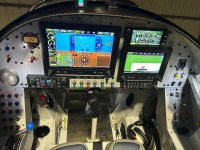
I agree with the starter switch on the right. Here is how I did mine with engine switches on right side console panel I made and CB's and engine controls on
the left.
 

Attachments

  • IMG_7336.jpeg
    IMG_7336.jpeg
    2 MB · Views: 30
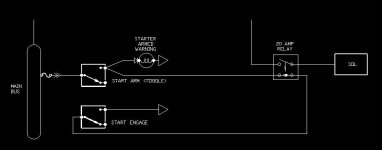
Starter button on stick, hidden start "arm" toggle, flashing LED on console when armed. Fifteen happy years now....

Start Arm Circuit.jpg
 
I already had my Tosten grips made without the starter button so that's out of the question for me. I do like it's advantages, but I couldn't think of a good way to auto disengage the starter and didn't want to have to remember to manually do it. I'm wondering now if you could do it with the GAD 27 somehow...

For Dan and those that have the starter engage switches--I've been thinking of adding one too. Are you using switches that fail closed? Though it would be very unlikely, I wouldn't want to have it fail open in the air if I needed to restart the engine and couldn't windmill it. More likely would be failure on the ground and inability to start the plane in some airport without a maintenance hangar unless you could hand prop it or get to the back of the switch and manually splice the wires.
 
To me the probability of a decent switch failing simultaneously with a need to restart in flight is a negligible risk. You test the switch every time you start the plane
 
Last edited:
Back
Top