Van's Air Force

The definitive Van's Aircraft support community! Buying, building or flying an RV? Join our exclusive family of mentors and enthusiasts!

Ok, do I need to pierce the crank plug or not????

JeremyL

Well Known Member
Patron
So i just picked up my engine from Lycoming, (io360-m1b) and i need to know if i need to do the SI and pierce the plug in the crank. I had heard that you no longer have to but i need to confirm this before doing surgery on a brand new engine or destroying it. I will be running a fixed pitch. Thank you all.
 
Depends? Is it already done? Does it have a plug in the back of the hollow crank? Or is it a set screw that you remove? I had a hollow crank and it had a set screw that you removed for fixed pitch. No need to punch a hole in anything. If it’s a plug then yeah that’s the way.
 
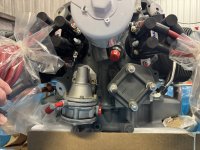
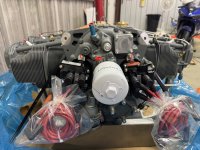
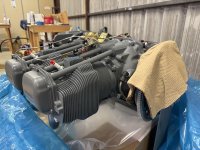
I’m not sure, I am finding it hard to get information or to understand exactly what I’m looking at in the SI. I’ll post pictures of the engine so that possibly someone could tell me what the set up is.
 

Attachments

  • IMG_1881.jpeg
    IMG_1881.jpeg
    3.6 MB · Views: 144
  • IMG_1880.jpeg
    IMG_1880.jpeg
    3.6 MB · Views: 141
  • IMG_1878.jpeg
    IMG_1878.jpeg
    4.3 MB · Views: 137
For constant speed prop, the front plug must be removed and the rear plug in place.

For fixed pitch, the front plug must be in place and the rear plug either removed or pierced.
 
The plug referenced isn't in the back of the engine. It is located in the front portion of the crank shaft.

1747768771472.png1747768847618.png
 
I think you should contact Lycoming and have them lookup for you whether they built it for fixed pitch prop or not.
 
I’m not sure, I am finding it hard to get information or to understand exactly what I’m looking at in the SI. I’ll post pictures of the engine so that possibly someone could tell me what the set up is.
IMHO you're holding your engine by the wrong end... the plug, pierced or not, plugged or not, present or not, is to be looked at from the propeller flange side, the front of the engine as seen when it'll be pulling your craft, which by coincidence is the place your carton paper rag gently rests.

Good luck :)
 
Call Lycoming. The presence of the governor line indicates that the engine is good to go as is. IF the proper governor pad cover is installed the excess oil from the front main bearing will be bypassed thru the governor line instead of thru a hole in the rear plug.
 
I’m not sure, I am finding it hard to get information or to understand exactly what I’m looking at in the SI. I’ll post pictures of the engine so that possibly someone could tell me what the set up is.
Will you be using a constant speed prop or a fixed pitch. That is the first and foremost question. Normally, you remove the front plug for a Constant Speed prop but leave the rear plug in. For a fixed pitch, the normal way is to remove the front plug. Punch a hole in the rear plug, then install a new front plug in the crankshaft. However, if using a fixed pitch, but planning a CS in the future, there is another method that does not require doing anything to either plug. This assumes that the CS prop governor mounts at the rear of the engine, not the front. DM me for all the details. The post above this one, is referring to the same method I mention.

Charlie
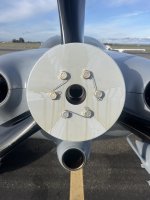
PS The photo you posted of the front are worthless. Remove the rag and take another photo from the direct front.
 
I am on the road so I don’t have all my info at hand. I had your exact situation. Ground adjustable prop with hollow crank on engine direct from factory. Super hard to find the info but it is on VAF somewhere so keep looking. Basically if you have the oil line that goes from the front of the engine to the rear where the prop governor would be you should be OK. When you find the discussion about this they talk about the plate that covers where the prop governor would be it has a channel in it to relieve the pressure in the crank. You can check this by blowing into the aft fitting on the engine and hearing/feeling that the rear plate allows the pressure to be relieved. Don’t take my word for it but search for a posting by Mahlon and how to be sure that it’s OK not to pierce the forward seal. I followed his advice and have 250 hours on the engine configured that way. No issues
 
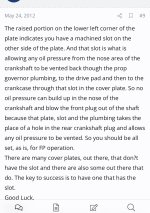
Here is part of that discussion,
BTW Lycoming was zero help on the subject.

 
I’m not sure, I am finding it hard to get information or to understand exactly what I’m looking at in the SI. I’ll post pictures of the engine so that possibly someone could tell me what the set up is.
These photos show fittings in the back and front for a constant speed prop and a stainless steel line for a constant speed prop. Only way to know what you have is to remove the front plug and check to see if there is a rear plug. Rear plug needs removed, pierced, or the allen plug in it removed. IF the rear plug is not installed, you will still need to reinstall a new front plug.
 
So i just picked up my engine from Lycoming, (io360-m1b) and i need to know if i need to do the SI and pierce the plug in the crank. I had heard that you no longer have to but i need to confirm this before doing surgery on a brand new engine or destroying it. I will be running a fixed pitch. Thank you all.
There is a govenor cover plate with a bypass machined into the face to relieve oil pressure from the propeller hub for FP installations,
 
Thank you to all. I attached the screen shot of Mahlon’s explanation for reference. My engine does have the front plug installed and has the same gov cover plate in the discussion with the milled section. I am going to verify it’s correct when I get back to the hangar by blowing into the rear gov connection to see if I get airflow. It is so frustrating that vans or Lycoming don’t even say one thing about any of this. But I guess that’s their way of CYA.
 

Attachments

  • IMG_1901.jpeg
    IMG_1901.jpeg
    389.6 KB · Views: 39
These photos show fittings in the back and front for a constant speed prop and a stainless steel line for a constant speed prop. Only way to know what you have is to remove the front plug and check to see if there is a rear plug. Rear plug needs removed, pierced, or the allen plug in it removed. IF the rear plug is not installed, you will still need to reinstall a new front plug.
That is not correct. Leaving the governor line in place with the Proper governor cover plate is an ALTERNATIVE to piercing the aft plug as described by Mahlon and others. It greatly simplifies possible future installation of constant speed prop. In this case no need to check the rear plug at the front main bearing. For a fixed pitch in the OP configuration it does not matter if the aft plug is solid.
 
(io360-m1b
I will be running a fixed pitch. Thank you all.
It's fine to use a hollow crankshaft swinging a FP prop, but can I ask why you didn't go with a IO-360-M2B (solid crankshaft) engine unless you plan on upgrading to a CS prop in the future? There's no crankshaft inspection required for the -M2B (solid crankshaft) engine swinging a FP prop. I have a solid crankshaft O-320-D2A (i.e. D2A) swinging an all metal Sensenich FP prop. A solid crankshaft swinging a FP prop avoids Lycoming Service Bulletin No. 505B.
 
Here is part of that discussion,
BTW Lycoming was zero help on the subject.

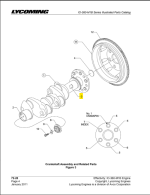
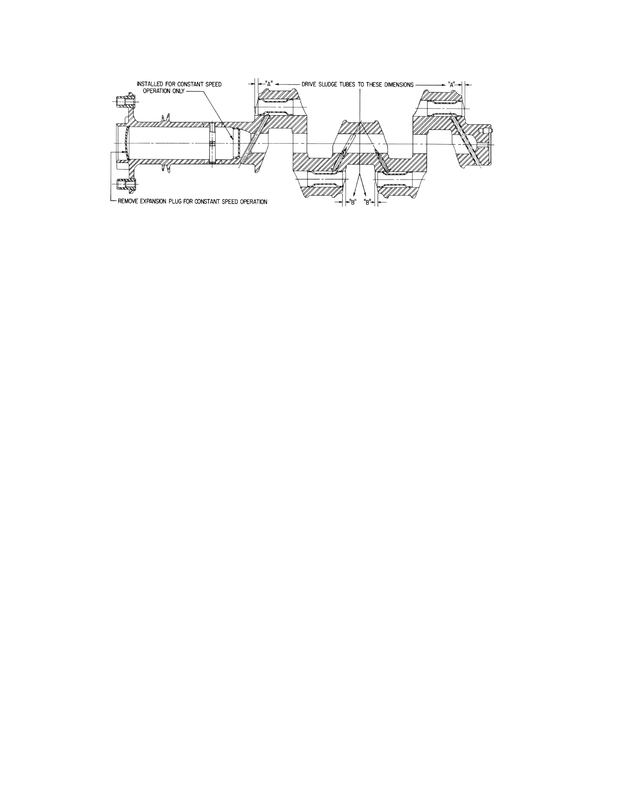
Great reference. Mahlon works for Mattituck, now part of Continental. If Mahlon says it, bank it! Since the engine was shipped with a rear governor mounting pad and the tube running from that pad to the right/front of the crankcases, nothing needs to be done when using a fixed pitch prop. Remove the front plug if using a Constant Speed prop as shown in the drawing below.

 
It's fine to use a hollow crankshaft swinging a FP prop, but can I ask why you didn't go with a IO-360-M2B (solid crankshaft) engine unless you plan on upgrading to a CS prop in the future? There's no crankshaft inspection required for the -M2B (solid crankshaft) engine swinging a FP prop. I have a solid crankshaft O-320-D2A (i.e. D2A) swinging an all metal Sensenich FP prop. A solid crankshaft swinging a FP prop avoids Lycoming Service Bulletin No. 505B.
Wasn’t an option through vans
 
Wasn’t an option through vans
I got my engine from Aero Sport Power, and they had both crankshaft types. If I recall on a previous engine install we did for an O-360-A1A (A1A hollow crankshaft), we didn't have to do anything because it already came with the front plug in place. But, to be certain, I would contact Vans Tech Support to verify -- Lycoming might have changed that configuration. (y) :cool: (y) Can you post a photo of the very front of your crankshaft? It's covered-up in your other photos.
 
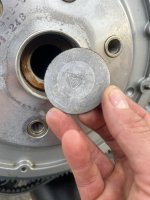
Double check that your plug is stamped correctly. My factory new engine lost the plug at 45 hours. In less than 10 seconds I lost all forward visibility. IMG_0040.jpegIMG_0047.jpeg
 
Just a follow-up, I understood that all of Lycoming's newer hollow crankshaft engines have a special coating in the front of hollow crankshaft, so I don't understand why you would need to pierce the rear expansion plug any longer since SB 505B was to address oil stagnating in the forward crankshaft area causing corrosion. So, why would the rear oil expansion plug need to be pierce using a FP prop -- just need the front plug and the coating I would think.
 
Just a follow-up, I understood that all of Lycoming's newer hollow crankshaft engines have a special coating in the front of hollow crankshaft, so I don't understand why you would need to pierce the rear expansion plug any longer since SB 505B was to address oil stagnating in the forward crankshaft area causing corrosion. So, why would the rear oil expansion plug need to be pierce using a FP prop -- just need the front plug and the coating I would think.
That is wrong. It is not about stagnating oil. Oil makes it way into that cavity via the clearance in the nose bearing, even when oil is not being fed their by a gov. That oil is at 80-100 psi. If you don’t provide a path to drain that oil, it will blow out the front plug and ruin your day. As others have said, a properly set up system with oil supply line, that will act as a drain.
 
That is wrong. It is not about stagnating oil. Oil makes it way into that cavity via the clearance in the nose bearing, even when oil is not being fed their by a gov. That oil is at 80-100 psi. If you don’t provide a path to drain that oil, it will blow out the front plug and ruin your day. As others have said, a properly set up system with oil supply line, that will act as a drain.
Have you read and understand SB 505B using a FP prop? There were crankshaft failures due to this where the prop departed the airplane, and that's what I'm talking about here. If the drain back line, rear cover plate and forward crankshaft plug is installed, why would that cause a problem?
 
Have you read and understand SB 505B using a FP prop? There were crankshaft failures due to this where the prop departed the airplane, and that's what I'm talking about here. If the drain back line, rear cover plate and forward crankshaft plug is installed, why would that cause a problem?
I understand the corrosion issue. You asked why you need to pierce the plate. I explained that some type of drain is required to avoid blowing out the front cap and that is why we pierce the rear cap. And,yes, I explained that a properly setup line will also do that. Also, that is not a drain back line. It is the line that lets the gov “supply” oil to the cavity, thought it will also drain when the gov allows it to do so.
 
I understand the corrosion issue. You asked why you need to pierce the plate. I explained that some type of drain is required to avoid blowing out the front cap and that is why we pierce the rear cap. And,yes, I explained that a properly setup line will also do that. Also, that is not a drain back line. It is the line that lets the gov “supply” oil to the cavity, thought it will also drain when the gov allows it to do so.
So, without a prop governor installed to supply pressure, and the proper plumbing line installed, then essentially you only have drain-back in a FP prop setup -- right?

So, if you pierce the rear cap in the crankshaft, some engine oil will splash into your hollow crankshaft from the front of the engine, which was causing that 505B corrosion issue before the new protective coating was added, but how could the engine be converted back to a CS prop setup after piercing that rear cap?
 
Last edited:
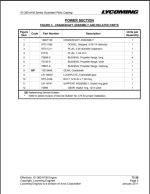
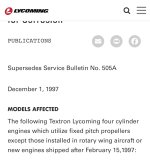
As a follow up to a couple things.. I can take a picture when I get to the hangar of the front. There is a solid cap/plug installed from factory. As far as the SB 505B.. see below direct from Lycoming… my engine is a 2025 engine!
 

Attachments

  • IMG_1906.jpeg
    IMG_1906.jpeg
    171.1 KB · Views: 34
So, without a prop governor installed to supply pressure, and the proper plumbing line installed, then essentially you only have drain-back in a FP prop setup -- right?

So, if you pierce the rear cap in the crankshaft, some engine oil will splash into your hollow crankshaft from the front of the engine, which was causing that 505B corrosion issue before the new protective coating was added, but how could the engine be converted back to a CS prop setup after piercing that rear cap?
No, there is ALWAYS oil migrating into the cavity. I am not going to Take the time to explain the entire oil circuit. However, oil is always moving across the bearing clearance area and gets to the cavity. This is why the SB applies to all hollow cranks, not just those with CS props installed. If you do not provide some way to drain this oil that collects in the cavity, It will eventually build up pressure and create issues.

You can either pierce a hole in the rear plate or you can use the line as a drain, If the correct blocking plate is installed, but you need some form of drain when the front cover is installed..

If the rear plate is pierced, you simply replace it when moving to CS.

 
Last edited:
No, there is ALWAYS oil migrating into the cavity. I am not going to Take the time to explain the entire oil circuit. However, oil is always moving across the bearing clearance area and gets to the cavity. This is why the SB applies to all hollow cranks, not just those with CS props installed. If you do not provide some way to drain this oil that collects in the cavity, It will eventually build up pressure and create issues.

You can either pierce a hole in the rear plate or you can use the line as a drain, If the correct blocking plate is installed, but you need some form of drain when the front cover is installed..

If the rear plate is pierced, you simply replace it when moving to CS.

Not so simple to replace that rear plug! BTW -- SB 505B primarily applies to fixed pitch prop setups (i.e. the one's that have experienced broken crankshafts from internal corrosion) -- I remember when they occurred, starting with a Piper Warrior at Aspen Colorado that lost a FP prop. Heading out for another long cross-country at the moment, so we can do some "real RV flying" instead of armchair RVing. (y):cool:(y) Catch you later lr172.
 
I’m curious. What is required to replace the rear plug? Does the engine have to come apart? Is it a reach through the front after the front seal is removed item?

Alternatively, if the seal needs to be removed does one pull the front plug, remove the rear plug, then reinstall a front plug?
 
Back
Top