

Van's Air Force
You are using an out of date browser. It may not display this or other websites correctly.
You should upgrade or use an alternative browser.
You should upgrade or use an alternative browser.
O-360 oil cooler ports
- Thread starter yahugh
- Start date

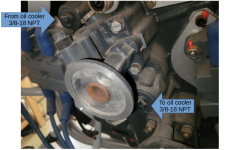

Here's what I think the answers to these questions are. Am I correct?
Yes. And the port with lots of plug threads showing is for oil temperature sender.

Thanks Dan! I was wondering about the third port, which you identified as well.Yes. And the port with lots of plug threads showing is for oil temperature sender.
A certified aircraft uses steel fittings on the engine and the oil cooler.
If the oil cooler is mounted on the fire wall, ensure that the hoses are supported on the fire wall side.
If installation instruction does not say otherwise, connect oil hose from engine to bottom port and return to engine to top port of the oil cooler.
Good luck
If the oil cooler is mounted on the fire wall, ensure that the hoses are supported on the fire wall side.
If installation instruction does not say otherwise, connect oil hose from engine to bottom port and return to engine to top port of the oil cooler.
Good luck
I was curious about why steel and not aluminum. So I asked claude.ai and here's what I learned.A certified aircraft uses steel fittings on the engine and the oil cooler.
If the oil cooler is mounted on the fire wall, ensure that the hoses are supported on the fire wall side.
If installation instruction does not say otherwise, connect oil hose from engine to bottom port and return to engine to top port of the oil cooler.
Good luck
I think I'm going to go with steel!The oil cooler fittings on Lycoming engines are made of steel rather than aluminum for several important reasons:
- Durability and strength - Steel offers superior strength compared to aluminum, allowing the fittings to withstand the repeated stress of installation, maintenance, and thermal cycling without stripping or failing.
- Thread integrity - Steel threads maintain their integrity better over time, especially important for components that may need to be removed and reinstalled during maintenance.
- Thermal expansion - Steel has a lower coefficient of thermal expansion than aluminum, which helps maintain a tight seal despite the significant temperature fluctuations aircraft engines experience.
- Galvanic corrosion prevention - Using steel fittings in an aluminum case creates a dissimilar metal junction that can actually help protect the more critical (and expensive) aluminum case from corrosion.
- Pressure resistance - The oil system operates under significant pressure, and steel fittings are better able to maintain their seal under these conditions without deforming.
While steel is heavier than aluminum, the small size of these fittings means the weight penalty is minimal compared to the reliability advantages they provide.

vlittle
Well Known Member
The most important reason for using steel fittings on the aluminum oil cooler and engine is to prevent galling/cold welding, which can damage the threads if you (try to) remove the fittings. I am in the process of replacing an oil cooler because of this problem. So claude.ai got it wrong.

I’m actually sort of terrified every time I see someone using AI to get answers airplane building questions. For entertainment purposes? Sure…not a problem. But these AI engines search what is available on teh internet, and there are so many wrong answers on teh internet that the chances of getting more bad info out there is pretty high. This is a safety-critical business, and the AI won;t die if it gets something wrong….but you or your passengers might.The most important reason for using steel fittings on the aluminum oil cooler and engine is to prevent galling/cold welding, which can damage the threads if you (try to) remove the fittings. I am in the process of replacing an oil cooler because of this problem. So claude.ai got it wrong.
Wholeheartedly agree.I’m actually sort of terrified every time I see someone using AI to get answers airplane building questions. For entertainment purposes? Sure…not a problem. But these AI engines search what is available on teh internet, and there are so many wrong answers on teh internet that the chances of getting more bad info out there is pretty high. This is a safety-critical business, and the AI won;t die if it gets something wrong….but you or your passengers might.
As AI uses info available online to fashion the answer, we still have very limited amount of aviation related information and some of that may be incorrect. While getting the answers is ok, we really need to exercise due diligence.
For example, this is incorrect.
"Galvanic corrosion prevention - Using steel fittings in an aluminum case creates a dissimilar metal junction that can actually help protect the more critical (and expensive) aluminum case from corrosion."
It is the more reactive metal i.e. Aluminum which corrodes.
"Galvanic corrosion prevention - Using steel fittings in an aluminum case creates a dissimilar metal junction that can actually help protect the more critical (and expensive) aluminum case from corrosion."
It is the more reactive metal i.e. Aluminum which corrodes.
Wholeheartedly agree.
As AI uses info available online to fashion the answer, we still have very limited amount of aviation related information and some of that may be incorrect. While getting the answers is ok, we really need to exercise due diligence.
Which is exactly why I vetted the AI information here.
A couple of points:
I never meant to suggest that AI should be the final authority on this or any other topic.
The AI response shed some light on *why* certified airplanes use steel.
My posting the AI response stimulated conversation that further educated me on this topic.
