Van's Air Force

The definitive Van's Aircraft support community! Buying, building or flying an RV? Join our exclusive family of mentors and enthusiasts!

New Elevator Root Fairings

scsmith

Well Known Member
Sponsor
Advertiser
I just landed from doing the flight testing on my new elevator root fairings. These are very light-weight fiberglass fairings that improve the aerodynamics of the area between the elevator and the rudder, taking advantage of extra room, but no change to the gap to the rudder skin from the elevator trailing edge.

Tests were done at 7500 ft pressure alt, 63F OAT, 2400 RPM, 22.5 in Hg. MAP, 8.0 gph fuel flow. Tests both days had almost identical atmosphere (wind, OAT) with less than 5 kt wind, except for the first test with the fairings installed, which had a 19 kt wind. Despite that, the computed TAS from that test was extremely close to the other results - Gives great confidence in the results.

Baseline, no fairings, average of three GPS Speed Triangle tests = 166.6 KTAS
With fairings, average of four GPS Speed Triangle tests = 168.2 KTAS.

So it looks like the fairings are good for 1.6 kts.

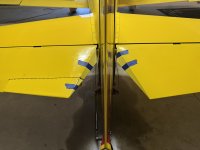
Here's a couple of pictures. It is hard to descern the contour shape from the pictures - I will draw some stream lines on one and take another picture so you can see the gentle curve to a trailing edge provided by the fairing.
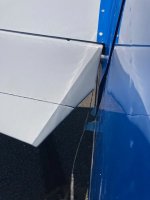
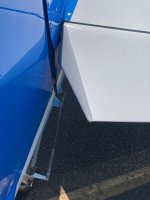
Left side elevator root fairing.jpgRight side elevator root fairing.jpg
 
We went through two iterations on the installation details. The first set I made had a joggle along the edge that slipped in under the elevator skin and root rib. This required making relief notches for the rivet tails and dimples on the inside. My plan was to put a couple of plate nuts on the fairings and install with 4-40 flat head screws. This presented a challenge for the trim tab portion, because there is no pocket at the root end. I also found that despite my best efforts, there was a rather distinct shape break at the joint that might cause flow separation.

So, we made a second set that fits over the outside of the elevator skin with about 1/2" of overlap. This first install used double-sided tape but we will remove that and bond the fairings on semi-permanently with RTV. The edge of the fairing was feathered to a nice smooth edge and the shape is aerodynamically better than the version that mounts inside. I do have molds for both styles so you can choose which you want.
 
Looks very similar to the fairings I cooked up for Race 57. We didn’t test all the mods we put on the plane separately, so is nice to hear that this particular one did actually add to going a bit faster. Besides it really cleaned up that area visually!

Good job!
 
It looks nice, but I’m trying to see what is different than the standard Vans installation instructions in this area. It looks like exactly what I have done on my last six RV’s, except for the use of far fewer screws. Is there something different in your design? Not obvious on your pics.
 
It looks nice, but I’m trying to see what is different than the standard Vans installation instructions in this area. It looks like exactly what I have done on my last six RV’s, except for the use of far fewer screws. Is there something different in your design? Not obvious on your pics.
Note I am not talking about the standard empennage fairing that fills the gap at the intersection of the horizontal stabilizer and the vertical stabilizer. I am talking about the fairings on the elevators.

The inboard edge of the standard elevator ends at the edge of the white paint in the pictures, except for about 1/2 inch that extends under the gray fairing. There are NO added screws. The new parts are the gray parts, providing a fair shape instead of the blunt inboard edge of the elevator root rib and skin. There is nothing in the Vans kit instructions to do anything like this. A few others have done this, including Ralph (above) and Jason Rovey (Race #76). The fairings are bonded on. Can be removed by carefully slicing through the RTV with a razor blade.
 
Nice! It seems pretty intuitive, blocking the control surface ends. Those trailing edges look unique too.
 
OK. I think I understand. You are talking about the inboard end of the elevator where there is an abrupt edge near the fuselage, and you’ve faired this edge. I’m impressed that this fairing gives a 1.6 kts advantage. I would have thought that something this far aft, with dirty air would not make that much difference.
 
I saw these on a -8 at reno.. looked slick. Do they offer any additional elevator authority near stall? Not that the RV needs more elevator authority, but I figured these might give more power when slow..
 
I saw these on a -8 at reno.. looked slick. Do they offer any additional elevator authority near stall? Not that the RV needs more elevator authority, but I figured these might give more power when slow..
Yes, Jason Rovey has had a similar set of fairings on his RV-8, Race #76 for several years. He arrived at his design completely independently, and they are quite similar. Jason's turn a little bit sharper corner to close to the trailing edge, I tried to moderate that turn as gently as possible. Pretty sure the flow stays attached.

I don't think that the elevator control power would be noticeably different. Perhaps if there was some limiting case where a slight added control authority would change something, you might notice.
 
Is this a product you're planning to offer for sale? I may be able to emulate it with a 3D printed part, but there would be a lot of trial and error. I'd love a set for my 8.
 
Is this a product you're planning to offer for sale? I may be able to emulate it with a 3D printed part, but there would be a lot of trial and error. I'd love a set for my 8.
Yes, we will sell them through HPAircraft.com. $200 includes conus shipping. I didn't mention that in the initial post because we are in the process of trying to re-establish our advertising arrangement with Doug, which apparently has lapsed.

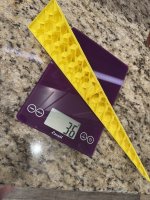
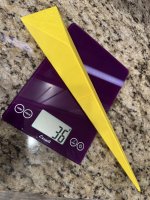
A caution about 3D printing these!!!!! Adding mass to the elevators is bad. The elevators are 100% (or close to) mass balanced. These fiberglass fairings are super light weight -- about 38 grams for the right side, and the combination of the two parts for the left side is under 50 grams. The thin, light fiberglass shell gets its stiffness from its shape and attachment around the perimeter. I don't think you could print a part anywhere near that light weight, and if you did, it would not be stiff enough. Add to that the poor surface finish and I think a fairing like this is just not a good candidate for 3D printing.
 
A caution about 3D printing these!!!!! Adding mass to the elevators is bad. The elevators are 100% (or close to) mass balanced. These fiberglass fairings are super light weight -- about 38 grams for the right side, and the combination of the two parts for the left side is under 50 grams. The thin, light fiberglass shell gets its stiffness from its shape and attachment around the perimeter. I don't think you could print a part anywhere near that light weight, and if you did, it would not be stiff enough. Add to that the poor surface finish and I think a fairing like this is just not a good candidate for 3D printing.
(y)(y)(y)
 
I just landed from doing the flight testing on my new elevator root fairings. These are very light-weight fiberglass fairings that improve the aerodynamics of the area between the elevator and the rudder, taking advantage of extra room, but no change to the gap to the rudder skin from the elevator trailing edge.

Tests were done at 7500 ft pressure alt, 63F OAT, 2400 RPM, 22.5 in Hg. MAP, 8.0 gph fuel flow. Tests both days had almost identical atmosphere (wind, OAT) with less than 5 kt wind, except for the first test with the fairings installed, which had a 19 kt wind. Despite that, the computed TAS from that test was extremely close to the other results - Gives great confidence in the results.

Baseline, no fairings, average of three GPS Speed Triangle tests = 166.6 KTAS
With fairings, average of four GPS Speed Triangle tests = 168.2 KTAS.

So it looks like the fairings are good for 1.6 kts.

Here's a couple of pictures. It is hard to descern the contour shape from the pictures - I will draw some stream lines on one and take another picture so you can see the gentle curve to a trailing edge provided by the fairing.

View attachment 67934View attachment 67932
Awesome,
I'm installing them tomorrow.
Looking forward to that potential aerodynamic gain of 1.6Kts.
Every KT counts.
Daddyman
 
Yes, we will sell them through HPAircraft.com. $200 includes conus shipping. I didn't mention that in the initial post because we are in the process of trying to re-establish our advertising arrangement with Doug, which apparently has lapsed.

A caution about 3D printing these!!!!! Adding mass to the elevators is bad. The elevators are 100% (or close to) mass balanced. These fiberglass fairings are super light weight -- about 38 grams for the right side, and the combination of the two parts for the left side is under 50 grams. The thin, light fiberglass shell gets its stiffness from its shape and attachment around the perimeter. I don't think you could print a part anywhere near that light weight, and if you did, it would not be stiff enough. Add to that the poor surface finish and I think a fairing like this is just not a good candidate for 3D printing.
I'm interested! I agree that it doesn't sound like a great candidate for 3d printing, although if I were developing from scratch it would be reasonable to prototype that way. There are a few tricks that might result in light parts and smooth surface finish but if you're already planning to produce for sale there's no good reason to reinvent it myself. Looking forward to it!
 
Anyone have results to report on the fairings?
We have sold quite a number of sets of fairings. I know that Bob Mills has installed them on his Rocket-6, and at least one other customer has them flying. Hopefully one of the customers with newly installed fairings will chime in.
Bob Mills did report back that on his xc flight from Georgetown to Las Cruces for the races, he felt like the speed improvement estimate was about right.
 
I just landed from doing the flight testing on my new elevator root fairings. These are very light-weight fiberglass fairings that improve the aerodynamics of the area between the elevator and the rudder, taking advantage of extra room, but no change to the gap to the rudder skin from the elevator trailing edge...
Update: We were sold out of these for a few weeks. But we've now got them back in stock.

One caveat, we've learned that they do not fit RV-4. We were under the impression that the RV-4 has the same elevator as RV-6, RV-7, and RV-8, but that is apparently not the case.

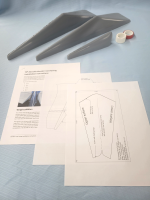
The fairings are provided in primer gray, ready for you to finish and paint to match. To install them, you simply trim them to fit according to the instructions and template provided, and bond them on with RTV silicone adhesive or high-strength double-sided tape (included).

The kit contains:
  • Two elevator fairings, one of which you cut short to clear the trim tab
  • One trim tab fairing
  • 64" of high-strength double-sided tape
  • 64" of PVC safety tape
  • Installation instructions
  • Installation drawings and trim template
kit contents.png
2024 pricing for the kit is $200 plus shipping. To order, email [email protected]
 
Hey all,

Would like to add my numbers as well. I recently installed these on my RV6A. I used clear RTV to attach them to the elevator and then applied gap seal tape over them per the instructions. A four way gps test at 6,600 Dalt 65% power shows 155 knots true before and 156 or 157 after. So i can vouch for the speed increase

Overall happy for the performance increase and the quick install
 
Back
Top