


Van's Air Force

The definitive Van's Aircraft support community! Buying, building or flying an RV? Join our exclusive family of mentors and enthusiasts!

Need a better understanding of nut plates/jigs

RNB

Well Known Member
Sponsor
I bought a nut plate jog set from yard store, today was the first time I went to use them. I hope folks can see in the photo but the jig spacing is much narrower than the nut plate I was attaching (for counterweight in RV10 rudder if it matters). I made do by clamping the nut plate in place but was surprised that the jig would not work. All of the jigs were similarly narrow.

If I were to buy another jig or set of jigs for building an RV10, what do I need to better understand?IMG_8108.jpeg
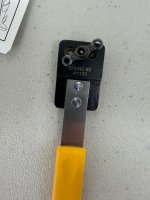
 
I bought a nut plate jog set from yard store, today was the first time I went to use them. I hope folks can see in the photo but the jig spacing is much narrower than the nut plate I was attaching (for counterweight in RV10 rudder if it matters). I made do by clamping the nut plate in place but was surprised that the jig would not work. All of the jigs were similarly narrow.

If I were to buy another jig or set of jigs for building an RV10, what do I need to better understand?View attachment 94216
It appears that jig is for a #8 screw. Are your nutplates for a #8 screw or a different size? As I remember, each size is spaced according to the screw size.
 
The jigs come in different sizes. My advice, ditch the purpose-built jigs altogether and just use an appropriate nutplate as the jig--problem solved at no cost.
 
There are both standard and mini pattern nut plates, the jig in the above photo is for the mini.

The yardstore item for standard #8 is:
  • Nut Plate Jig #8 Two Lug Double Wing Standard 518B (#41101)
 
When I built my 7A, I used nut plates jigs quite a lot. When I built the 12, I was amazed to find the nut plate holes were pre-punched! No need for jigs, except maybe a few places.
Talk about a time saver.👍
 
I run a screw in the all the way in until only the grip length area is exposed, then cut off the head and put a screwdriver slot in it. Place the nut plate in position through your drilled screw hole, drill one leg, then cleco that, then drill the other hole. You can get several holes drilled out of the nut plate jig before the holes begin to wear. I will then remove the screw, place it in the new nut plate, and install the old jig nut plate. I keep them in several sizes in a special bid labeled "Installation Tools", along with other special tools I have accumulated.
 
not sure as to why a jig for nut/anchor plate is needed...
Take the nut/anchor plate, drill the screw hole (the one that is really important), insert and hand-tighten the screw. Then clamp down one side of the plate, drill the rivet hole thru the other side, insert cleco, drill the other side.
Proceed to the next one... jig?
 
I prefer to locate the nutplates screw hole with a pilot hole sized for a cleco that will secure the nutplate through the nut. This keeps the nutplate centered over the pilot hole and is much faster than screwing the nutplate in place. Match drill and cleco the rivet holes, remove the nutplate and punch out the center hole to clearance size for the screw and install the nutplate.
 
not sure as to why a jig for nut/anchor plate is needed...
Take the nut/anchor plate, drill the screw hole (the one that is really important), insert and hand-tighten the screw. Then clamp down one side of the plate, drill the rivet hole thru the other side, insert cleco, drill the other side.
Proceed to the next one... jig?
A jig is not necessary but it sure is a time saver. Position the jig in the screw hole, drill the 1st nut plate hole, flip the jig over and drill the second hole and you’re done.
 
Yea, when I started my 10 build I was using a nut plate as the jig. I finally decided to breakdown and get some nut plate jigs and what a timesaver that was, should have gotten them from the beginning.
 
not sure as to why a jig for nut/anchor plate is needed...
Not all nutplates are fixed location types. In the production world, most are floating and allow some misalignment to the screw/bolt holes. Use of a jig eliminated the probability of damaging the factory coating on a new nutplate and giving corrosion/rust a ready location to start, when exposed to the right conditions.

We used both tool steel jigs and preset Winslow drill guns for drilling nutplate holes. The Winslows were a massive time saver when you were drilling and installing hundreds of nutplates in a shift. Using the tool steel jigs allowed one to "float" the nutplate alignment when needed, due to structural configurations and at the same time maintain at least minimum edge distance for all holes.

BTW...There are multiple attach hole spacing dimensions for the various size nutplates based on the part number.
 
Last edited:
I have quite an assortment of nutplate jigs, collected over the years from various used parts stores, fly markets, and stolen from various friends tool boxes…. (Just kidding….maybe….). Many different sizes, and I love using them. But with modern pre-punched kits, you will find that most places the factory wants a nutplate, they have already punched the holes, so you might have little chance of using them, unless you are doing a lot of custom work (I do a LOT of custom work). I always want to have and use my jigs, but if you add up what they cost, and figure out how many times you’ll need them, you might find that some ClickBond nutplates will do the job cheaper from and overall perspective. Something to check.
 
Paul: ClickBond stuff works great, especially if you are working on composites, but it has one draw back. It will not tolerate poor preparation work on the structure. If one elects to used CB, read the prep instructions, read them several more times and then read them again and do the work exactly as it wants. IF it tells you to wait 24 hours before using, then do so, or you risk popping the nutplates off. Also, DO NOT use power tools installing ore removing screws and bolts into CB nutplates. You can generate enough heat in that short of a time to cause the adhesive to fail when the nutplate is pushed, or tugged on. It's sensitive enough that we send new kids to an all day school on CB nutplate installation and removal before they hit the line.

Nothing is more frustrating than putting in 330 screws into a panel and be torquing the last dozen or so and pop a CB nutplate loose....BTDT many times...
 
Thanks everyone, I did not realize there were different sizes of plates and jigs.
The place I used it was not prepunched for such.
 
If I were starting over and knew what I know now....nutplate jigs would be toward the top of my tool list. The wingtips alone make the tool(s) worth it IMO.

After using the tool one time, I now own quite an assortment of them.
 
I find the jig is very useful but only have a #6 as the spacing is the same for all screw sizes. Pilot drill screw hole #40, then drill #28 (IIRC) for jig and drill holes #40 for legs. In thin sheet dimple nut plate as well as sheet.
 
Back
Top
