Van's Air Force

The definitive Van's Aircraft support community! Buying, building or flying an RV? Join our exclusive family of mentors and enthusiasts!

Manifold Pressure variation

enigmakv

Well Known Member
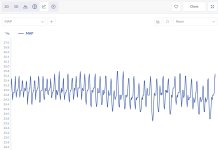
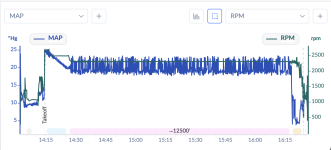
I recently purchased an RV-14A and could not be happier. I have flown it about 17 hours so far including the x/c home to Phoenix from the Minneapolis area. I am noticing that the manifold pressure readings on the G3X are pretty variable (see included screen shot from one of the flights).

The plane has the YIO-390-EXP239 with dual E-mags. I have been told that the MP indication line may need to be a smaller diameter line. I have read in other threads of a restrictor.

Any thoughts would be appreciated.

Kevin
 

Attachments

  • Screenshot 2025-09-24 at 10.30.02 AM.png
    Screenshot 2025-09-24 at 10.30.02 AM.png
    140.3 KB · Views: 52
Where are you picking up MAP from? if its from a cylinder port you would likely need a filter to block out the pressure pulses.
 
Section 21.3.4 in the current G3X installation manual (revision AZ) talks about this:

A restrictor or snubber fitting (not available from Garmin) may be installed (between the hose and the sensor) to dampen manifold pressure fluctuations. One example is the PS-8G fitting from Omega Engineering.
 
Typically the variability seen is closer to 1-2” and yours is 5-6”. A snubber may help, but wonder if this is beyond the typical oscillations seen by many. Maybe an issue with your sensor.
 
I recently purchased an RV-14A and could not be happier. I have flown it about 17 hours so far including the x/c home to Phoenix from the Minneapolis area. I am noticing that the manifold pressure readings on the G3X are pretty variable (see included screen shot from one of the flights).

The plane has the YIO-390-EXP239 with dual E-mags. I have been told that the MP indication line may need to be a smaller diameter line. I have read in other threads of a restrictor.

Any thoughts would be appreciated.

Kevin
The e mag manual discusses the need for the snubber in the map line. emagair.com
 
Typically the variability seen is closer to 1-2” and yours is 5-6”. A snubber may help, but wonder if this is beyond the typical oscillations seen by many. Maybe an issue with your sensor.
Yeah, I'd like to start with easier things first and the MP line after the "T" to the emags seems the easiest place to start. Probably sensor next and then induction leak (which I really don't want to even think about as this is all new to me right now). During climb the graph doesnt seem to have a much of the fluctuation and variability but cruise looks aweful. And I was cruising at WOT so no changes on my part.
 
Where are you picking up MAP from? if its from a cylinder port you would likely need a filter to block out the pressure pulses.
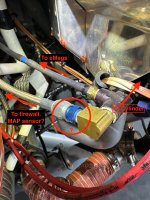
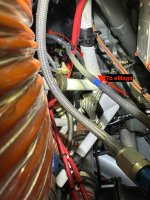
Kind of what I am hoping. I'm working from memory as my plane is 2,500 miles away right now. I KNOW the MP is tapped off the #3 cylinder. I'm pretty sure there is a "T" where one line heads off to the emags and the other to the firewall. During transition training I was told it may be that the line to the sensor is too big.
 
Yes, as noted above you need a snubber or dampener in the line.

I had this exact issue myself after the G3x installation on the Bolkow. I was going from steam gauges to an electronic system I didn't consider that the MAP line snubber was inside the old guage, not in line itself. I made my own snubber but the hole I drilled wasn't small enough and it's still a little wobbly on the graph. Today I tried to make an adjustment to the snubber to reduce the hole diameter but ran out of time - a tomorrow job now. The smallest drill I have is 0.012" but even that is probably still a little big.

If you have a fuel primer nozzle laying around the shop, use that. The fuel nozzle hole diameter is REALLY small, but its about what you need. The sensors seem to be quite sensitive to undampened pressue pulses. If you install the fuel primer nozzle into the cylinder at the primer port its the perfect location to pick up your MAP while also preventing a leak should the MAPline break at some piont on its way to the sensor.
 
Yeah, I'd like to start with easier things first and the MP line after the "T" to the emags seems the easiest place to start. Probably sensor next and then induction leak (which I really don't want to even think about as this is all new to me right now). During climb the graph doesnt seem to have a much of the fluctuation and variability but cruise looks aweful. And I was cruising at WOT so no changes on my part.
induction leaks don't typically create oscillating readings like that. Further, induction leaks have a very small impact at higher power settings, like shown in your first post. What you see there is not from an induction leak.
 
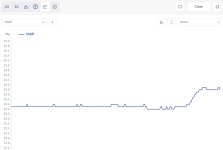
Here is a graph from a flight where there was no dampening of the MAP - no snubber was installed:

Screenshot_20250926_073137_Chrome.jpg


Same aircraft, but after installation of the snubber:

Screenshot_20250926_073100_Chrome.jpg
 
induction leaks don't typically create oscillating readings like that. Further, induction leaks have a very small impact at higher power settings, like shown in your first post. What you see there is not from an induction leak.
This is very welcome news and makes sense.
 
Here is a graph from a flight where there was no dampening of the MAP - no snubber was installed:

View attachment 98158


Same aircraft, but after installation of the snubber:

View attachment 98159
This is pretty typical without a snubber 1-2” oscillation.

OP - yours is a much larger oscillation range than this. I still believe your issue goes beyond just needing a snubber. Definitely get one to stabilize things, but have my doubts that it will fully resolve your problem. You want to start with the snubber and the sensor first, as next on the list is not something you’ll like.
 
If it is the missing snubber, makes me wonder why the original owner/builder put up with this.... yuk.
The builder probably didn't operate the engine where it was a problem -- IIRC from my installations, that issue only manifested around 2420 RPM.

...and I don't recommend the "snubber" (Omega Engineering PS3G), the snubber acts like a filter, and will load up with oily residue and reduce response rate or become blocked. Use a "damper" (restrictor) instead, a .008" is sufficient; see McMaster-Carr (link) (https://www.mcmaster.com/catalog/131/665/3820K260

Cheers!
 
The builder probably didn't operate the engine where it was a problem -- IIRC from my installations, that issue only manifested around 2420 RPM.

...and I don't recommend the "snubber" (Omega Engineering PS3G), the snubber acts like a filter, and will load up with oily residue and reduce response rate or become blocked. Use a "damper" (restrictor) instead, a .008" is sufficient; see McMaster-Carr (link) (https://www.mcmaster.com/catalog/131/665/3820K260

Cheers!
Kevin---post a pic of the hose setup you have. On ours, we use a .040 restrictor fitting in CYL #3, with -3 hose and hose ends. The stem ID is .079. Been doing it that way for years---normally takes care of any pressure pulses. See whats actually installed on the plane.
Tom
 
I recently purchased an RV-14A and could not be happier. I have flown it about 17 hours so far including the x/c home to Phoenix from the Minneapolis area. I am noticing that the manifold pressure readings on the G3X are pretty variable (see included screen shot from one of the flights).

The plane has the YIO-390-EXP239 with dual E-mags. I have been told that the MP indication line may need to be a smaller diameter line. I have read in other threads of a restrictor.

Any thoughts would be appreciated.

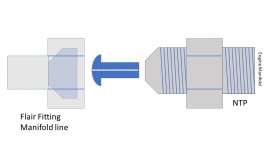
KevinManifold pressure line.jpg
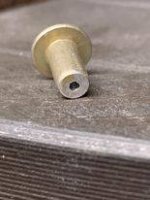
Drill a hole in a 470 rivet, and put it in the manifold pressure line. My MAP is rock steady470 manifold line rivet1.jpg
 
I've always had the restrictor (snubber) fitting for my MAP. Very early on I had a poor connection at the wires to the sensor and the vibration made the MAP wander; for me fixing the poor connection made my MAP rock solid.
 
Kevin---post a pic of the hose setup you have. On ours, we use a .040 restrictor fitting in CYL #3, with -3 hose and hose ends. The stem ID is .079. Been doing it that way for years---normally takes care of any pressure pulses. See whats actually installed on the plane.
Tom
I apologize to all for disappearing for a while. Plane is in AZ, I work in Hawaii. It's once a month that I get back to AZ for a week to fly. Then a medical issue came up requiring emergency surgery.

The graph I posted was with WOT and 2300 prop rpm. Those are the settings I was taught many years ago and until I can experiment with other rpm/mixture settings its what I default to.

I purchased the plane with 517 on the tach (581 hobbs). Previous owner flew it a lot (~12/mo) including some substantial x/c flights since its "birth" day November 2021. He didn't mention anything about it and probably just considered it "normal". Unless it is a new issue to me.

At any rate, here's a couple photos I took during oil change in mid October...
 

Attachments

  • MAP Tee.jpeg
    MAP Tee.jpeg
    1.5 MB · Views: 35
  • eMag Tee.jpeg
    eMag Tee.jpeg
    1.4 MB · Views: 34
Back
Top