Van's Air Force

The definitive Van's Aircraft support community! Buying, building or flying an RV? Join our exclusive family of mentors and enthusiasts!

Magneto P Lead shielding contradiction.

JonJay

Well Known Member
Sponsor
As a course of wiring my new panel, much is being redone.
The original plans OP-10, shows connecting the shield to ground at the magneto only. This is how it was wired 20 years ago.
However, Advance Panel wiring shows grounding the shield at the key switch and at the mag. Bob Nukolls also shows grounding at both locations. This is counter to what we normally do for shielding.
What is correct?
 
The shielding is open at the switch until it is switched to ground the mag. Both examples are correct, except one grounds to the panel and has the shield grounded at one end only. And the other uses the shield to ground back to the mag.
 
The shielding is open at the switch until it is switched on grounding the mag. (P lead). Both examples are correct, except one grounds to the panel and has the shield grounded at one end only. And the other uses the shield to ground back to the mag.
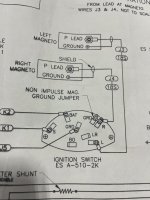
Per Vans original schematic, the shield is always open at the switch. It isn’t connected there at all.
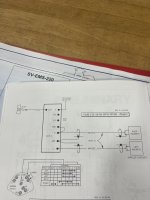
Per Nuckolls and Advance Panel schematics, the shield is connected to ground terminal, which, yes, is open except when P lead is grounded at mags for mag check or on start to ground the non impulse mag.
Here are the two schematics.
They might both work, but both can’t be right. IMG_1034.jpegIMG_1033.jpeg
 
I think the idea of Knuckolls' Z-26 is that instead of relying on airframe grounds daisy-chained through several structural connections back to the magnetos, you're ensuring that there is a good electrical connection from GRD back to the magneto ground connection, for safety reasons. The ignition switch in Z-26 is just completing a circuit from each P-lead to ground, where ground current is going through the shields back to the magnetos. I think any noise you might induce on the P-leads of the magnetos by small currents conducted through the shield is macht nichts. And unless the GRD connection on the switch is tied to the body of the switch and thus to the airframe, there may not be any current path from GRD to the airframe, unless you connect the GRD terminal to the nearest aircraft structure. You could figure that out by measuring the resistance between the GRD terminal(s) and the mounting hardware on the switch with nothing else connected. If you think there might be enough current running through the shield that it's going to generate noise you're worried about, run a shielded pair (P-lead and ground) back to each magneto and connect the shield to ground at one end, and connect GRD on the switch through the other (non P-lead) wires to ground at the magnetos.

You might infer from the above that I am not a fan of relying on airframe structure for grounding, esp. where safety-critical circuits are involved. If so, you're correct.

Edit 3/18/26: Bear in mind that Bob Knuckolls put some thought into how to get electrical systems to work in composite aircraft, where airframe ground is sometimes not an option.
 
Last edited:
Ok. Thx.
I misspoke - in the Nuckolls schematic the shield is always grounded at the ignition switch. In the Vans schematic the shield is never grounded at the switch.
I assume the mag ground is tied to the engine case through the mag? If so, the key switch would be a redundant, or more “fool” proof ground.
I am not concerned about noise.

I am going to wire it per Nuckolls and Advance although I will lay odds there are hundreds if not thousands of Vans aircraft flying per OP-10 without issues.
 
Ground=Ground (usually).. I like to ground shielding at both ends, but usually one grounding point is enough. Somebody mentioned the possibility of noise which makes good sense.
 
There must be some potential for noise as Advance uses the P lead to sense RPM’s, through a 30k resistor.
 
General rule of thumb, keep noise out ground at one end, keep noise in ground at both ends.
(I would ground at both ends).
 
The general wisdon is to use the center conductor to bring the p lead to the switch and send it back to the grd point on the mag via the shield. The signal here is noisy from the magnet and having the two leads together cancels that out, just like twisted pair wires used in telephony and data wiring. Same reason folks bind the + feed and the ground to pitot heat and strobes. Yes, both options work, but one will radiate less emi.
 
I grounded the shield at the mag only because I wanted to avoid a possible ground loop. The engine is grounded to my single point ground at the firewall, so the shield also grounded at the ignition switch would provide a possible loop. I suspect grounding it at the switch may work- if you do experience problems you can always disconnect it as an experiment to fix that problem. I used the word possible twice because ground loops are sometimes hard to predict. 😄
 
I grounded the shield at the mag only because I wanted to avoid a possible ground loop. The engine is grounded to my single point ground at the firewall, so the shield also grounded at the ignition switch would provide a possible loop. I suspect grounding it at the switch may work- if you do experience problems you can always disconnect it as an experiment to fix that problem. I used the word possible twice because ground loops are sometimes hard to predict. 😄
This would be how Vans original plans shows it, at least the OP-10, 20 plus year old version. I had no issues. I would be curious to know how current plans show the shield wiring.

I find it interesting that just when we think we know something, along comes some contradiction to challenge our understanding.

I will be grounding the shield at the switch, per Advance and Nucholls drawings. Essentially grounding the shield at both ends.
 
This would be how Vans original plans shows it, at least the OP-10, 20 plus year old version. I had no issues. I would be curious to know how current plans show the shield wiring.

I find it interesting that just when we think we know something, along comes some contradiction to challenge our understanding.

I will be grounding the shield at the switch, per Advance and Nucholls drawings. Essentially grounding the shield at both ends.
The reason for the method shown in OP – 10 was a conscious engineering decision to make the integrity of the shield connection at the magneto end of the p-lead never be able to have an influence on whether a magneto would be disabled by the ignition switch.
History has shown that the methods that a lot of builders used to make the shield connection at the magneto andwere not very reliable.
If the shield was not being used as the ground path for disabling the magneto, the worst thing that could happen with a breakage would be some ignition noise being induced and potentially the owner investigating what the cause was.
This has been the recommendation from Vans for decades, and as far as I am aware, has never been a cause for any electrical issues, even though it is probably the configuration flying on many hundreds of RVs.
 
The reason for the method shown in OP – 10 was a conscious engineering decision to make the integrity of the shield connection at the magneto end of the p-lead never be able to have an influence on whether a magneto would be disabled by the ignition switch.
History has shown that the methods that a lot of builders used to make the shield connection at the magneto andwere not very reliable.
If the shield was not being used as the ground path for disabling the magneto, the worst thing that could happen with a breakage would be some ignition noise being induced and potentially the owner investigating what the cause was.
This has been the recommendation from Vans for decades, and as far as I am aware, has never been a cause for any electrical issues, even though it is probably the configuration flying on many hundreds of RVs.
Gotcha. Makes sense.
I made the assumption that the Nucholls drawing would have the switch ground lug grounded with a wire, like OP-10. It does not and relies on the shield back to the mag ground lug.
I’ll have to think on what I’m going to do.
 
Gotcha. Makes sense.
I made the assumption that the Nucholls drawing would have the switch ground lug grounded with a wire, like OP-10. It does not and relies on the shield back to the mag ground lug.
I’ll have to think on what I’m going to do.
Just don’t paralyze yourelf with analysis Jon - I am pretty sure that in more than half a century of messing with airplanes, I have done it both ways with no ill effect…..
 
Edited 3/11/26 2 p.m. MST...

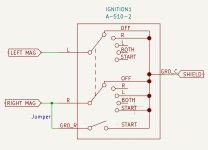
Let me clarify something. On the A-510-2 ignition switch, the center GRD terminal is the main ground terminal for the switch, and the GRD terminal next to the R terminal is connected to the center GRD terminal when the switch is in the START position. Neither one of those terminals is connected to aircraft ground unless you connect a wire from the center GRD terminal to the airframe or a wire that goes to your common ground point. Again, an ohmmeter can be used to confirm.

When you wire the center GRD terminal up to the shields and tie the shields to ground at or near the magnetos as per Z-26, you are making that ground connection to the switch back at the magnetos. Consequently, no current flows on the shield unless the switch is in the L, R, or OFF position. In the OFF position, current won't flow for long because the engine shuts down. In the R position, you're grounding the left magneto and current will flow on the left magneto P-lead and shield, and vice-versa for the L position.

Noise only radiates off the shield when current flows through the shield. In normal operation (BOTH position), neither L nor R is connected to GRD and thus no noise radiates off the shield.

Here, under my interpretation, GRD doesn't mean "this terminal is ground". It means "this is the terminal you connect to ground".

The bottom line, if my understanding is correct, is that the shield is not connected to ground at both ends in the Z-26 diagram. It is only connected to ground at the magneto end.

Here is how I think the switch works in the Z-26 diagram (updated):

A-510-2.jpg

I don't have one to test. Someone who has one and has an ohmmeter can confirm or correct.
 
Last edited:
Let me clarify something. On the A-510-2 ignition switch, the GRD terminals are most likely connected together internally, but most likely neither one of them is grounded unless you connect a wire from at least one of them to aircraft ground. Again, an ohmmeter can be used to confirm.

When you wire at least one of the GRD terminals up to the shields and tie the shields to ground at or near the magnetos as per Z-26, you are making that ground connection to the switch back at the magnetos. Consequently, no current flows on the shield unless the switch is in the L, R, or OFF position. In the OFF position, current won't flow for long because the engine shuts down. In the R position, you're grounding the left magneto and current will flow on the left magneto P-lead and shield, and vice-versa for the L position.

Noise only radiates off the shield when current flows through the shield. In normal operation (BOTH position), neither L nor R is connected to GRD and thus no noise radiates off the shield.

Here, under my interpretation, GRD doesn't mean "this terminal is ground". It means "this is the terminal you connect to ground".

The bottom line, if my understanding is correct, is that the shield is not connected to ground at both ends in the Z-26 diagram. It is only connected to ground at the magneto end.

Here is how I think the switch works in the Z-26 diagram:

View attachment 112138

I don't have one to test. Someone who has one and has an ohmmeter can confirm or correct.
I believe you are correct. My conclusion; it really doesn’t matter and I will take Paul’s advice and move along. It’s currently wired per OP-10 and will stay that way. Scott made some good points and although I have confidence in my wiring, I see the reasoning.
Good discussion regardless. Appreciate all of the contributions!
 
For future reference: the firewall single point ground protects the vulnerable "victim" circuits (headphone audio, mv level engine instruments) from aggressor circuits (10kv+ ignition, radio transmit, strobes). Have fun wiring your RV!
 
Back
Top