Van's Air Force

The definitive Van's Aircraft support community! Buying, building or flying an RV? Join our exclusive family of mentors and enthusiasts!

Loose stick/elevator controls

kirkbauer

Well Known Member
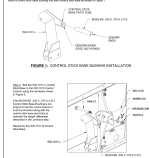
I'm almost done with Section 39 and was trying hard to NOT have any slop or looseness in my controls. I believed I followed the instructions well (picture below):
  • My bushing felt pretty snug inside of the control stick base pivot tube
  • I trimmed the length of the bushing so that it just barely can fit inside the WD-1010 bracket
  • I trimmed the control stick base tube so that it is 0.01" shorter than the brass bushing
But I still have just a little bit of forward/back slop in my stick. I can tell that the WD-1011 is moving slightly relative to the WD-1010, but I can't tell why. Either the AN4 bolt is loose inside of the brass bushing, or the brass bushing is loose inside of the control stick base pivot tube. I think it is possible that if the WD-1011 is a bit too short then it could slide forward and back, but I can tell that's not happening in this case.

I'll be taking it apart soon to try to figure things out, but before I assembled all of it, everything felt quite tight. Is there a common source of this problem and, if so, is there a good solution?
1740350327401.png
 
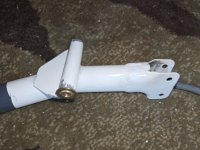
I just went through a similar issue on my 9A. It looks like the setup is the same as what you have on the 10. My issue was mostly due to the fact that the pivot tube was not concentric, so while on one end the bushing fit fairly well, on the other end the pivot tube hole was large enough that the bushing had a significant amount of slop. Someone on VAF stepped in and helped by machining a new bushing to my specs. I reamed the pivot tube to a new size and had the new bushing made to be a slip fit. That fixed most of the slop, but I still had some play due to my pivot tube being ground too short initially (completely my fault). To get rid of the back and forth slop because my pivot tube was too short, I just made the new bushing to be a length that when combined with a thin washer, made the pivot tube fit perfectly in the brackets (the pic is deceptive, the washer actually sets closer to the end of the bushing when it's all tightened down). Now there is zero slop in any direction.

20250222_125047.jpg
 
I have the exact identical issue, haven't addressed it yet, but has always bothered me a bit.
 
I have the exact identical issue, haven't addressed it yet, but has always bothered me a bit.

We have the same issue in our current RV-10 so I was hoping to do just a tad bit better here.

I disassembled everything and I have found that the AN4 bolt is just slightly loose inside of the brass bushing. It's a brand new bushing so I don't think it is anything that I did. Is there a way to address this issue other than machining a custom bushing?
  • Is there such a thing as "ever so slightly larger" AN4-27?
  • Is there something that can fill the space but keep it removable?
  • Any other ideas?
According to the wiki, the brass bushing is supposed to rotate within the base pivot tube, which means the AN4 bolt can be very tight within the bushing... but it isn't.
 
This is a common problem. They take a round tubular piece and weld it on to the stick. The heat warps the tube and now it is no longerr a perfect circle with consistent dimensions. When doing work like this, you are supposed to use an undersized piece and ream it after welding. I have a lathe and made bushings that tapered to fit better, but should have bought a reamer and made a bushing like the above poster. My effort improved the fit enough that it doesn’t bother me. You can’t ream to the original 3/8”, as some of the warping goes bigger than that. Think of squeezing a soda can. Two sides shrink and two sides grow.
 
We have the same issue in our current RV-10 so I was hoping to do just a tad bit better here.

I disassembled everything and I have found that the AN4 bolt is just slightly loose inside of the brass bushing. It's a brand new bushing so I don't think it is anything that I did. Is there a way to address this issue other than machining a custom bushing?
  • Is there such a thing as "ever so slightly larger" AN4-27?
  • Is there something that can fill the space but keep it removable?
  • Any other ideas?
According to the wiki, the brass bushing is supposed to rotate within the base pivot tube, which means the AN4 bolt can be very tight within the bushing... but it isn't.
The fit of the bolt to the bushing doesn’t matter since the design intent of the assembly is for the stick to pivot on the bushing with the bushing stationary and captured by the bolt.
The reason a castellated nut and cotter pin is used is because it is fairly common for the two ears on the control column to not be exactly square and parallel to each other. When that is the case, fully torquing a self locking nut will deflect the bushing so that it is no longer straight, which then causes increased resistance in the pivoting of the stick.
Having the castellated nut allows you to torque it just enough that the bushing is captured and won’t rotate.
It is also beneficial to adjust the angle of each end of the bushing so that it will nest with full contact on each ear of the control column.
 
Last edited:
Looks like I have some work to do here if I want to eliminate the control stick play I have. To be honest, I only notice it in the hangar. I really don't notice it when I'm in the run-up area (testing full deflection of all control surfaces), or when flying. But it still bothers me a little.
 
The sticks on my 1999 RV-6 have always had a small amount of play which can be noticed in the hangar. However, it has never degraded the fantastic control response or prompted me to give it any thought in flight so will continue to fly "as is". This reminds me of when autopilot servos first came into common use and many complained about the "drag" of the servos which could be felt in the hangar but was completely unnoticeable in flight. Some "problems" may not have a practical need for resolution.
 
The fit of the bolt to the bushing doesn’t matter since the design intent of the assembly is for the stick to pivot on the bushing with the bushing stationary and captured by the bolt.
It's possible that I didn't tighten the AN4 bolt enough -- I will try again and see if that makes a difference because what you are saying does make sense.

The sticks on my 1999 RV-6 have always had a small amount of play which can be noticed in the hangar. However, it has never degraded the fantastic control response or prompted me to give it any thought in flight so will continue to fly "as is".
It's a good point. On my current RV-10 it is definitely noticeable in flight, but it's possible this new one is much less significant and therefore wouldn't be noticeable.
 
Ok, great news, and I'm passing it along in the hopes that it helps others. While it is true that the AN4 bolt is fairly loose inside of the bushing, it is also true that it doesn't matter, as long as the AN4 bolt is tightened sufficiently. Once the AN4 bolt is tightened sufficiently, the bushing should no longer rotate when the stick is moved. The AN4 bolt's just is simply to secure that bushing and keep it firmly in place.

Once I fully tightened the AN4 bolt the looseness has gone away (sadly I didn't understand that interaction originally). So for others that have a similar problem, I assume it is one of the following factors:
  • Control stick to Stick Base connection is loose
  • AN4 bolt is not tightened enough, allowing the brass bushing to move
  • Control stick base pivot tube is too short, allowing it to slide forward/back along the bushing (it is supposed to be 0.01" shorter than the bushing)
 
I wanted to update here as I assisted the original builder with the annual condition inspection of our flying RV-10 this weekend and we took the time to remove the left control stick and made some changes to address the looseness in our current plane. Both sticks had some looseness but the left one was worse.

1) The base of the left stick was definitely slightly loose inside of the WD-1011 bracket. A little movement at the base is more noticeable at the top of the stick. We carefully enlarged the holes and installed an AN4 bolt in lieu of the AN3 bolt.
2) The WD-1011 was sliding within the WD-1010 bracket. We found that a AN960-616L washer fit perfectly around the end of the brass bushing to fill in that gap.
3) The AN4 bolt on both sides securing the brass bushing to the WD-1010 bracket was not particularly tight. I'm unclear if fully torqueing castle nuts is the default that you should do, but I do know that there are places where you don't want to fully torque them. In this case, we tightened them to try and find balance between minimal forward/back movement but not overly compressing the bracket.

In the end we removed 100% of the looseness with these changes. The left/right aileron movement on the sticks is a little bit stiffer, but neither of us really have something to compare against. So I'm not sure if we overdid it a bit. We could back out the two castle nuts 1/6 turn and see how that affects things.
 
Back
Top