Van's Air Force

The definitive Van's Aircraft support community! Buying, building or flying an RV? Join our exclusive family of mentors and enthusiasts!

Looking to Buy SLSA

lathansalex

I'm New Here
Hi everyone - first post on Vans Air Force. My name is Alex and I'm looking to buy an RV12. I've been training in RV12s up in Portsmouth NH and absolutely love this plane. Problem is: RV12is aircraft are on a 9 month backorder, and Vans doesn't sell any RV12s anymore. Most RV12s for sale out on Controller or Barnstormers are E-LSAs. So if anyone has any ideas or tricks for getting my hands on a Vans SLSA, that would be a huge help.

Let me know!
 
Hi everyone - first post on Vans Air Force. My name is Alex and I'm looking to buy an RV12. I've been training in RV12s up in Portsmouth NH and absolutely love this plane. Problem is: RV12is aircraft are on a 9 month backorder, and Vans doesn't sell any RV12s anymore. Most RV12s for sale out on Controller or Barnstormers are E-LSAs. So if anyone has any ideas or tricks for getting my hands on a Vans SLSA, that would be a huge help.

Let me know!
Nothing to add on the 12, but when you're done, take their spin class in the Alpha. I went up there in Dec for my grandfathers funeral and snuck in the time. It was a blast! I also kind of did it as a tribute to my grandfather, he retired out of Pease as an F-111b instructor after doing most of his career in B-52's. It was cool to use the runway he used so many times. But dang, that little robin felt so small on it!
 
Trade-A-Plane frequently lists SLSAs. Realize that an ELSA is identical to an SLSA in every respect, as long as workmanship is verified by a reliable prebuy inspection.
 
Nothing to add on the 12, but when you're done, take their spin class in the Alpha. I went up there in Dec for my grandfathers funeral and snuck in the time. It was a blast! I also kind of did it as a tribute to my grandfather, he retired out of Pease as an F-111b instructor after doing most of his career in B-52's. It was cool to use the runway he used so many times. But dang, that little robin felt so small on it!
Wow so cool! I'll have to try that for sure.
 
Trade-A-Plane frequently lists SLSAs. Realize that an ELSA is identical to an SLSA in every respect, as long as workmanship is verified by a reliable prebuy inspection.
Interesting. What is the process for verifying the safety of the build on an ELSA?
 
For two reasons 1) to have the possibility of leasing it to a flight school and 2) Maybe I'm mistaken on this, but it's my understanding that E-LSAs don't have the best safety record.
The safety of either is only as good as the quality of the DAR inspection or last condition inspection.
 
Find someone who has experience with homebuilts, and especially RVs, to do the prebuy. Vic Syracuse comes to mind. However, you’re correct that you would not be able to leaseback an ELSA (cannot be used for commercial purposes).
 
Find someone who has experience with homebuilts, and especially RVs, to do the prebuy. Vic Syracuse comes to mind. However, you’re correct that you would not be able to leaseback an ELSA (cannot be used for commercial purposes).
Wow super helpful - thank you! I'll look into this for sure.
 
Maybe I'm mistaken on this, but it's my understanding that E-LSAs don't have the best safety record.

According to Ron Wanttaja...


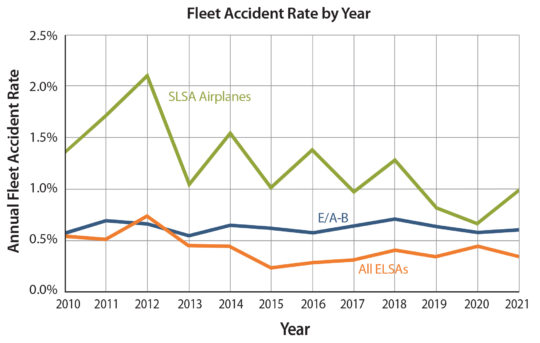
... E-LSAs have a better safety record than E-ABs (not super surprising)... and, somehow, a better safety record than S-LSAs! (Surprising!)

SLSA_0524_Chart2-540x343.jpg
 
... E-LSAs have a better safety record than E-ABs (not super surprising)... and, somehow, a better safety record than S-LSAs! (Surprising!)

Correlation is not causation, though... there are lots of S-LSA aircraft in flight schools and no E-AB or E-LSA, which I imagine might skew the statistics.
 
Trade-A-Plane frequently lists SLSAs. Realize that an ELSA is identical to an SLSA in every respect, as long as workmanship is verified by a reliable prebuy inspection.
This is only true at the moment the ELSA’s airworthiness certificate is issued.
After that the owner is free to change and modify as desired, as long as a modification doesn’t change aircraft performance to be outside of the basic requirements for an LSA. I’m not saying that a modification is automatically a bad thing but I have seen some that in my opinion are.
An unsuspecting new owner could thing they bought an exact copy of a SLSA, when they didn’t.
 
There SHOULD be zero difference between SLSA and ELSA aircraft. As aircraft builds go, the RV12 is not difficult
I agree that it is not difficult to build but this is true about any of the current Van's models. Some take longer than others but for the most part the same skills are needed across the board. The 12IS while very well engineered still requires allot of work. In some ways it is more complex than any of the other Van's models. The flight controls are definitely more complicated. The powerplant is more complicated in many ways. The electrical system is also very complex compared to a Bob Knuckles style airplane. Like Scott mentions above, there should be little if any difference in how an S-SLA an an E-LSA are constructed but remember that the E-LSA owner can change whatever they want after it is issued its birth certificate.
 
There SHOULD be zero difference between SLSA and ELSA aircraft. As aircraft builds go, the RV12 is not difficult.
My E-LSA RV-12 has a three bladed Whirlwind prop, a remote mounted Dynon comm radio, and electronic circuit breakers (VP-X) instead of those automotive fuses. S-LSA aircraft are usually converted to E-LSA so that there CAN be differences with the S-LSA.
 
Correlation is not causation, though... there are lots of S-LSA aircraft in flight schools and no E-AB or E-LSA, which I imagine might skew the statistics.

For what it's worth, Ron Wanttaja's hypotheses are the following. Long story short: Most E-LSAs (all of them, when the regulations first came out) are/were "fat ultralights": they were past their infant-mortality stage, damage often went unreported, and they don't fly very many hours (e.g. none in flight schools like you said). So, yeah, some confounding factors there.

Why is the rate for ELSAs so low? A couple of things come to mind.
  • First, the majority of the airplanes licensed as ELSA prior to 2008 had already been flying as ultralights. First-flight accidents occur to about one in 150 homebuilts, but these preexisting fat and two-seat ultralights had already been through their infant mortality period. They had less of a chance of mechanical failure. The pilots already had experience in them, too—fewer chance for bumbling the first flight.
  • Second, most of these airplanes were glorified ultralights, even if they exceeded the Part 103 limitations. They weren’t flying all that fast, and ultralight pilots are probably a bit more accustomed to fixing bent tubing without making it a (literal) federal case. Unless injuries are involved, many Experimental pilots have proven reluctant to report their accidents to the NTSB.
  • Third, the certification of new Grandfathered ELSAs ended over 15 years ago. Beyond 2009 or so, there were no Grandfathered ELSAs making their first flights or undergoing the Phase I test period. In comparison, almost 13% of all E/A-B accidents occur during the first flight or the test period.
  • Finally, realize that Figure 3 shows the number of accidents divided by the number of registered aircraft in a given year. It does not reflect the flying time of the aircraft involved. The 2021 FAA General Aviation Activity Survey says that Special Light Sport Aircraft fly, on the average, more than twice as many hours as Experimental Light Sport Aircraft. After all, the whole intent was to produce a new series of trainer and rental aircraft.
When you account for the fact that the SLSAs are flying twice as much as the ELSAs, it appears that on a per-hour basis, the accident rate for the two are very similar. It’s still a good reflection on ELSAs that the per-hour accident rate isn’t much different than the LSAs sold ready to fly.

 
More generally... I followed the same journey as you: started renting an S-LSA RV-12, loved it, got fed up with rental availability, bought my own (and now have over 300 hours in it). I think the E-LSA was the right choice for a lot of reasons:
  • As others have mentioned, an E-LSA starts out as an exact down-to-the-rivet copy of an S-LSA; so at least you're starting from a known point.
  • If an E-LSA has an issue, you can fix it however you like. If an S-LSA has an issue, you are very closely bound to manufacturer instructions, even more so than with a certificated aircraft. In particular, parts availability for legacy RV-12 S-LSAs can be a problem; Van's still supports them but it can be a slow process.
  • A secondhand S-LSA RV-12 could be a former flight school or rental aircraft, and so may have had a much harder life than an E-LSA. (I'm not saying "never buy a former flight school plane" but it's something to consider as a factor in the overall condition.)
  • Also as mentioned, an E-LSA with the right avionics can fly IFR in IMC; an S-LSA can't, due to ASTM paperwork requirements.
  • Just like with a certificated aircraft, there is still a possibility that a former owner performed undocumented modifications. Just because it's illegal doesn't mean it doesn't happen; I've talked to one S-LSA RV-12 owner who's had to un-do such changes from previous owners.
As an example, I installed the F-12132 headset brackets from the 12iS on my E-LSA RV-12; it wouldn't be legal to do that on an S-LSA without explicit permission from Van's. When SB-00059 came out, I replaced the affected part with a screwdriver in about 3 minutes, but a certified mechanic (LSRM or A&P) would have had to do so on an S-LSA.
 
I'm dancing around on this issue right now. I think E-LSA is a better choice in all areas of consideration except the ability to rent the aircraft out. If you want to use it in a flight school or as an individual instructor/operator, it needs to be an S-LSA to be profitable.
 
Back
Top