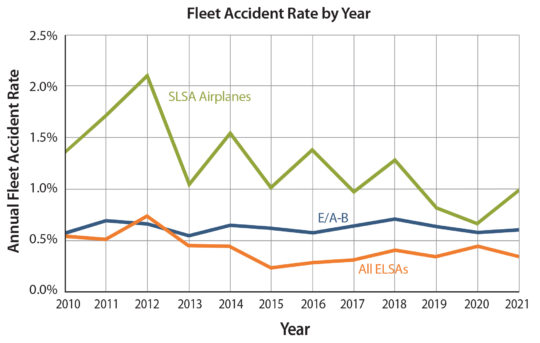
Why is the rate for ELSAs so low? A couple of things come to mind.
- First, the majority of the airplanes licensed as ELSA prior to 2008 had already been flying as ultralights. First-flight accidents occur to about one in 150 homebuilts, but these preexisting fat and two-seat ultralights had already been through their infant mortality period. They had less of a chance of mechanical failure. The pilots already had experience in them, too—fewer chance for bumbling the first flight.
- Second, most of these airplanes were glorified ultralights, even if they exceeded the Part 103 limitations. They weren’t flying all that fast, and ultralight pilots are probably a bit more accustomed to fixing bent tubing without making it a (literal) federal case. Unless injuries are involved, many Experimental pilots have proven reluctant to report their accidents to the NTSB.
- Third, the certification of new Grandfathered ELSAs ended over 15 years ago. Beyond 2009 or so, there were no Grandfathered ELSAs making their first flights or undergoing the Phase I test period. In comparison, almost 13% of all E/A-B accidents occur during the first flight or the test period.
- Finally, realize that Figure 3 shows the number of accidents divided by the number of registered aircraft in a given year. It does not reflect the flying time of the aircraft involved. The 2021 FAA General Aviation Activity Survey says that Special Light Sport Aircraft fly, on the average, more than twice as many hours as Experimental Light Sport Aircraft. After all, the whole intent was to produce a new series of trainer and rental aircraft.
When you account for the fact that the SLSAs are flying twice as much as the ELSAs, it appears that on a per-hour basis, the accident rate for the two are very similar. It’s still a good reflection on ELSAs that the per-hour accident rate isn’t much different than the LSAs sold ready to fly.