Van's Air Force

The definitive Van's Aircraft support community! Buying, building or flying an RV? Join our exclusive family of mentors and enthusiasts!

Lifting Tail Wheel W&B

Karetaker

Well Known Member
Howdy everyone. I am curious best way to grab and lift tail; by the tail spring, horizontal stabilizer at roots, or...? Also what is an estimate tail wheel height for leveling; 2 feet, 3 feet...? I don't currently have any type of lift so I need to know about how tall I may need to make something to hold the tail.

Much obliged.
 
The tail spring is a safe way to lift it - for the airplane. Your back might not like it (it’s sort of a sideways, twisting lift….), but that’s how most do it if they don’t have a TailMate (or similar) lift.

It’s going to be several feet in the air - the airplane is level when the longerons at the cockpit are level.
 
When I did my W&B, I made a platform for the tail that was big enough to accommodate a scale, and measured the weight on all three wheels simultaneously with the fuselage level.

Then later, I realized this method would be easier:
  1. With the airplane sitting on the ground, use three scales under all three wheels to get the total weight.
  2. Put main wheels onto two scales, and use a tail lift to level the fuselage.
  3. Calculate the weight on the tail by subtracting line 2 from line 1.
Since I was already set up to do this, I went ahead and tried it. The results were identical, as the math predicts. The advantage is that you can use a tail lift without trying to get a scale under the tailwheel when it's up in the air.

One other tip: To avoid side-loading the scales due to the gear flexing, either build a low ramp so you can roll the plane onto them, or else use a few layers of slippery trash bag material to allow them to slide to a relaxed position when you lower them from the jacks.
 
I made a tailwheel stand out of 2x4 lumber and plywood years ago when I was building, which sounds like what you're trying to do. I found it easier to have the plane level when working inside so that you don't slide downhill. It's still used on and off to this day. I'll be down at the airport later today if you want me to measure the height of the stand, but I'm guessing it's a little over three feet high.

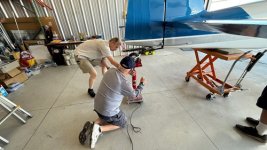
Regarding lifting it up there, we make it a two-person job for safety reasons. Chock the main wheels first, then one person lifts the tailwheel spring (and yeah, it's just shy of 100 pounds on the ground), then the other person slides under the tail just forward of the spring and holds the bottom of the fuselage up. The original person lifting the tail is now free to get the wood stand and slide it into place under the tailwheel. Incidentally, there are a couple eye bolts on the stand so the tailwheel can be tied in place. If it were to fall off the stand, it would be a very bad day.
 
The height of the stand I made is 34". With a Doug Bell tailwheel fork and a lightweight tailwheel, the sides of the cockpit at the longhorns are level when the tailwheel is sitting on the stand. If you have a Van's tailwheel and a standard fork, the measurement may be slightly different. If in doubt, build it a little low and you can always shim up to the correct height with plywood. It's really tough to shim down, though.
 
Thanks everyone. I used an existing wood box I had made years ago that worked just fine. Plane is now sitting level and ready for weight and arm measurements.
 
It took a few years to figure out that if you jack up the the whole AC with a pair of hydraulic jacks @ the main tiedowns on the wings ,usually screw in a pair of 3/8 X 2 “ carriage bolts , the tail lifts off the ground without any other input! This is especially helpful if later on when the tail gets way heavier with any amount of fuel in the tanks ,
 
Howdy everyone. I am curious best way to grab and lift tail; by the tail spring, horizontal stabilizer at roots, or...? Also what is an estimate tail wheel height for leveling; 2 feet, 3 feet...? I don't currently have any type of lift so I need to know about how tall I may need to make something to hold the tail.

Much obliged.
IMG_0787.jpg
My tail wheel weight is 57 pounds. I had the luxury of a proper jack stand designed to hold the tail wheel securely and then jack up to the proper height to level the airplane.
 
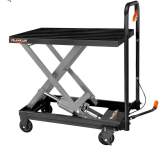
I have a Harbor freight motorcycle jack for my Harleys, and made a box that sits on top of it for extra height..whatever you use, it's nice to be able to pump it up/bleed it down to get the plane leveled at the longerons for W&B or instrument leveling.
 
..whatever you use, it's nice to be able to pump it up/bleed it down to get the plane leveled at the longerons for W&B or instrument leveling.

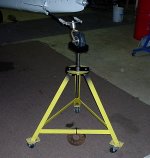
Yep, because not all the airplanes are the same. Built this stand with a length of acme screw and a nut welded to a baseplate. Re-purposes an ordinary engine stand that doesn't get used all that often. Allows infinite adjustment to level any tailwheel airplane. The cup captures the tailwheel, but is replaced with a flat platform for a scale.

Lifting is done with a two part line and a snatch block, hanging from a hangar crossmember...fast and easy.

P8220005.JPG
 
What about using an engine hoist at the tail with a strap that goes under the fuse just in front of the stab to level the airplane and useing the method Matt suggested to get the weights (post #4)?
 
When I did my W&B, I made a platform for the tail that was big enough to accommodate a scale, and measured the weight on all three wheels simultaneously with the fuselage level.

Then later, I realized this method would be easier:
  1. With the airplane sitting on the ground, use three scales under all three wheels to get the total weight.
  2. Put main wheels onto two scales, and use a tail lift to level the fuselage.
  3. Calculate the weight on the tail by subtracting line 2 from line 1.
I have used this method to weight many tailwheel aircraft. RV's have the advantage of being light enough on the tail that you don't really need a stand, just a couple of friends handy. One to eyeball the level, and another to read the two scales on the main wheels. You can hold the tailwheel by hand steady enough for a reading.

What's annoying is that in half the cases I've needed to do it both ways (lifting without a scale and putting on a stand with a third scale) to prove to the greybeards supervising that this way was faster and no less accurate...
 
Back
Top