

Van's Air Force
You are using an out of date browser. It may not display this or other websites correctly.
You should upgrade or use an alternative browser.
You should upgrade or use an alternative browser.
Leaking radiator troubles - RV-12iS
- Thread starter fehdxl
- Start date

RV-12iS, 223 hours. Major radiator leak in July of this year.. Ordered new one from Van’s, back ordered, due in Mid SeptemberHi folks,
Is your RV-12iS radiator leaking? A little? A lot? Or totally dry?
We’ve been having an on-going issue with multiple radiators that’s pretty frustrating… just trying to see what’s going on with the rest of the community and see what fixes have been done and such.
Thanks. Fly safe!
-Jim

mrpilotron
Member
Ggbrewer, are you grounded while waiting? I may be able to help.
RV-12iS, 223 hours. Major radiator leak in July of this year.. Ordered new one from Van’s, back ordered, due in Mid September
YES!Ggbrewer, are you grounded while waiting? I may be able to help.

mrpilotron
Member
Well, as a public service to help the grounded guys I can provide patched radiators that have epoxy repairs on the leaky spot. They may or may not be long-term fixes, but they will get you flying until the supply chain resumes. Send me a PM and we can discuss details.

DanFrazer
Active Member
I was notified today that my powerplant kit has shipped but without a radiator. I ordered the powerplant kit in May 2023. I’m very excited as this is the last kit I need to get my plane in the air.
When I asked when I should expect the radiator to ship so I can complete my build, they said the next shipment will be May 2025.
When I asked when I should expect the radiator to ship so I can complete my build, they said the next shipment will be May 2025.
New radiator arrived 13 November!YES!

Glad to hear it - unfortunately they didn't get enough from the vendor so still waiting.New radiator arrived 13 November!
DanFrazer
Active Member
Are there any differences with the new radiators vs. old? Or are the changes made as part of the SB the only differences?New radiator arrived 13 November!
Jarett.Locklear
I'm New Here
How long did this fix last? I am about to attempt it, and am looking for guidance if it worked or not?radiator leak repair
A friend of mine has an RV12 and has had 2 radiator failures. He's 87 and loves to fly, so I wanted to help him get back in the air. His newest radiator had a small pinhole leak on the lowest row of water tubes. It was coming from a spot where the tiny fins are attached to the tubes. The repair method I chose to use may not be long term. Only time in service will reveal if it's a good method to salvage an existing bad radiator. I cut out a small area of the outside of the tanks to gain access to the lowest water tubes. Once I had access I used a very small stainless steel wire brush to clean off the aluminum around the water tubes. After that I carved 2 small pieces of balsa wood to be inserted into the water tubes. The wood plug is slightly oversize. Balsa is soft and it's easily compressed using needle nose pliers. I squashed it to the size needed to fit into the water tube. The balsa expands once it's pushed into the tube to tightly fit the tube. I pushed the wood in about 1/8th inch below the end of the tube. I used regular overnight cure J B Weld epoxy to fill in those 2 water tubes and then built up a mound of epoxy over the 2 tubes to encapsulate them. By doing this on both ends of the radiator you prevent any water from going though those 2 lower tubes. After everything had cured for a minimum of 24 hours, I welded patches over the areas I had cut out. J B Weld is good for up to 550 degrees F. once fully cured. Do NOT use the Kwik Set J B Weld for this type of repair. It does not have the same tolerance for heat as the slow cure J B. When I did the welding, I did it in short increments and cooled the area immediately with a wet rag to keep the heat affected area below what would potentially damage the J B Weld epoxy. Once it cooled, I did more welding and repeated the procedure until everything was fully welded. My friend has only flown his RV twice since the repair, but so far it's OK. He flies at least 3 - 5 times per week. If it starts to leak again, I'll post something in this thread. He'll likely replace the radiator with the new improved version from Vans once they become available. For now, he's very pleased that he can fly again.
Cheers
Enzo
Yes the new radiator has the modifications called for in the applicable S/B. But, after installing the new radiator IAW the S/B I still have only a fingernails width of clearance between the cowling and radiator on the upper right side. This is the same place my old radiator had obviously been contacting the cowling. I’m now looking at my options.Are there any differences with the new radiators vs. old? Or are the changes made as part of the SB the only differences?
My friends repaired radiator is still doing fine. He flies the plane at least 4 times per week, and sometimes more. He bought one of the new upgraded radiators, but it didn't come with the proper brackets, so he reinstalled the one I repaired for him and as of today he has no plans to put the new one back in as long as the repaired one keeps being trouble free. Based on our success, I'd suggest my repair method as being reliable and worth doing, especially if you can weld or you have a friend that can do the welding. I don't know what a welding shop would charge to weld the tank patches on. Once the tanks are opened to gain access to the leaking tube it's an easy process to block that tube or tubes on both ends to keep any water from flowing through it. The important thing is to use the slow cure high temp tolerant JB Weld and not the 5 minute cure version of the product. It's important to do the weld in small sections and to cool the area as you go to keep from overheating the epoxy.How long did this fix last? I am about to attempt it, and am looking for guidance if it worked or not?
Cheers
Enzo

CessnaTPA
Well Known Member
I'm now a member of the leaking radiator club on my 912iS with 141 hrs.
I haven't done the SB and put it off because I was under the impression the cowl hitting the radiator was the culprit and I had added 1/16" more clearance than the KAI calls for. The day I noticed the leak was after a cold morning start and the engine sputtered a few seconds before it smoothed out. Maybe those vibrations caused the leak? I'll never know if I had done the SB if it would have prevented the leak, but for those putting it off I'd go ahead and do it.
I'm going to look into Enzo's fix while I wait for Van's to get them back in stock.
I haven't done the SB and put it off because I was under the impression the cowl hitting the radiator was the culprit and I had added 1/16" more clearance than the KAI calls for. The day I noticed the leak was after a cold morning start and the engine sputtered a few seconds before it smoothed out. Maybe those vibrations caused the leak? I'll never know if I had done the SB if it would have prevented the leak, but for those putting it off I'd go ahead and do it.
I'm going to look into Enzo's fix while I wait for Van's to get them back in stock.

Tony - congrats on 141 hrs! You're not letting dust accumulate on the surfaces.I'll never know if I had done the SB if it would have prevented the leak, but for those putting it off I'd go ahead and do it.
My replacement radiator was the original design and I have chosen to not perform the SB. The vibration is the most likely culprit and performing the SB would apply twisting forces and vibration to the radiator possibly accelerating the the arrival of the leak. Most certainly this latest radiator will begin leaking but I will get the most flight hours out of it that I can. I will replace with the new radiator design when this occurs. Before purchasing the new design I will take the radiator to a shop (telling them it is from a lawn mower or a go-cart or something, anything but airplane) and see if it is repairable.
I do recommend dynamic balancing of the propeller to reduce vibration.
CessnaTPA
Well Known Member
I had the prop balanced before 1st flight. It's interesting you feel the SB will do more harm than good, what do you base that on?Tony - congrats on 141 hrs! You're not letting dust accumulate on the surfaces.
My replacement radiator was the original design and I have chosen to not perform the SB. The vibration is the most likely culprit and performing the SB would apply twisting forces and vibration to the radiator possibly accelerating the the arrival of the leak. Most certainly this latest radiator will begin leaking but I will get the most flight hours out of it that I can. I will replace with the new radiator design when this occurs. Before purchasing the new design I will take the radiator to a shop (telling them it is from a lawn mower or a go-cart or something, anything but airplane) and see if it is repairable.
I do recommend dynamic balancing of the propeller to reduce vibration.
So is it confirmed there is a new and improved design in the works?
The SB involves cutting the radiator frame. This will involve clamping the radiator to a workbench (or wrapped in a rag and put in a vice) or some other method of holding it in place and taking a cutting tool to it. My thought is this would be quite a bit of vibration to complete the task. Could be the amount of vibration of one engine start and shut down or the vibration equivalent of 200 hours flight time, I don't know, but vibration none the less.It's interesting you feel the SB will do more harm than good, what do you base that on?
The new radiator design has a new frame/mounting design.
CessnaTPA
Well Known Member
I followed Enzo's repair and feel confident it's going to work. Thanks for sharing your fix.I'm now a member of the leaking radiator club on my 912iS with 141 hrs.
I haven't done the SB and put it off because I was under the impression the cowl hitting the radiator was the culprit and I had added 1/16" more clearance than the KAI calls for. The day I noticed the leak was after a cold morning start and the engine sputtered a few seconds before it smoothed out. Maybe those vibrations caused the leak? I'll never know if I had done the SB if it would have prevented the leak, but for those putting it off I'd go ahead and do it.
I'm going to look into Enzo's fix while I wait for Van's to get them back in stock.
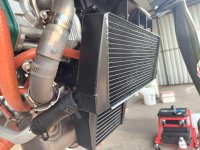
As added insurance to mount the radiator more securely, we recently made and installed the aluminum angle brackets designed by CT Cole to my friends RV. The weld repair I did is still doing great, and hopefully it will work as well for others. This forum is a great place for everyone to share their solutions to this radiator problem.
Cheers
Enzo
Cheers
Enzo
RomeoHotel
I'm New Here
We've ordered our PP kit in May 2023. It arrived in December 2024 without the radiator. Van's tells us they haven't found an "engineering solution" yet and don't know when the radiator will be shipped. I spoke to one of the main Rotax distributor in Europe and was told that this is a know issue with any radiator mounted directly to a Rotax engine. Apparently, there is enough twisting going on when revving the engine to damage the radiator. They recommended detaching the radiator from the engine and mounting it to the cowling (in a detachable way). Just leaving this here, maybe it helps someone who is further along in the build.
