Van's Air Force

The definitive Van's Aircraft support community! Buying, building or flying an RV? Join our exclusive family of mentors and enthusiasts!

Jettisoning a canopy

Berchmans

Well Known Member
Sponsor
In searching the site a bit I couldn't find a real simple way to rig a canopy for jettisoning while performing aerobatics. Below is my solution.


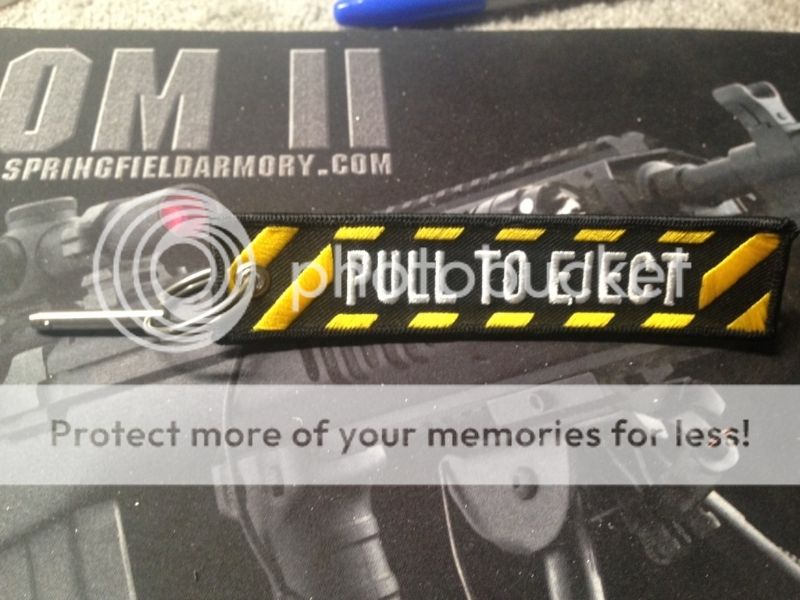
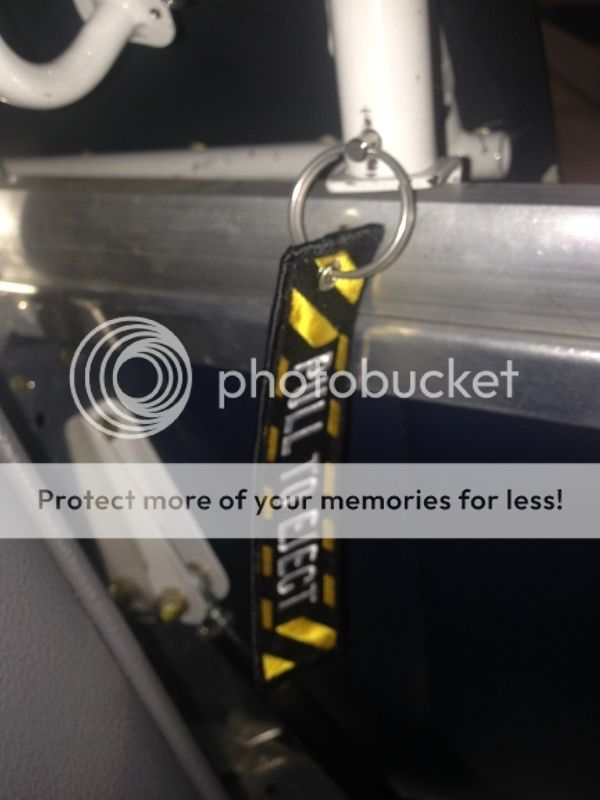
Using a quick release pin I replaced the original fasteners that hold the canopy rollers in place. I put a pull strip on the pin to make it easy to grab onto.


See pin in place on left side roller.

The pin is a 3/16" Dial by .8" usable length. McMaster-Carr carries them, part no. 95255A216. They fit perfectly. I looked at the other styles with "T" and "D" handles but it looked as if they would strike the mid cabin brace sliding the canopy for and aft. There is not wobble in the rollers when secured by these pins.
 
great idea

That will work perfectly by just replacing the bolts with the pins. I assume you had the pull tag custom designed locally?
Thanks,
Bill McLean
RV-4 slider
lower AL:)
 
My experience with a partially open canopy in flight is there was a load on it, it would not move open or closed. (RV-7 not 8)

That load will be on the pins and they may not come out easily. Or if one comes out, the canopy may become cocked with a greater load on the other.

And there is no way to test it, is there. :)
 
My experience with a partially open canopy in flight is there was a load on it, it would not move open or closed. (RV-7 not 8)

That load will be on the pins and they may not come out easily. Or if one comes out, the canopy may become cocked with a greater load on the other.

And there is no way to test it, is there. :)

I agree.
That is why I have always recommended to anyone doing this mod., that the procedure they use is to pull the pins before unlatching the canopy. Then pull aft on the handle without inserting fingers.

If you test it let us know if it works :D
 
Canopy Jettison

I have an -8A with nearly 700 hours on it - 496 flights and counting. After reviewing as much data as I could find, I put canopy jettison/bailout in the "Just something to keep you busy 'til you crash" category.
 
Agree

I agree with all the comments...but the IAC requirements are that it be jettisonable...not that it necessarily be easy to jettison...of note I did fly the plane and pulled each pin while in flight with the canopy latched...they don't pull as easily as they do on the ground but they do come out...also if tumbling I assume that there will be moments when the canopy will be unloaded...and yes you may wind up on the ground holding on to the pins with a perfectly good chute strapped to your butt...oh and the little flags are keychain fobs from one of the local FBO's. I tested them to 100 lb pull and they did not tear...normal people don't do aerobatics anyway, right? Flying weather in Anchorage has been outstanding for the last few days, severe clear and no winds...
 
There is one test in the accident database on a RV-7

And there is no way to test it, is there. :)

Well there was one that was tested the hard way:
I have read all of the accident probable causes in the accident database for the RV-3, -6, -7, -8, -9, -10, and -12's. Have not finished the RV-4.

Out of all the accident reports, this is the one that made me cringe the most, probably because of the unsuspecting nature of it while knowing the inevitability of the outcome while falling from 8500 feet. This accident report would seem to indicate that the sliding canopy for the RV-7 cannot support the body weight of the pilot when inverted when the pilot forgets to attach his seatbelt. Think you have too much experience to do this? This pilot had over 2300 hours.

From the accident report:
FAA records indicated that he held a valid Private Pilot's certificate and had about 2,328 flights hours...
One of the canopy roller tracks was not found. The found roller track exhibited deformations about 8 inches aft of the forward ends on its left and right sides consistent with the attachment rollers being pulled from their tracks in an upward direction.
? Given the location of the pilot?s body and the acrylic canopy parts and the witness?s statement, it is likely that the pilot lost control of the airplane, which then inverted, and that the pilot subsequently fell through the open canopy

The full narrative below:
Accident number: CEN11FA634 http://ntsb.gov/_layouts/ntsb.aviation/brief2.aspx?ev_id=20110909X24928&ntsbno=CEN11FA634&akey=1

The pilot?s in-flight loss of control. Contributing to the pilot?s fatal injury was his failure to use the available restraint systems, which resulted in him falling through the open canopy when the airplane inverted.

The private pilot was flying his experimental home-built airplane on a visual flight rules (VFR) cross-country flight. While en route, the pilot requested VFR flight following services from air traffic control. A review of radar data revealed that, at the time of the request, the airplane was level at 8,500 feet. About 6 minutes later, radar and radio contact were lost. No distress calls from the pilot were reported. A witness who was working near the accident site reported hearing a very loud revving engine noise. When he looked up, he saw the airplane flying upside down. He also stated that he did not see a cockpit or a pilot in the airplane. A few seconds later, the airplane passed behind a stand of trees and out of sight. He went to the impact site and found the wreckage but not the pilot.
First responders reported that the wreckage was mangled and spread across a soybean field in a southerly direction. Ground scars at the accident site indicated that the airplane impacted the ground at a high velocity in a wings-level, slightly nose-down attitude and inverted. The engine and propeller assembly exhibited evidence consistent with high power at impact. All of the flight control surfaces were accounted for at the main wreckage site. Flight control continuity was established from the cockpit to all of the flight control surfaces, and no evidence indicated that any of the flight controls were disconnected or otherwise separated before impact. The pilot?s body was found about 1 mile northwest of the airplane wreckage. Canopy parts were found about 3/4 mile northwest of the wreckage, and various pieces of the acrylic canopy were found scattered for about 1/2 mile southward. One of the canopy roller tracks was not found. The found roller track exhibited deformations about 8 inches aft of the forward ends on its left and right sides consistent with the attachment rollers being pulled from their tracks in an upward direction. The pilot and copilot lap seat belts were found attached to their respective anchor points with no evidence of overload failures or stresses on any of the latching blades or buckles consistent with the buckles not being latched at the time of impact. The pilot?s autopsy findings did not show any evidence of incapacitation, and toxicological tests were negative for drugs and alcohol. The on-scene evidence indicates that the airplane was likely controllable and that the engine was producing power at the time of impact. Given the location of the pilot?s body and the acrylic canopy parts and the witness?s statement, it is likely that the pilot lost control of the airplane, which then inverted, and that the pilot subsequently fell through the open canopy. The reason for the pilot?s loss of control of the airplane could not be determined.

 
I agree with all the comments...but the IAC requirements are that it be jettisonable...not that it necessarily be easy to jettison...of note I did fly the plane and pulled each pin while in flight with the canopy latched...they don't pull as easily as they do on the ground but they do come out...also if tumbling I assume that there will be moments when the canopy will be unloaded...and yes you may wind up on the ground holding on to the pins with a perfectly good chute strapped to your butt...oh and the little flags are keychain fobs from one of the local FBO's. I tested them to 100 lb pull and they did not tear...normal people don't do aerobatics anyway, right? Flying weather in Anchorage has been outstanding for the last few days, severe clear and no winds...

I've been in touch with my brother who lives near Palmer. He says it is very nice spring, thinking about his garden and the fish are biting at the Legion Club lake. :)
 
Last edited:
Have any of our aeronautical engineers here ever been able to estimate the load on the back of the canopy at various airspeeds? I wouldn't know where to begin on a calculation like this.

It would seem that in a bailout situation with adrenaline pumping, a pilot might be able to unstrap and push up on the unpinned canopy with the shoulders and upper back to force it off. This is of course if the air load is not too high.
 
It would seem that in a bailout situation with adrenaline pumping, a pilot might be able to unstrap and push up on the unpinned canopy with the shoulders and upper back to force it off. This is of course if the air load is not too high.

It is only theory, but I don't think any pushing would be required.
There should be low pressure (lift) on the fwd end of the canopy and high pressure at the back (attempting to push it fwd).
As long as the occupant was able to un-pin both sides and then slide the canopy aft enough to get it out from under the overhang on the wind screen, I think the rest of the process would take care of it self (the reason I suggested that a hand not be inserted into the handle.......).
 
Reminder

And remember if you reach this point in your aviation experience that once that engine quits or your decide to leave the plane you no longer own it, the insurance company does...in the words of Bob Hoover, fly the plane as far into the crash as you can...
 
that the sliding canopy for the RV-7 cannot support the body weight of the pilot when inverted when the pilot forgets to attach his seatbelt. Think you have too much experience to do this? This pilot had over 2300 hours.


Nobody is saying if this guy was wearing a parachute or not. I'm guessing he was, otherwise why jettison his canopy. I can't believe he forgot to fasten his seatbelt. My guess is he first undid his seatbelt, "THEN" tried to jettison his canopy. Then the canopy hung up on him, he rolled inverted, and was knocked out by hitting his still there canopy. Therefore, never opened his chute. (Same thing happened to a Marine Corps instructor in a T 28 many years ago)

OK, I'm going to get on my soapbox now. I've got an 8, not a 7, but I've got the quick release pip pins also. Since nobody knows for sure what happens when you try to jettison your canopy, my plan is to stay strapped in tight, "then" pull the canopy back a little and push up. (DO NOT insert fingers in canopy opening---too many reports here of it slamming back shut) Everybody talks about this pressure on the canopy, so I don't know if pushing up will work or not---but one could try to slow down first and then push. Then when you "know" what its like to fly without a canopy, then unstrap, roll inverted, fall out and hope your kneecaps come with you (since they partially stick under the instrument panel). OK, I know what you're all saying----a heck of a lot to think about if you're panicked.

But I don't know what other option one would have. I've sat on the ground and rehearsed these steps in the proper order, so I wouldn't have to think much about it if say I caught fire or whatever.

I'm gonna guess this is exactly what this guy did, only his canopy didn't leave his plane properly, and his body weight is what took it off.

What say you guys out there?
 
---but one could try to slow down first and then push. Then when you "know" what its like to fly without a canopy, then unstrap, roll inverted, fall out and hope your kneecaps come with you (since they partially stick under the instrument panel).

If one has this much of control of their airplane, I honestly don't think they would be considering bailout in the first place...unless it was a bad fire, but I don't think fire is the primary reason people where chutes during aerobatics.

Skylor
RV-8
 
In searching the site a bit I couldn't find a real simple way to rig a canopy for jettisoning while performing aerobatics. Below is my solution.


Using a quick release pin I replaced the original fasteners that hold the canopy rollers in place. I put a pull strip on the pin to make it easy to grab onto.


See pin in place on left side roller.

The pin is a 3/16" Dial by .8" usable length. McMaster-Carr carries them, part no. 95255A216. They fit perfectly. I looked at the other styles with "T" and "D" handles but it looked as if they would strike the mid cabin brace sliding the canopy for and aft. There is not wobble in the rollers when secured by these pins.
Thank you for posting with the specifics. Just what I needed and was very helpful.
 
Well what do you know, an old post comes back to life...still have the pins in my canopy but have never had to use them other than to remove the canopy for cleaning.
 
Well what do you know, an old post comes back to life...still have the pins in my canopy but have never had to use them other than to remove the canopy for cleaning.
I just ordered a set thanks to this post. Mini Softie on the way from Silver Parachutes. Not sure exactly how much all of this would benefit me in the event an appropriate scenario presents itself, but I like the idea of going down swinging rather than having no options.

I didn’t really like the idea of having a 5” brightly-colored keychain hanging from the pin so I ordered some paracord and plan to make a loop/handle out of that for the pins. I thought about making them a bright color, but I’m going to rely on some chair flying practice and muscle memory instead.

Hoping the pins fit snug with no rattling, etc!
 
Interesting topic. I've thought about this and came to the conclusion that it's not going to come off in any manner that makes for a safe egress. I come by way of this opinion via my experience as an ejection seat mechanic in the Corps. We were also responsible for the canopy jettison system, among a lot of other stuff. The system on the F/A-18 was quite complex to get the canopy cleared before the seat went up the rails. CAD to shear the actuator, SMDC to transfer the charge to the canopy rockets which unlock the canopy and force it back a micro-second before the rockets fire and fling it off the jet. Granted this is necessary when ejecting at the speeds it flies, but the system was pretty complex. In the Harrier, FCDC essentially fragmented the acrylic and the pilot/seat went through it. All this to say that I don't see it possible to remove both pins simultaneously, hope the slip stream can grab the canopy (doubtful) and then come off cleanly and not knock you out. Sadly, I just don't see it happening. Better to fly her to the crash...
 
The accident to refer to ejecting a RV-8(A) canopy is this 1999 one: NTSB report. The canopy had been installed using pullable pins as per this thread, in the result of a major engine fire he was able to remove the canopy and jump out of the plane. Sadly he wasn't wearing his parachute that day. That accident is why I always wear my chute, even if no aerobatics are planned for that flight.
 
Very old thread here - this topic hasn’t come up for awhile, but when a lot of us came up with the idea of using pins instead of bolts for the forward rollers on an -8 (twenty plus years ago), the idea was that since you have the big lip on the windshield bow that overlaps the canopy, you pull the pins BEFORE TAKEOFF if you are wearing a chute and think there might be a reason to jettison the canopy. the latch will hold the canopy forward, and holding it forward keeps it down. You pull both pins during run-up (this “arms” your system) - and then if you have to jettison the airplane, the thought was you unlatch and somehow push the canopy back an inch to get it out from under the lip, then push “up” so the slipstream grabs the canopy and carries it away. No pulling pins in an emergency.

Would all that work? No one knows, becasue no one has ver jettisoned one that way. But the case cited above gave us reason to believe that it would. For me, if I still have all the big pieces attached and still have control, I’m flying the airplane to the ground (unless I am on fire and think an exit attempt was mandatory).
 
Apologies for a bit of a thread drift, but what happens if you open a slider at approach speed (say 80 mph)? The reason I ask, is the CFI that did my transition training in my RV-6A said to open it before landing if you had to ditch in a field. His reasoning was that if/when the plane nosed over, egress would be much easier.
Anyone tried it? Would love to know.
Stephen
 
The accident to refer to ejecting a RV-8(A) canopy is this 1999 one: NTSB report. The canopy had been installed using pullable pins as per this thread, in the result of a major engine fire he was able to remove the canopy and jump out of the plane. Sadly he wasn't wearing his parachute that day. That accident is why I always wear my chute, even if no aerobatics are planned for that flight.
In this accident, the canopy wasn’t jettisoned.
It was present at the crash site.
That fact is the reason for the theory that the canopy can be opened in flight and either pushed up or jettison via the forces induced by the slipstream, and the reasoning behind Paul’s post prior to this one.
 
Apologies for a bit of a thread drift, but what happens if you open a slider at approach speed (say 80 mph)? The reason I ask, is the CFI that did my transition training in my RV-6A said to open it before landing if you had to ditch in a field. His reasoning was that if/when the plane nosed over, egress would be much easier.
Anyone tried it? Would love to know.
Stephen
From my experience, a sliding canopy on a side-by-side RV, or the RV – 8 will not stay positioned in the fully open position in flight.
The opening versus closing forces acting on the canopy find a point of equilibrium which in most instances has the canopy positioned slid back about 4 to 6 inches. Any more open than that requires physical input from an occupant.
 
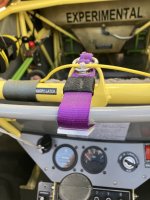
This is what I did. The same way I secure and jettison the main canopy on my skydiving rig. The Three Ring Release System. A mechanical advantage device in which a ~1000 lb load is reduced to ~ a 20 lb pull force at the nearby handle at the end of that yellow cable. Instantaneous and has proven itself over hundreds of thousands of cut-a-ways and 5 decades of use.
 

Attachments

  • IMG_1455.jpeg
    IMG_1455.jpeg
    1.8 MB · Views: 8
In searching the site a bit I couldn't find a real simple way to rig a canopy for jettisoning while performing aerobatics. Below is my solution.


Using a quick release pin I replaced the original fasteners that hold the canopy rollers in place. I put a pull strip on the pin to make it easy to grab onto.


See pin in place on left side roller.

The pin is a 3/16" Dial by .8" usable length. McMaster-Carr carries them, part no. 95255A216. They fit perfectly. I looked at the other styles with "T" and "D" handles but it looked as if they would strike the mid cabin brace sliding the canopy for and aft. There is not wobble in the rollers when secured by these pins.

This was my solution for my first RV-8 25+ years ago and I'll be doing the same again for my new one. FWIW, I can think of at least one person who bailed out of an RV-8 inflight, though "successfully" is likely a misnomer, as he didn't have a parachute. Long time RVators know the guy I mean...
 
Back
Top