Van's Air Force

The definitive Van's Aircraft support community! Buying, building or flying an RV? Join our exclusive family of mentors and enthusiasts!

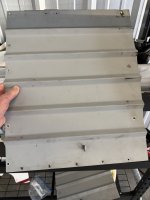
Is this a structural component?

RNB

Well Known Member
Sponsor
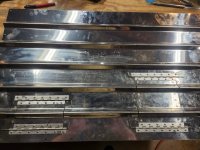
I would like to add a trickle charger battery minder AND a shore power connection. Each of these has a smallish yellow plug for connecting. I’d like to cut maybe 1 inch by 4 inches out of the panel shown from the baggage area, likely in the lower right corner. I can reinforce if needed.

Is this ill advised?

Is this part providing structural rigidity that I would weaken by doing so?
 

Attachments

  • IMG_9245.jpeg
    IMG_9245.jpeg
    1.9 MB · Views: 159
It’s been done a number of times so I think you’re safe to do so. If you want peace of mind add some reinforcement on the aft side around the cutout.
 
It is structural but a lot of people have added holes and panels to this part. You can always add a doubler as well. But you will need to remove the panel annually if not more often than that. What I did was mount a connector behind it and then cut a hole that lines up with that connector so it's easy to remove the panel.
 
It's definitely structural. Yours has been cut in half. It should span the whole width of the cargo area.
 
  • Like
Reactions: RNB
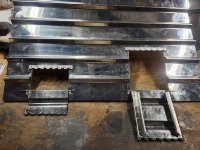
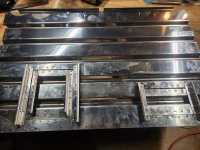
That bulkhead is structural. I did two doors, and reinforced the openings.
 

Attachments

  • 20250719_125150.jpeg
    20250719_125150.jpeg
    3.9 MB · Views: 99
  • 20250719_125340.jpeg
    20250719_125340.jpeg
    3.8 MB · Views: 102
  • 20250719_125203.jpeg
    20250719_125203.jpeg
    3.3 MB · Views: 99
It's definitely structural. Yours has been cut in half. It should span the whole width of the cargo area.
I’m certain Van would be rather displeased with that bulkhead in two pieces.
If you think about the design philosophy of an aluminum monocoque this could well be one of the most important structural pieces in the entire airframe.
If it was me I’d buy a new one then put your reinforced small hole in it.
If you want to minimize the reduction in strength put the hole in the flat and leave the pointy bits of the bulkhead intact. They’re what gives it strength.
 
I put a larger access panel in it and reinforced all sides of the hole. The cover is made from the same corrugated aluminum and is nested with the bulkhead when installed.
 
I’m certain Van would be rather displeased with that bulkhead in two pieces.
If you think about the design philosophy of an aluminum monocoque this could well be one of the most important structural pieces in the entire airframe.
If it was me I’d buy a new one then put your reinforced small hole in it.
If you want to minimize the reduction in strength put the hole in the flat and leave the pointy bits of the bulkhead intact. They’re what gives it strength.
Just a guess but I suspect it takes most of the twisting loads from the tail and transfers them to the forward fuse structure? Without it those loads go into the fiberglass cabin top.
 
I’m certain Van would be rather displeased with that bulkhead in two pieces.
If you think about the design philosophy of an aluminum monocoque this could well be one of the most important structural pieces in the entire airframe.
If it was me I’d buy a new one then put your reinforced small hole in it.
If you want to minimize the reduction in strength put the hole in the flat and leave the pointy bits of the bulkhead intact. They’re what gives it strength.
agree 100%(y)
 
Just a guess but I suspect it takes most of the twisting loads from the tail and transfers them to the forward fuse structure? Without it those loads go into the fiberglass cabin top.
That bulkhead is probably close or a little aft of the point on the fuselage where the peak bending moment occurs both laterally (VS & rudder) and vertically (HS & elevator).
Some torsion but suspect that’s not the limiting factor. (Engineer but not an aero eng)

Those loads are transferred through the skin as tensile or compressive forces. The bulkhead is what prevents the skins from buckling under compression.
 
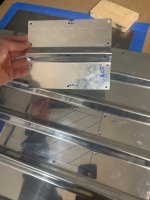
I kept the access hole pretty simple. Just fabricated a cover plate and used 10 screws to secure it rather than the 40 or so to remove the whole thing.
 

Attachments

  • Access Panels 11.jpg
    Access Panels 11.jpg
    450 KB · Views: 30
There are some guidelines in AC-43 1b to estimate strength of sheet associated with repairs, with guidelines. You might be shocked how many fasteners are required to maintain even 85% strength through the sheet with a patch.
So, when “winging it”, without an engineered solution, you are accepting that your “repair” is most likely not as strong aa the original bulkhead.
I am not saying it’s wrong, or even bad, but it is the reality.
That bulkhead will not be as strong as the original.
 
  • Like
Reactions: Mel
It's definitely structural. Yours has been cut in half. It should span the whole width of the cargo area.
It is structural in the sense that it makes the bulkhead rigid; preventing twisting motions of the structure in that area. Yours has been cut in half so already significantly compromised. Think of a gusset and how it adds rigidity and then imagine slicing it in half. I have no idea how important this component is to structural integrity, but i would research it if i was in your shoes. I suspect they had a good reason for putting it there.
 
There are some guidelines in AC-43 1b to estimate strength of sheet associated with repairs, with guidelines. You might be shocked how many fasteners are required to maintain even 85% strength through the sheet with a patch.
So, when “winging it”, without an engineered solution, you are accepting that your “repair” is most likely not as strong aa the original bulkhead.
I am not saying it’s wrong, or even bad, but it is the reality.
That bulkhead will not be as strong as the original.
This is definitely important but the real issue here is the section being compromised.
Before people chop thru the ridges they should look up area moment of inertia. It’s basically the thickness of the cross section (the ridges) that give you the stiffness. It’s the cube power of the “thickness” - the amount and distance of material away from the bending axis.
That bulkheads stiffness perpendicular to the ridges is many orders of magnitude (like 100 or 1000x) stiffer than without the ridges - or (and this is important) with the ridges cut.
There’s no practical way to make that up with fasteners and sheet metal. (there is, but you’d probably find your backing plate would need to be 0.250 thick if not more to be equivalent)
The reality is that there are indeed heaps of RVs flying around with small holes, big holes, split bulkheads, no bulkheads etc. I’m sure everyone doing so gave it some thought and some TLAR engineering and none have fallen out of the sky - but make no mistake it’s nowhere near as strong as designed if you’ve chopped more than a few ridges. Let alone all of them!
 
Back
Top