Van's Air Force

The definitive Van's Aircraft support community! Buying, building or flying an RV? Join our exclusive family of mentors and enthusiasts!

Increased Rudder Forces After a Windy Week in the TieDowns

mike3715

Member
Sponsor
My RV7 is in the tie-downs at KSNA in Southern California. After last week's crazy winds, I'm missing the hangar space I lost over the summer due to construction and insane demand.

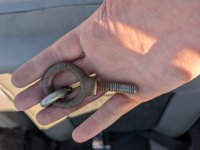
The aircraft was definitely bouncing around a bit in the wind. There was a clear bend to one of the tie-down "eye" rings (since replaced), and a friendly neighbor added an extra ratchet strap to the tailwheel. There was no visible damage or scuffs. After pulling an inspection panel and verifying no damage to the wing spar near the bent "eye" ring, and also ensuring no new play with the installed eye rings, I did a short flight.

During the flight, the right rudder pressure necessary to maintain coordinated flight nearly doubled. Rudder trim consists of a thin triangle of material bonded to the trailing edge of the rudder. The amount of right rudder pressure (as usual) varies approximately linearly with airspeed (more pressure is required at higher speeds).

Are there any thoughts on:
  • Any concerns with safety? I flew my fair share of "bent" jets in the Air Force, so it seems this does not need to be automatically grounding.
  • Any thoughts on the cause?
  • Any thoughts on remedy?
Thanks!
 
If it were me I probably wouldn't fly it again until I had a pretty good idea of what was going on, or at least eliminated stuff that might get catastrophic if unattended.

Easy enough to get out the tape measure and make sure something isn't bent, but I imagine you'd have see any buckling already.

Is it possible that all that wind and bucking around in the tiedowns twisted the MLG leg fairings or wheel pants? They will definitely cause the ball to be out if they aren't clocked right.

I think I'd also look over the rudder and make sure it isn't bent.
 
How do the ailerons in straight/level flight? is one displaced more than the other?
How about the gear leg fairings? Any changes there?
 
I'm on board with Desert Rat and what the others are suggesting. And without knowing how beefy the tie-down eye was, I'd be more than a little concerned about how much force it took to bend that eye ring. If memory serves me correctly, that's the equivalent of a 3/8" bolt on that. If you had a steel ring, that was some significant force. The only other things I can think of that may need to be checked are:
  • Is the rudder trim wedge still attached?
  • If all the other things people have suggested to look at are good, pull the wing root fairing and inspect the places where the wing attaches to the fuselage--especially the rear spar attachment point. It's very unlikely that those were damaged, but I still don't understand how the tie-down was bent.
 
If it were me I probably wouldn't fly it again until I had a pretty good idea of what was going on, or at least eliminated stuff that might get catastrophic if unattended.

Easy enough to get out the tape measure and make sure something isn't bent, but I imagine you'd have see any buckling already.

Is it possible that all that wind and bucking around in the tiedowns twisted the MLG leg fairings or wheel pants? They will definitely cause the ball to be out if they aren't clocked right.

I think I'd also look over the rudder and make sure it isn't bent.
Thanks! Any specifics (or references) on how you would do the measurements?
 
Yes.
RV’s don’t have ejection seats.
Sorry for the hassle and, always, thank you for your service.
Super fair! I would add the context that you would never want to fly something relying on the ejection seats before you even took off. Rather, I just want to acknowledge that some minor performance issues can still be airworthy. Regardless, I definitely want to have a better idea of what's happening before I fly again.
 
How do the ailerons in straight/level flight? is one displaced more than the other?
How about the gear leg fairings? Any changes there?
I didn't visually check the ailerons in cruise on the last flight; that would have been wise.

I didn't notice anything visually different on the gear leg fairings, but that's definitely something to take a closer look at. Any specific recommendations? Thanks!
 
I'm on board with Desert Rat and what the others are suggesting. And without knowing how beefy the tie-down eye was, I'd be more than a little concerned about how much force it took to bend that eye ring. If memory serves me correctly, that's the equivalent of a 3/8" bolt on that. If you had a steel ring, that was some significant force. The only other things I can think of that may need to be checked are:
  • Is the rudder trim wedge still attached?
  • If all the other things people have suggested to look at are good, pull the wing root fairing and inspect the places where the wing attaches to the fuselage--especially the rear spar attachment point. It's very unlikely that those were damaged, but I still don't understand how the tie-down was bent.
Yes, it is a 3/8" bolt. The tie down was a chain to a steel cable with a significant forward angle to the steel cable from the bolt. There was also a decent amount of slack on the chain. I suspect the slack was taken out quickly, resulting in a very large momentary forward force on the bolt, resulting in the deformation. Attaching photo for reference.

Yes, the rudder trim wedge is still attached.

Good call on pulling the wing root fairing and taking a look.
 

Attachments

  • DeformedBolt.jpg
    DeformedBolt.jpg
    1.3 MB · Views: 246
Mike3715

Your plane could have been flying without you with the gusts that were reported.

I would remove the rudder. A couple of 7A bolts and (1) one 10a bolt on the bottom. Disconnect rudder cables and disconnect light or ADSB in tail?. Once the cables are disconnected you can feel the rudder before removing and make sure it is swinging freely. Run a nylon fishing line through the three (3) attach brackets for the rudder assuring they are all perfectly aligned.

Check the trailing edge of the rudder either with string or a flat surface, (granite counter) eg. Check the bearings installed in the rudder to make sure they are intact and suffered no damage.

Measure from the top or the same spot on ea side of the vertical stab to the same spot on the horizontal stabilizer to insure the tail fin is exactly where it is supposed to be, also a spot on the outside of the horizontal stab to the same rivet on ea side of the fuselage near the baggage bulkhead.

These measurements and inspections will help to assuage that anything is amiss with your empennage.

Also remove the empennage fairing and have a really good look at all the tail attachment points.

All the best. If you were not the builder find a local RV builder who can help you with this project. Maybe 4 hours of work for this thorough examination.

Of course replace any hardware , should only be the 3 rudder bolts and nuts.

A
 
My RV7 is in the tie-downs at KSNA in Southern California. After last week's crazy winds, I'm missing the hangar space I lost over the summer due to construction and insane demand.

The aircraft was definitely bouncing around a bit in the wind.

I live under the final approach fix for SNA. A nearby school has a weather package installed on it, and they clocked wind gusts at nearly 100 mph. I believe there were other places around the L.A. basin did as well. I'd be surprised if something didn't get bent or damaged in that kind of environment.

On the other hand, you came through pretty well if the plane is still in one piece!

--Ron
 
I would bet the rudder was flexed so the trailing edge was moved very slightly and is acting like a trim tab does. To correct, put a hand on the rudder near the trailing edge and apply a little force on the opposite side of the trailing edge and work your way down the trailing edge. It doesn’t take much tweaking to impact a change in the ball’s position. Since right rudder pressure is needed, the trailing edge would need to be moved to the left. Or add more trim tab.

My A&P told me that the Beech factory adjusts rudder trailing edges. They don’t want to see trim tabs on a rudders. Of course my response was…..you guessed it……No Way.
 
Last edited:
To clarify.. with feet off the pedals, the airplane is in trim (vertical axis) or has that changed? If still in trim, rudder is probably OK but check the rudder control linkage for damage. If no longer in trim, check the rudder itself for damage.
 
To clarify.. with feet off the pedals, the airplane is in trim (vertical axis) or has that changed? If still in trim, rudder is probably OK but check the rudder control linkage for damage. If no longer in trim, check the rudder itself for damage.
With feet off the pedals, the airplane is no longer in trim. The ball is deflected to the right by one ball width. This is about double what it was before. It sounds like the rudder itself is suspect and I will check it out. Thank you!
 
Thanks! Any specifics (or references) on how you would do the measurements?
Essentially, youre trying to determine if something bent. I'd find a couple of rivet heads on the tips of the various surfaces and measure thh distance between them. Like for example, measure between the tip of the vertical and the tip of the H/S, or the tip of the H/S to a rivet one teh centerline of the tailcone up behind the canopy. Then mirror that process on the other side of the plane. If the measurements are different from one side to the other, that would tell you that something is bent.

You said that the rudder interconnect was the only thing keeping the rudder from flopping around and that really is just the chain tension to the tailwheel. If I'm understanding that right, then the restriction to movement is all at the rudder horn, but the wind load would have been over every inch, top to bottom. If you were having 100 mph gusts, It doesn't seem that farfetched to think that maybe you rudder ended up twisted. At any rate it's something to check.
 
Chains and steel cable. Check the wings very carefully. Last year a friend tied his Cessna 414 by chains and cable and it cracked the spar in a 60 kt. wind in Colorado. I usually like to use ropes, they give a little without hard shear. My opinion after 61 years of tying down airplanes. Take your own ropes.
 
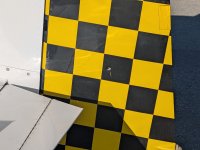
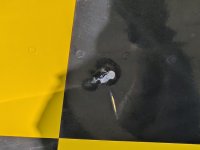
I did a closer inspection and found damage on the rudder(photo attached). In particular, it seems that the wind had enough force to overcome the rudder/wheel interconnect and the rudder slammed into the elevator, which was full up/aft stick at the time.

Wheel pants and wheel fairings looked normal. No scuffing, play, or any obvious deformation.

Any thoughts on how to pursue a repair for this sort of damage, and if there's any other part of the rudder mechanism to inspect?
 

Attachments

  • TailDamage1.jpg
    TailDamage1.jpg
    1.2 MB · Views: 276
  • TailDamage2.jpg
    TailDamage2.jpg
    532.4 KB · Views: 278
if there's any other part of the rudder mechanism to inspect?
A couple of dents in the rudder aren't causing the increased forces. As suggested earlier in the thread, you probably want to determine if the rudder or vertical stab were tweaked and the hinge line(s) are no longer straight, and deal with that issue. That's the obvious place to look if rudder forces have changed. As far as repairing the visible damage, your options are probably to patch the hole using data from AC 43.13-1B (the FAA's repair guidance), to reskin the rudder, or to build an entirely new rudder.
 
As you figured out it is the rudder. The 7 design is very susceptible to bending at the trailing edge usually from tail winds. Mine got damaged from the gusting tail wind storm at Oshkosh a few years ago when a lot of 7 and 9 rudders got destroyed. Not directly visible but immediately felt on departure. I had a full bubble left needed in cruise. No trim tab before but a large one then needed on the right side. Only acceptable fix was to build a new rudder.
 
I’m just curious what you meant by just having the “rudder interconnect”. Is that just the cables that connect your rudder horn to the rudder pedals? That centering mechanism on the full swivel tailwheel assembly is just a centering mechanism, not to be considered a control lock. The air gizmo universal control lock will help, but I’ve found them not to be adequate if it’s windy. You might want to consider one of these if you’re going to be tied down outside for long. Look at all the pics on the product page. (rvplasticparts.com / Steve Melton)


If you click on the gust lock rope link, there is a video of Steve installing the elevator/rudder control lock system.
 
Last edited:
Is it possible that the trim tab you mentioned has changed its shape as a result of rudder flapping side to side? Also depending on what type of gust lock you used, it is worth checking to see if there has been any twist in the rudder been developed as a result.
 
The fact that the rudder hit the elevator likely means the hard stop on the horn hit hard first, and the rudder then bent further to hit the elevator. Assuming the rudder stop is built to spec, that’s a lot of extra flex that rudder experienced. Have an experienced eye look at the structure. Even without a smoking gun issue, I’d build a new rudder.

I had a dust devil throw my Rocket’s tail into my garage a couple years ago and it caused a lot of damage that was only apparent after I started pulling the tail off.
 
Also don’t mean to be an alarmist, but there is at least one fatal rudder flutter event on a -7 that can be traced back to a repair on a rudder. Go into any repair of a primary control surface with eyes wide open!
 
I did a closer inspection and found damage on the rudder(photo attached). In particular, it seems that the wind had enough force to overcome the rudder/wheel interconnect and the rudder slammed into the elevator, which was full up/aft stick at the time.

Wheel pants and wheel fairings looked normal. No scuffing, play, or any obvious deformation.

Any thoughts on how to pursue a repair for this sort of damage, and if there's any other part of the rudder mechanism to inspect?
Was the aircraft flown like this? Not scene on a walk around?
 
I did a closer inspection and found damage on the rudder(photo attached).
Recommend that you take a hard look at the rudder stop and the horn. They took the hit first. Also look at the elevator, trim tab and especially the linkage back to the mounting of the servo. Sloppy trim tabs are also a good source of flutter.
 
A friend had his -4 at the Grand Canyon (tied down), went away for a couple of days of hiking, and when he came back his rudder skin on the left hand side was PENETRATED! from elastically flexing past the rudder stop on the tailcone. Hard enough hit (and enough times) to put a 2" gash in the skin.

Result - New rudder ...

YMMV - But probably won't if the rudder can move (his was "nominally" tied down - never again)

HFS
 
The way this is supposed to be built, the rudder travel is supposed to be 30 degrees minimum, 35 degrees maximum either side of the neutral position. Section 8 of the build manual tells you that the way to achieve this travel is to verify that when the rudder hits the control stop there should still be a gap of of 1 & 1/8" between the face of the rudder and the inboard trailing edge of the elevator when the elevators are neutral.

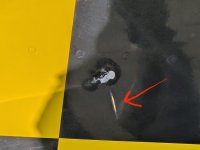
You clearly don't have that, because I can see in your pictures right below the dent where the end of the elevator has rubbed through the paint.

Maybe the rudder is bent or twisted, maybe the control stops weren't right to start with (not uncommon, lots of us have had to remake them because we discovered after the fact that if they were made with dimensions exactly per print you ended up with way too much rudder deflection), maybe the left control stop is broken, maybe a lot of stuff. The bottom line is that this isn't right. Like I said before, I really think you should get out a straight edge and tape measure to figure this out.

I added a red arrow to one of the pictures you attached above to show you what I'm talking about.
 

Attachments

  • TailDamage2.jpg
    TailDamage2.jpg
    974.1 KB · Views: 96
The 7/9 rudders seem to have less torsional stiffness than the bent trailing edge rudders on the small rudder designs (4/6/8). If it twisted enough to hit the elevator, I would take a real close look for a permanent twist. Clamp the counterbalance to the VS, and see if the bottom is in trail. And of course, look for any tipped rivets.
If things were banging around that hard, I'd check the ailerons too. The rudder would be my prime suspect though.
 
Last edited:
Have a real good look at the rod end bearings (rudder hinges). Enough force could possibly bend the nutplate riveted to the rudder spar, causing the rod end bearing to lean sideways a bit, causing misalignment of the 3 rudder hinges. This could be the reason for the unequal force to move the rudder in one direction.
If this is the case, a new rudder would be the best solution.
 
Also don’t mean to be an alarmist, but there is at least one fatal rudder flutter event on a -7 that can be traced back to a repair on a rudder. Go into any repair of a primary control surface with eyes wide open!
I was thinking of this also. I believe he was doing aerobatics and the tail came off. If we are thinking of the same incident, here is a link https://www.nbcphiladelphia.com/news/local/plane-crashes-in-atlantic-county/2109764/
Have a real good look at the rod end bearings (rudder hinges). Enough force could possibly bend the nutplate riveted to the rudder spar, causing the rod end bearing to lean sideways a bit, causing misalignment of the 3 rudder hinges. This could be the reason for the unequal force to move the rudder in one direction.
If this is the case, a new rudder would be the best solution.
Also check the hinges on the vert stab spar-----they took the same load as the rudder hinges.
 
Last edited:
I would strongly recommend reading the final accident report on the Atlantic City(Hamilton
township) accident Sep 20, 2013. I believe this was the first in flight structural breakup of an RV7.
 
I would strongly recommend reading the final accident report on the Atlantic City(Hamilton
township) accident Sep 20, 2013. I believe this was the first in flight structural breakup of an RV7.

It was not. There was one in Canada prior to that (7A).

Skylor
 
It was not. There was one in Canada prior to that (7A).

Skylor
Canadian accident caused by a number of factors. Two of the major factors- spiral dive resulting in speeds 250 knots or more, rudder flutter caused in part by rudder imbalance (& speed). Recovered rudder parts showed a thick layer of bondo over much of it’s surface.
 
Half the rudder ripped off & I think was never recovered. The lower rudder half was still attached by lower 2 hinges, trailing edge separated like a zipper, what was there looked like trailing edge rivets were too short (possibly excessive adhesive used on trailing edge wedge) shop heads didn’t fill the dimples, skins had layer of bondo, maybe covering lots of nasty stiffener rivet lines.
This is all recounted from memory of reports viewed a long time ago.
 
Remove the rear empennage fairing and closely inspect all the hardware holding the vertical and horizontal stabilizer on. Also measure the top of the vertical stabilizer to the tip of the horizontal stabilizer as outlined in the build manual to make sure nothings tweaked there. The airplane is talking, you just have to figure out what it's saying.
 
I would be checking the routing of the rudder cables to make sure they are in the proper routing and not caught around something, or out of place.
 
Is it possible that the trim tab you mentioned has changed its shape as a result of rudder flapping side to side? Also depending on what type of gust lock you used, it is worth checking to see if there has been any twist in the rudder been developed as a result.

I’m just curious what you meant by just having the “rudder interconnect”. Is that just the cables that connect your rudder horn to the rudder pedals? That centering mechanism on the full swivel tailwheel assembly is just a centering mechanism, not to be considered a control lock. The air gizmo universal control lock will help, but I’ve found them not to be adequate if it’s windy. You might want to consider one of these if you’re going to be tied down outside for long. Look at all the pics on the product page. (rvplasticparts.com / Steve Melton)


If you click on the gust lock rope link, there is a video of Steve installing the elevator/rudder control lock system.
Thanks! By the interconnect I just meant the locking mechanism which allows for tailwheel steering.
 
Thank you, everyone, for the excellent context, suggestions, and recommendations!

First off, I should explicitly say that it was inexcusable to miss the rudder damage on the preflight. I was fixated on the bent eye bolt and was lucky to return safely to the ground.

Secondly, while I ambition to one day be a builder, today is sadly not that day. Does anyone have any recommendations for a local professional/shop to help assess the feasibility of repair and double-check what I've done? While I have a fantastic A&P who works with me on CIs every year, he's unfortunately away (and also a 2.5-hour drive away). I'd certainly welcome any local support, of course, but I don't want to overly burden anyone.

Thanks!
 
Thank you, everyone, for the excellent context, suggestions, and recommendations!

First off, I should explicitly say that it was inexcusable to miss the rudder damage on the preflight. I was fixated on the bent eye bolt and was lucky to return safely to the ground.

Secondly, while I ambition to one day be a builder, today is sadly not that day. Does anyone have any recommendations for a local professional/shop to help assess the feasibility of repair and double-check what I've done? While I have a fantastic A&P who works with me on CIs every year, he's unfortunately away (and also a 2.5-hour drive away). I'd certainly welcome any local support, of course, but I don't want to overly burden anyone.

Thanks!
PM sent re: LA area builders.
 
Thank you, everyone, for the excellent context, suggestions, and recommendations!

First off, I should explicitly say that it was inexcusable to miss the rudder damage on the preflight. I was fixated on the bent eye bolt and was lucky to return safely to the ground.

Secondly, while I ambition to one day be a builder, today is sadly not that day. Does anyone have any recommendations for a local professional/shop to help assess the feasibility of repair and double-check what I've done? While I have a fantastic A&P who works with me on CIs every year, he's unfortunately away (and also a 2.5-hour drive away). I'd certainly welcome any local support, of course, but I don't want to overly burden anyone.

Thanks!
Although I could have built a new rudder myself, why, that is what insurance is for and besides it was winter and too cold to paint. Global said no penalty due to low cost and it being ground damage from a well known weather event at Oshkosh. Had Vans send parts to Synergy build center and they built a perfect straight one. With another $200 for a body shop to paint. Insurance paid me to install. Think it was just around $2000 total. No brainer!

My AirGismo control lock got destroyed by the Oshkosh 22 wind event that allowed the rudder to hit stops. No apology but they did give me a replacement lock in exchange for the pieces at their display tent. Entire trailing edge got bent right causing a full bubble left deflection on cruise. Embarrassed that I missed the extent of bend upon departure pre-flight. Got used to not using right rudder on take off so with first flight after repair I was uncoordinated.
 

Attachments

  • IMG_1822.JPG
    IMG_1822.JPG
    947.2 KB · Views: 57
Last edited:
Although I could have built a new rudder myself, why, that is what insurance is for and besides it was winter and too cold to paint. Global said no penalty due to low cost and it being ground damage from a well known weather event at Oshkosh. Had Vans send parts to Synergy build center and they built a perfect straight one. With another $200 for a body shop to paint. Insurance paid me to install. Think it was just around $2000 total. No brainer!

My AirGismo control lock got destroyed by the Oshkosh 22 wind event that allowed the rudder to hit stops. No apology but they did give me a replacement lock in exchange for the pieces at their display tent. Entire trailing edge got bent right causing a full bubble left deflection on cruise. Embarrassed that I missed the extent of bend upon departure pre-flight. Got used to not using right rudder on take off so with first flight after repair I was uncoordinated.
This is super helpful, thanks!

I spoke to Tom at Van's on the builder support line this morning. Here are my notes from the conversation:
  1. The rudder damage is likely due to the wind blowing the rudder into the left elevator (confirmed later today below).
  2. The bent eye bolt is likely due to the plane shifting around in the wind. It is unlikely that the spar was damaged because the tie down mounting assembly is far more robust than the eyebolt, especially if there was an angled load on the bent eyebolt. Good to check, and should have shop take a closer look as the tie down assembly is mounted on the forward part of the spar and not easily visible.
  3. Should push rudder to the side and look for damage (done below).
  4. Should be OK after this to apply speed tape and ferry to shop for inspection and decision on next steps (replace vs. re-skin vs. apply patch).
I spent a few hours at the plane implementing the advice above. Added lots of photos to the google album here. Rudder was not removed (yet).
  • No issues were found when pulling panels under the wings and between the wing and fuselage.
  • The trailing edge of the rudder was completely straight.
  • No issues where the rudder attaches to the vertical stabilizer.
  • No issues under the empennage fairing.
  • When measuring the tail to horizontal stab, we found at most a 0.5 cm difference. But there may be some operator error here (with higher winds contributing towards some issues).
  • When rotating the rudder to the stops, no issue on the right. On the left, however, there is a problem. When initially contacting the stop, the spacing appears correct. When applying more pressure, the stop begins to rotate allowing the rudder to get closer to the elevator. The rotation is due to a sheared rivet.
  • The trim tab on the elevator (which impacted the rudder) appears unharmed. While there is a little bending in the metal, there is no damage to the paint there, which makes me think this is just the way it's designed.
  • I applied speed tape to the rudder per Van's recommendation. While I'm not planning to ferry it without further consideration, it's good to keep things sealed up.
 
Back
Top