Van's Air Force

The definitive Van's Aircraft support community! Buying, building or flying an RV? Join our exclusive family of mentors and enthusiasts!

Increased fuel flow with boost pump (not a reading error)

SwimmingDragon518

Well Known Member
Patron
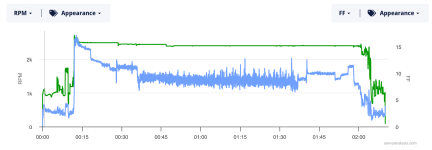
I posted a likely too long thread earlier about a ghost I'm chasing in my RV (RPM fluctuations on takeoff). One thing that is clear is that I have is that I am getting increased fuel flow when I hit the boost pump before takeoff. I have a carbed O360-A1A with a CS Hartzell on my 7A with a floscan downstream of both the electric and engine driven fuel pump. I also get heavy oscillations of fuel flow in flight, albeit without any effect observable effects on any engine parameters. First screenshot shows the increased fuel flow (from 3 up to 10gph!) and a subsequent drop in RPM which I felt as a hesitation right when I hit the boost pump before takeoff on my most recent flight. Second pic shows my variable fuel flow in level flight (RPM is green, FF blue).

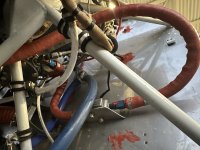
All the threads I've read discuss anomalies associated with having the floscan between the two pumps, but I am downstream of both. Final picture shows fuel system plumbing from engine driven fuel pump --> floscan --> carb.

Thanks in advance!

 

Attachments

  • IMG_2541.PNG
    IMG_2541.PNG
    229.1 KB · Views: 51
  • Screenshot 2025-03-24 at 9.17.06 PM.png
    Screenshot 2025-03-24 at 9.17.06 PM.png
    98.5 KB · Views: 51
  • IMG_2540.jpg
    IMG_2540.jpg
    1.8 MB · Views: 53
Turning on the electric pump in many fuel system, configurations does artificially change the fuel flow indication. This can even happen with the transducer located downstream of both pumps. The facet pumps typically used on carbureted installations, have a pulse output versus a linear flow output. The pulses produced can travel far downstream in the system, and cause an influence on the flow transducer.
Since you actually detect a change in engine operation, when the pump is switched on, it does sound like the pump may actually be having a physical influence on engine operation.
Turning on the electric pump does typically raise the system operating pressure slightly. Perhaps the needle valve in your carburetor is marginal and the small pressure increase is overcoming its ability to operate properly which would cause the overall mixture to get richer.
How old is the carburetor? Is this a newly flying airplane or is this a new symptom on one that has been operating normally previous to this?
 
Turning on the electric pump in many fuel system, configurations does artificially change the fuel flow indication. This can even happen with the transducer located downstream of both pumps. The facet pumps typically used on carbureted installations, have a pulse output versus a linear flow output. The pulses produced can travel far downstream in the system, and cause an influence on the flow transducer.
Since you actually detect a change in engine operation, when the pump is switched on, it does sound like the pump may actually be having a physical influence on engine operation.
Turning on the electric pump does typically raise the system operating pressure slightly. Perhaps the needle valve in your carburetor is marginal and the small pressure increase is overcoming its ability to operate properly which would cause the overall mixture to get richer.
How old is the carburetor? Is this a newly flying airplane or is this a new symptom on one that has been operating normally previous to this?
Hello there, and thanks for your reply.

The carburetor was purchased in ‘07 and went into service in 2014. I think this is the first I noticed this issue, but I took particular notice on this flight due to a mystery im chasing involving unsteady RPM at takeoff power (2600-2650). The unsteady RPM on takeoff is definitely new.
 
Hello there, and thanks for your reply.

The carburetor was purchased in ‘07 and went into service in 2014. I think this is the first I noticed this issue, but I took particular notice on this flight due to a mystery im chasing involving unsteady RPM at takeoff power (2600-2650). The unsteady RPM on takeoff is definitely new.
So the carb has not been rebuild/overhauled since 2007? I think you have found at least part of the problem...
 
I posted a likely too long thread earlier about a ghost I'm chasing in my RV (RPM fluctuations on takeoff). One thing that is clear is that I have is that I am getting increased fuel flow when I hit the boost pump before takeoff. I have a carbed O360-A1A with a CS Hartzell on my 7A with a floscan downstream of both the electric and engine driven fuel pump. I also get heavy oscillations of fuel flow in flight, albeit without any effect observable effects on any engine parameters. First screenshot shows the increased fuel flow (from 3 up to 10gph!) and a subsequent drop in RPM which I felt as a hesitation right when I hit the boost pump before takeoff on my most recent flight. Second pic shows my variable fuel flow in level flight (RPM is green, FF blue).

All the threads I've read discuss anomalies associated with having the floscan between the two pumps, but I am downstream of both. Final picture shows fuel system plumbing from engine driven fuel pump --> floscan --> carb.

Thanks in advance!
Slow news day and I only know the -8 but... The other possibility is fuel vaporizing at the flow meter. It’s right in front of the heater discharge that gets pretty hot on a -8. Is that where people put the fuel line/FM on that airplane?
 
Slow news day and I only know the -8 but... The other possibility is fuel vaporizing at the flow meter. It’s right in front of the heater discharge that gets pretty hot on a -8. Is that where people put the fuel line/FM on that airplane?

The floscan is quite far from the exhaust and heat so that would be surprising, you can see it in my third picture.
 
I was talking about the cabin heat discharge.
Ahh very interesting! You are certainly right, the cabin heat discharge is blowing right onto the fuel line and this seems to be pronounced with a hot engine. Curious if anyone else has seen this issue in a two place side by side?
 
Man, I'd be glad if my cabin heat actually made heat. Back to the topic... mine shows increased GPH with pump on also. But not change in actual performance.
 
Man, I'd be glad if my cabin heat actually made heat. Back to the topic... mine shows increased GPH with pump on also. But not change in actual performance.
Do you have the same configuration? Floscan downstream of both pumps?

As for your cabin heat, try blocking off half of the inlet (mine's behind cylinder 3). This was a suggestion from the manufacturer of the standard Vans cabin heat system. He said the 2" inlet was designed for slow planes, but our planes are so fast with so much ram air that 2" is too large of an inlet to efficiently heat the air before it reaches the cabin. A great side effect of this is reduced CHTs due to taping off half of a 2" gaping hole on the high pressure side of things.
 
Back
Top