Van's Air Force

The definitive Van's Aircraft support community! Buying, building or flying an RV? Join our exclusive family of mentors and enthusiasts!

Identifying Fuel Filters

Chachi7565

Well Known Member
Friend
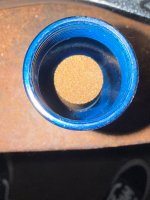
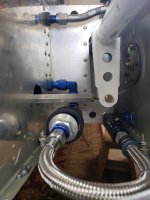
Hi, I'm learning more and more about my new-to-me RV-8A. I pulled the fairings off, and found that I have fuel filters in each wing root. Unfortunately, there are no markings on them, and I have no idea what level of filtration they provide, or if they are serviceable or if they must be regularly replaced. Can anyone help point me in the right direction?

My intent is to open the filters and see what's inside (I need to either defuel the aircraft or get some fittings to cap off the fuel line) - what should I look for?

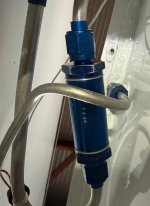
Here's a picture for reference.

Thanks!
 

Attachments

  • IMG_1347.JPG
    IMG_1347.JPG
    500.3 KB · Views: 111
They are serviceable by removing the end cap(s) for access to the filter media. Hard to say what level of filtration they have but many are 40 to 75 microns. The media is most likely a SS wafer mesh which can be rinsed and blown out. It could possibly be a SS cartridge but you won't know till you remove it. I had similar filters from Summit Racing on my 7. No need to defuel. Just shut off the fuel selector and tape up the cap and vent. Use a flare fitting plug on the tank line when you remove the filter. Not much fuel will drain while you quickly install the plug. I did it that way with full tanks many times.
 
That looks just like the one that was on my- 8 when I bought it. Some planes have a fuel filter for each tank but the builder of mine installed just one filter forward of the fuel selector. I removed the whole thing to clean & inspect and discovered it was exactly the same size as the Airflow Performance models. I replaced it with a maintainable fuel filter shown on their website. I don’t recall offhand if it was the 40 or the 74 micron internal filter so I installed what they recommended in a phone call and it was the exact same size as the old filter and bolted right in. As Al said there was very little fuel spilled with the fuel selector off. I did put a couple shop towels underneath and had little fuel but it was minimal. The hardest part was contorting my body around enough in the left lower forward floor area to reach it.

 
Hi, I'm learning more and more about my new-to-me RV-8A. I pulled the fairings off, and found that I have fuel filters in each wing root. Unfortunately, there are no markings on them, and I have no idea what level of filtration they provide, or if they are serviceable or if they must be regularly replaced. Can anyone help point me in the right direction?

My intent is to open the filters and see what's inside (I need to either defuel the aircraft or get some fittings to cap off the fuel line) - what should I look for?

Here's a picture for reference.

Thanks!
I've tested probably a half dozen different filters and just from your picture hard to tell. Probably serviceable (If it's SS of some type) probably in the 40 to 75 micron as others have said but until you open it up totally unknown. (Could be empty, I've seen that) If it's a disc filter media I would be cautious as they do not have much surface area, but you do have 2 so maybe not a concern. Hopefully the filter will have a model number that would identify its micron rating. There are many cheaper filters that do not. If you can replace the O-rings with Viton, they are cheap. (On the filter and the filter case) Take a pic and post I'm sure someone will recognize it.
 
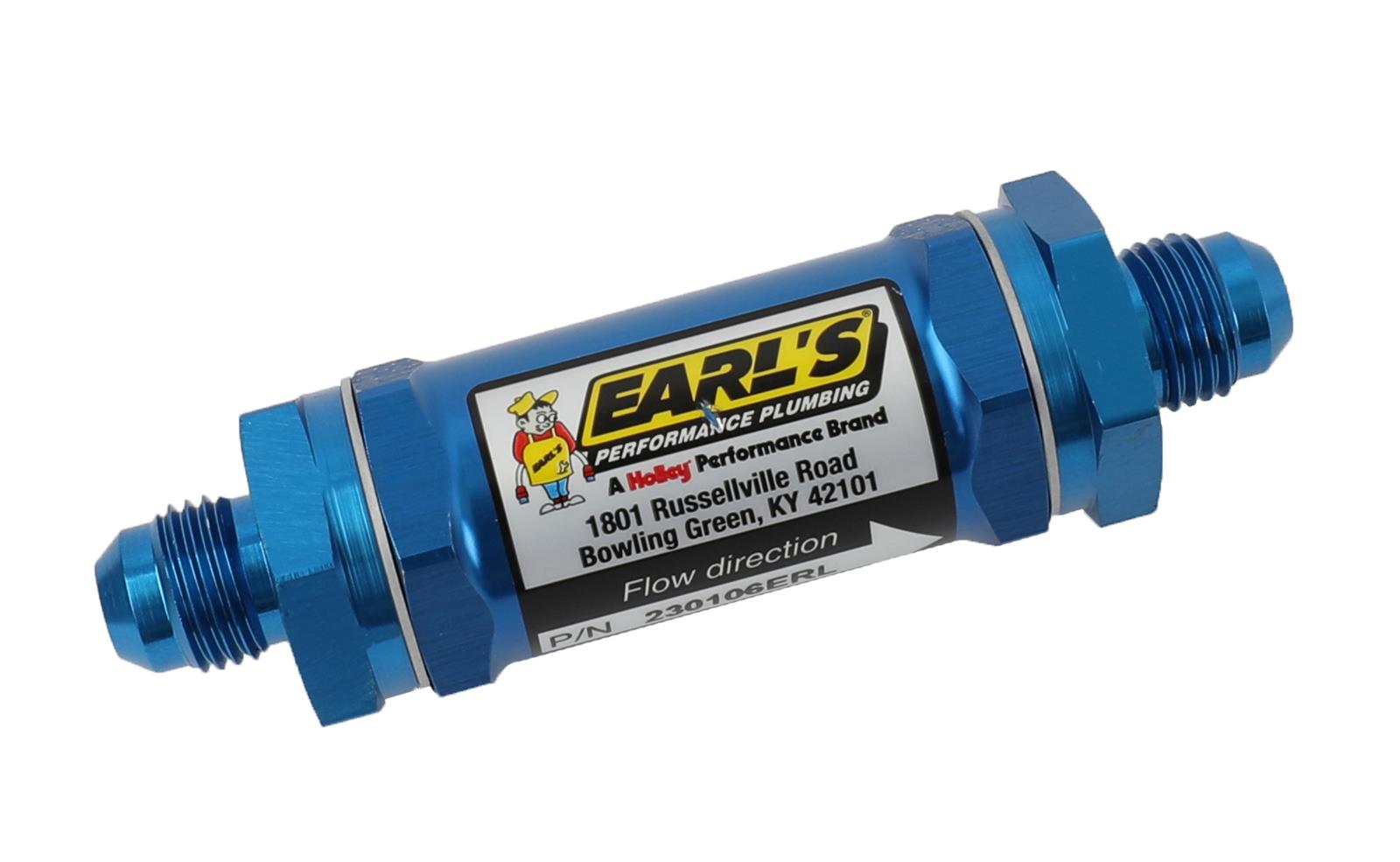
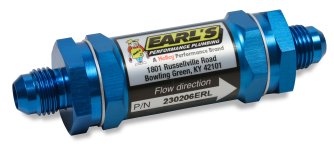
OP's filter looks a lot like Earl's 230106:

Impossible to know what filter element is installed until opening it up. The Earl's brand can have a conical-shaped 35-micron sintered bronze filter element or a flat 85-micron screen.
 
I recommend larger full screen filters, like the AFP, for the first filter in the system. Risk of fuel contamination seems much higher in aviation than we see at the corner gas station. I helped a friend that got fuel from somewhere the papaer filter in the pump was breaking down. Completely plugged the filter, put it in bypass and then plugged up the servo, preventing the engine from running. Those filters with little tiny discs clog very fast and can't deal with much debris. Further, some of those cheap ones do not have a bypass mechanism, like the AFP. I suppose that is good in the sense that you wont plug up downstream parts, but bad in the sense your engine will stop running when you don't want it.
 
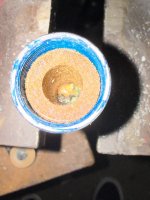
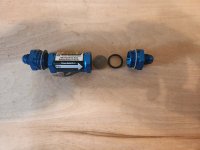
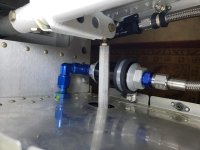
OK, I opened it up, and it's a sintered bronze conical filter - looks like this one

Looking at my system, these seem to be the only filters. So, the system looked like this:

Fuel Tank -- Fuel Filter -- Fuel Selector Valve -- Fuel Flow Meter -- Electric Boost Pump -- Engine Driven Fuel Pump - Bendix Type Fuel Injector System - IO-360-B1B

Burning up an inappropriate boost pump (Holley) was what precipitated all of this; I'm replacing that with an EFii Boost Pump. That pump comes with a 90-micron pre-filter.

I'm curious what recommendations you might have. I could:

A) clean the current filters, reinstall them, and omit the 90-micron pre-filter that came with the EFii pump (since the fuel has already been filtered below 90 microns)
B) Clean and install the current filters, and include the 90-micron pre-filter before the EFii pump
C) Replace the current filters (they're a little beat up on the outside, but functional and the inside looks good)
D) Add a filter after the boost pump - I was looking at this one from Airflow Performance, a 40 micron maintainable filter

I'm interested to hear what you have done, and what level of filtration is necessary in your experiences.

Thank you!
 

Attachments

  • IMG_1454.JPG
    IMG_1454.JPG
    2.2 MB · Views: 31
  • IMG_1455.JPG
    IMG_1455.JPG
    1.7 MB · Views: 31
  • IMG_1456.JPG
    IMG_1456.JPG
    1.6 MB · Views: 31
If it was me I would use the Airflow filter before the boost pump. That's what I have in my 8. If it was an easier retrofit you could replace the current wing root filters with a similar size but with a cartridge style cleanable media. That's what I had in my 7. I would not use the sintered filters. FWIW
 
The first job is protection of the electric fuel pump. AFP requires 125 micron protection in front of the pump. Apparently EFII requires 90 micron. The Andair PX375 filter is 60 micron.

Note the AFP canister and element is much larger than the others. Based on my one past experience with serious contamination, I think (warning...opinion) the EFII and Andair pre-filters are too small, and the sintered filters are waaaay too small. The little bit of garbage we see in a fuel drain cup isn't the problem. Real contamination can have volume.

You don't want a fine filter ahead of the electric pump. It's the suction side (low pressure) for both the electric pump and the engine driven pump. Restriction on the low pressure side, in particular if combined with a local temperature increase, is a setup for vapor lock...or if you're lucky, just reduced fuel pressure. We want the electric pump to feed without much inlet pressure drop, so it can (1) push fuel past any downstream restriction, and (2) keep pressure high in the hot engine compartment hoses and engine driven fuel pump.

Downstream filters...

AFP has 75 micron screens in both the servo inlet and the divider. They're on the small side; for sure, check the inlet screen at each annual. It's easy.

Matt mentioned "Bendix type fuel injection". An RSA-5 has a 75 micron tubular inlet screen.

I don't know what AvStar's equivalent uses for an inlet screen. For now I'll assume it's the same as the Bendix.

Precision's approach is a little different. They call the inlet screen "a last chance filter" which does not need to be checked or cleaned as long as the upstream filter doesn't show signs of contamination. No great surprise, given they also specify a 32 micron upstream filtration requirement, downstream of the electric pump.

Break.

Matt, I'd remove the bronze cones and leave the empty housings, or if convenient, replace the assemblies with a new section of aluminum line. Then I'd install a large canister and 75 micron element (AFP or similar) prior to the electric pump. It was the original plan for your 8A. Unfortunately, IIRC those plans placed the canister way forward in the cabin, down by your left ankle, and everyone hated it because it was hard to access. So, your builder installed wing root filters.

As an alternate, I'd simply replace the small filters with large element 75 micron filters in the roots. Adel them to solid structure for G support.
 
Last edited:
The first job is protection of the electric fuel pump. AFP requires 125 micron protection in front of the pump. Apparently EFII requires 90 micron. The Andair PX375 filter is 60 micron.
I know Dan said apparently but just FYI the maker of the pump (Walbro GSL series that EFII and SDS use) recommends this:

Screenshot 2026-01-09 140529.png

Of course, the nice thing about using a larger micron filter is less pressure drop. When I tested various filters (EFII supplied (paper 90 micron, Aeromotive, Fuelab, Andair, Holley all 40-micron SS pleated except Andair which was 62-microns) The measured pressure drop at 40 GPH was almost the same as a AN6 hard 90 so pretty good. I did also test Aeromotive and Fuelab 10-micron SS pleated, and they were considerably higher but those would be used post pump.

I've never weighed the particles my 40-micron filter captures but it is a fraction (1/8 - 1/4??) the number of particles my 10-micron post filter captures.

I never tested a sintered bronze filter as the filter area is obviously very small.
 
I just spoke with the folks at EFii; here's what they said:

- Recommended I use their filter before their pump
- Recommended strongly that I NOT use the sintered bronze filters, as they have a small area
- Said that I do not need an additional filter beyond their 90 micron filter before the pump - e.g. nothing additional required downstream before the Bendix fuel injection system, but that if I really wanted something, that the Aeromotive filters (link) are the gold standard.

When I pointed out that my fuel flow sensor is just after my fuel selector, and that I don't want to send unfiltered fuel to that sensor, they suggested using two of their filters, one in each wing root, which would be fairly simple.

I appreciate all of your inputs. I'm still processing all this, deciding what course of action gives me the best combination for my system. I'm thinking that putting the EFii 90-micron filters in my wing roots will filter out anything that could jam up my fuel flow sender, and putting the Aeromotive 100-micron filter after the boost pump would filter out anything generated by the pump. So the system would look like this:

Fuel tank - 90 micron EFii filter - fuel selector - fuel flow sensor - electric boost pump - Aeromotive 100 micron filter - Bendix Fuel Injection System
 
Last edited:
I just spoke with the folks at EFii; here's what they said:

- Recommended I use their filter before their pump
- Recommended strongly that I NOT use the sintered bronze filters, as they have a small area
- Said that I do not need an additional filter beyond their 90 micron filter before the pump - e.g. nothing additional required downstream before the Bendix fuel injection system, but that if I really wanted something, that the Aeromotive filters (link) are the gold standard.

When I pointed out that my fuel flow sensor is just after my fuel selector, and that I don't want to send unfiltered fuel to that sensor, they suggested using two of their filters, one in each wing root, which would be fairly simple.

I appreciate all of your inputs. I'm still processing all this, deciding what course of action gives me the best combination for my system. I'm thinking that putting the EFii 90-micron filters in my wing roots will filter out anything that could jam up my fuel flow sender, and putting the Aeromotive 100-micron filter after the boost pump would filter out anything generated by the pump. So the system would look like this:

Fuel tank - 90 micron EFii filter - fuel selector - fuel flow sensor - electric boost pump - Aeromotive 100 micron filter - Bendix Fuel Injection System
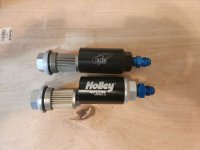
Just for reference, the Holley 162-562 filters have 40 micron screens. They havent been an issue. The SDS Filters that Rosss provides are also 40 micron.
 
Just for reference, the Holley 162-562 filters have 40 micron screens. They havent been an issue. The SDS Filters that Rosss provides are also 40 micron.
Its not just about the micron rating though. The SDS filter is a large area mesh, while the holley is a MUCH smaller area sintered bronze mass; Most of the area is deep inside the thick chunk and unusable with larger debris particles. The mesh's surface area is all usable in that case. In everyday use, this is no big deal, but if you end up getting a large debris load from a top off from a poorly maintained delivery system, this makes a substantial difference. Having seen that happen first hand and starve fuel flow, there is no way I would use that holley filter.

Bypass is also another factor. Unsure on the SDS, but the AFP will bypass when fully loaded, allowing for a few more minutes of engine running that could make the difference between on or off field landing. The holley has no bypass. When it becomes loaded, you're done.
 
Its not just about the micron rating though. The SDS filter is a large area mesh, while the holley is a MUCH smaller area sintered bronze mass; Most of the area is deep inside the thick chunk and unusable with larger debris particles. The mesh's surface area is all usable in that case. In everyday use, this is no big deal, but if you end up getting a large debris load from a top off from a poorly maintained delivery system, this makes a substantial difference. Having seen that happen first hand and starve fuel flow, there is no way I would use that holley filter.

Bypass is also another factor. Unsure on the SDS, but the AFP will bypass when fully loaded, allowing for a few more minutes of engine running that could make the difference between on or off field landing. The holley has no bypass. When it becomes loaded, you're done.
For what its worth, the SDS and Holley screens are the same---in this case 40 micron. I had previously verified that with Ross. The Small diameter Earls filter has a screen 'disc' of 35 micron. We like the length of the housing, but not the screen----WE do like the Holley version screen.
 

Attachments

  • Earls disc screen filter.jpg
    Earls disc screen filter.jpg
    306.8 KB · Views: 53
  • 230206erl_01.jpg
    230206erl_01.jpg
    428.7 KB · Views: 53
  • SDS and Holley filters.jpg
    SDS and Holley filters.jpg
    231.7 KB · Views: 53
Keep in mind what we learned about screen blinding last year. A larger mesh size and more mesh area both promote staying in the air longer if you pick up a load of crap in a fuel stop.

Quantifying things often lends perspective. Particularly in the In the case of a Bendix-type system, the screen is just protecting the part-time pump against wear. Blockage isn't really an issue. For example, the smallest restrictor we typically see in an injector nozzle is 0.024". That's over 600 microns. A standard 0.028" is over 700. Yeah, we've all seen trash in a nozzle, but you can bet it entered the flow someplace after the screen.

Practically anything works when clean. Personally I think large area 75 and 90 micron sizes are the best bet when real garbage hits the system.
 
Last edited:
For what its worth, the SDS and Holley screens are the same---in this case 40 micron. I had previously verified that with Ross. The Small diameter Earls filter has a screen 'disc' of 35 micron. We like the length of the housing, but not the screen----WE do like the Holley version screen.
my apologies. i thought you were discussing the scintered bronze version pictured earlier.
 
Keep in mind what we learned about screen blinding last year. A larger mesh size and more mesh area both promote staying in the air longer if you pick up a load of crap in a fuel stop.

Quantifying things often lends perspective. Particularly in the In the case of a Bendix-type system, the screen is just protecting the part-time pump against wear. Blockage isn't really an issue. For example, the smallest restrictor we typically see in an injector nozzle is 0.024". That's over 600 microns. A standard 0.028" is over 700. Yeah, we've all seen trash in a nozzle, but you can bet it entered the flow someplace after the screen.

Practically anything works when clean. Personally I think large area 75 and 90 micron sizes are the best bet when real garbage hits the system.
I suspect there are passages in the servo that are more critical than the injectors. In my case of blockage from paper debris (bad load of fuel), the servo stopped flowing fuel, yet the injectors were still open. The big problem was the servo blocking internally after it's final defense screen started to bypass. The larghe load of paper fiber is a nasty case, but probably pretty common.
 
I suspect there are passages in the servo that are more critical than the injectors.

It's a constant flow system. The servo must flow 4x to 6x the volume of any one nozzle.

BTW, pushing a Bendix inlet screen into bypass is a textbook example of screen blinding.
 
Its not just about the micron rating though. The SDS filter is a large area mesh, while the holley is a MUCH smaller area sintered bronze mass; Most of the area is deep inside the thick chunk and unusable with larger debris particles. The mesh's surface area is all usable in that case. In everyday use, this is no big deal, but if you end up getting a large debris load from a top off from a poorly maintained delivery system, this makes a substantial difference. Having seen that happen first hand and starve fuel flow, there is no way I would use that holley filter.

Bypass is also another factor. Unsure on the SDS, but the AFP will bypass when fully loaded, allowing for a few more minutes of engine running that could make the difference between on or off field landing. The holley has no bypass. When it becomes loaded, you're done.
The Holley filter that SDS (and others) recommend is not sintered bronze if that is what you are suggesting. It's a good quality filter SS, pleated with excellent filter area. Pressure drop is very low and meets the spec that Walbro recommends. (20-40 micron) The box that it does not check is you need AN6 adapters on each end which makes it longer and introduces a possible leak source. BTW it would take a lot to load it up.
 
Might want to reconsider the location of your fuel flow meter. My understanding is it is supposed to be between the last pump and the spider
 
The Holley filter that SDS (and others) recommend is not sintered bronze if that is what you are suggesting. It's a good quality filter SS, pleated with excellent filter area. Pressure drop is very low and meets the spec that Walbro recommends. (20-40 micron) The box that it does not check is you need AN6 adapters on each end which makes it longer and introduces a possible leak source. BTW it would take a lot to load it up.
I apologized above that i mistakenly thought he meant the holley scintered bronze filter discussed earlier in the thread.
 
my apologies. i thought you were discussing the scintered bronze version pictured earlier.
Larry----I remember the sintered bronze filters from the old Rochester carburetor days --a lifetime ago. And yes, they were a headache back then too!
 
Following up on this post with some resolution, and a final (?) question.

I opted to go with the following setup:

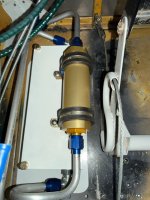
100 micron wing root filters from Earl's with a serviceable pleated stainless steel element. My intent is to catch any contamination coming from the tanks to prevent the fuel flow sensor, which is in a non-standard location just after the fuel selector, from getting clogged, without introducing too much filtering before the boost pump.

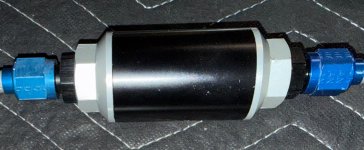
74 micron Airflow Performance post-boost pump fuel filter, much larger than the wing root filters, also with a serviceable pleated stainless steel element. My intent here is to catch any debris that made it through the wing root filters or was generated by the fuel selector, flow meter, or boost pump, and to closely match the 75 micron screen in my Bendix fuel injector servo.

Thanks for all of your input and advice. I think this is a good solution that finds a reasonable balance between adequate filtering and minimized constriction.

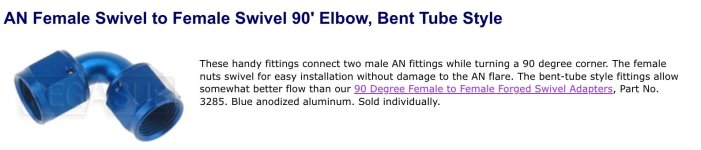
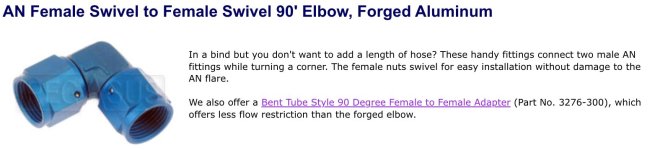
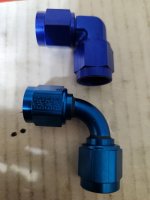
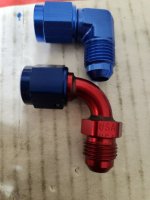
Here's my question - I'm having to re-plumb the fuel lines in the wing root to accommodate the Earl's filters, as they are larger than the inappropriate sintered bronze filters that started this whole thread. I need to make a 90-degree turn coming off the AN-6 nipple protruding from the fuel tank. I have two choices - a forged version and a tubular version (see pics). I'd prefer to use the forged version, because these filters are a little larger/heavier than the previous ones, and it seems to provide more support than the tubular version - but the website says that the flow rate for the tubular version is higher. That's from an automotive racing website, and I suspect the flow rates required are much higher for those cars. Am I good to use the forged version - i.e. flow rate is not an issue - or should I use the tubular version?

Thanks!
Matt
 

Attachments

  • 90 Degree Tube Style.jpg
    90 Degree Tube Style.jpg
    73.5 KB · Views: 21
  • 90 Degree Forged Style.jpg
    90 Degree Forged Style.jpg
    78.7 KB · Views: 23
  • Boost Pump Filter.jpg
    Boost Pump Filter.jpg
    1.6 MB · Views: 22
  • Wing Root Filter.jpg
    Wing Root Filter.jpg
    413.9 KB · Views: 26
Following up on this post with some resolution, and a final (?) question.

I opted to go with the following setup:

100 micron wing root filters from Earl's with a serviceable pleated stainless steel element. My intent is to catch any contamination coming from the tanks to prevent the fuel flow sensor, which is in a non-standard location just after the fuel selector, from getting clogged, without introducing too much filtering before the boost pump.

74 micron Airflow Performance post-boost pump fuel filter, much larger than the wing root filters, also with a serviceable pleated stainless steel element. My intent here is to catch any debris that made it through the wing root filters or was generated by the fuel selector, flow meter, or boost pump, and to closely match the 75 micron screen in my Bendix fuel injector servo.

Thanks for all of your input and advice. I think this is a good solution that finds a reasonable balance between adequate filtering and minimized constriction.

Here's my question - I'm having to re-plumb the fuel lines in the wing root to accommodate the Earl's filters, as they are larger than the inappropriate sintered bronze filters that started this whole thread. I need to make a 90-degree turn coming off the AN-6 nipple protruding from the fuel tank. I have two choices - a forged version and a tubular version (see pics). I'd prefer to use the forged version, because these filters are a little larger/heavier than the previous ones, and it seems to provide more support than the tubular version - but the website says that the flow rate for the tubular version is higher. That's from an automotive racing website, and I suspect the flow rates required are much higher for those cars. Am I good to use the forged version - i.e. flow rate is not an issue - or should I use the tubular version?

Thanks!
Matt
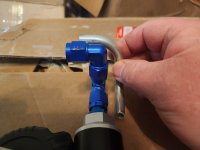
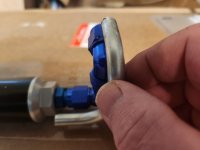
Many of you detest the use of 90* adapter fittings. Certainly where possible, a straight is better. However, there are just some places where a 90* may solve plumbing issues. Like in our wing root filter package. There generally isnt room to run a completely straight system with a looping hose. On the RV14, we opted for a 90* coming out of the tank and 90*s going into the fuselage. The turn from the filter to the fuselage bulkhead fitting meant an almost impossible rigid tube. So we tested this fitting package and found no real issues. Other than the flame war. Its been flying on all of our RV14 packages for 9 years.
 

Attachments

  • Wing root Fuel 2.jpg
    Wing root Fuel 2.jpg
    361.5 KB · Views: 35
  • Wing root Fuel 4.jpg
    Wing root Fuel 4.jpg
    283.2 KB · Views: 33
74 micron Airflow Performance post-boost pump fuel filter, much larger than the wing root filters,
There are benefits to having that AFP as the first filter. If you ever have a large debris load, which is absolutely a real threat that I have seen first hand, a large filter will greatly extend time before the system stops flowing fuel. I would give serious thought to not adding smaller filters upstream that will decrease your debris load capacity. No benefit, with real downside.
 
Last edited:
100 micron wing root filters from Earl's with a serviceable pleated stainless steel element. My intent is to catch any contamination coming from the tanks to prevent the fuel flow sensor, which is in a non-standard location just after the fuel selector, from getting clogged, without introducing too much filtering before the boost pump.

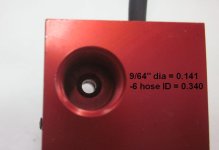
You won't clog the fuel flow sensor with typical granular debris, only chunks of silicone sealant, or fuel lube, or similar. Nor will a jammed rotor stop the flow. That said, the fuel flow sensor (assumed to be a red cube) introduces an additional unknown pressure drop prior to the electric pump....added to all the others contemplated. Note the 0.141" orifice.

The cube belongs on the pressure side, downstream of the all the screens and pumps. Adding wing root filters, with additional 90's, to protect a cube installed in the wrong place is a classic example of "The road to hell is paved with good intentions".

Red Cube Flow Passage.jpg

I'd prefer to use the forged version, because these filters are a little larger/heavier than the previous ones, and it seems to provide more support than the tubular version - but the website says that the flow rate for the tubular version is higher. That's from an automotive racing website, and I suspect the flow rates required are much higher for those cars. Am I good to use the forged version - i.e. flow rate is not an issue - or should I use the tubular version?

Let's review. The issue is not flow rate. It is vapor bubble formation. Lower pressure and/or higher temperature = more bubbles. Bubbles don't pump.

Pressure on the suction side of the pumps is below atmospheric, so vapor bubbles form at a lower temperature. Pressure on the downstream side of the pumps is higher than atmospheric, so higher temperatures can be tolerated.

Sharp corners are a wildcard. Turning the flow around an edge tends to form a little region of low pressure. Given it's hard to quantify, good practice says design them out when possible, in particular on the suction side. It's not always possible.

So we tested this fitting package and found no real issues. Other than the flame war. Its been flying on all of our RV14 packages for 9 years.

A bit of caution may be in order. The RV-14 installations, being 390's not approved for mogas, see only a steady diet of 100LL, specifically formulated to maintain low vapor pressure. A mogas user with a different RV could get in trouble with the same collection of wing root 90's. Consider a load of high RVP winter blend mogas on a warm spring day, with the sun warming the tank.

 
You won't clog the fuel flow sensor with typical granular debris, only chunks of silicone sealant, or fuel lube, or similar. Nor will a jammed rotor stop the flow. That said, the fuel flow sensor (assumed to be a red cube) introduces an additional unknown pressure drop prior to the electric pump....added to all the others contemplated. Note the 0.141" orifice.

The cube belongs on the pressure side, downstream of the all the screens and pumps. Adding wing root filters, with additional 90's, to protect a cube installed in the wrong place is a classic example of "The road to hell is paved with good intentions".

View attachment 108634


Let's review. The issue is not flow rate. It is vapor bubble formation. Lower pressure and/or higher temperature = more bubbles. Bubbles don't pump.

Pressure on the suction side of the pumps is below atmospheric, so vapor bubbles form at a lower temperature. Pressure on the downstream side of the pumps is higher than atmospheric, so higher temperatures can be tolerated.

Sharp corners are a wildcard. Turning the flow around an edge tends to form a little region of low pressure. Given it's hard to quantify, good practice says design them out when possible, in particular on the suction side. It's not always possible.


A bit of caution may be in order. The RV-14 installations, being 390's not approved for mogas, see only a steady diet of 100LL, specifically formulated to maintain low vapor pressure. A mogas user with a different RV could get in trouble with the same collection of wing root 90's. Consider a load of high RVP winter blend mogas on a warm spring day, with the sun warming the tank.

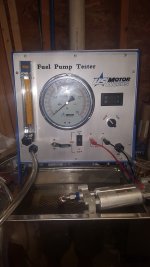
After further review, I'd like to respectfully amend my earlier comment. Yes, a short legged, perpendicular bent tube can be done. Would take the special dies we have for our CNC bender and the flaring machine. See the comparison of the 2 different adapters--Yes bent tube, so supposedly better flow. My (personal) thing about aluma-brazed fittings is that they are brazed, and unless you know the quality of the company, a brazed joint would typically put up a yellow flag for me. YES, there are alot of really good aluminum brazed adapters on the market by quality companies. Aeroquip, Earls (Holley), Russell (Edelbrock), Fragola, and others. We tend to use these, mainly form my past history with them in the racing community. I figured if it was good enough for an Indy car---like Earl's started out, then I think it would be good enough for us. UNDERSTAND, for alot of our applications, there isnt a Mil Spec adapter to solve the problem, like a male/female 90* AN. Yes there is a AN821 but its male/male. BUT--there is a mil spec for it, AN822, and the like, for the inside dimensions. While yes, there is a ridge on the inboard side, (a peak if you will) that you would think would interrupt the flow alittle, these fittings would not have a MilSpec if they were bad to use. I would say that 'most' of the adapters out there are based on the MilSpec drawings. This what we do know from our testing with our fuel pump flow tester. Not as great a tester like a SuperFlow machine at AirFlow Performance, but served our purpose. ( Those that have visited AFP know what I'm talking about). Interested parties may contact me, and I'll share the results and test procedures. Tom
 

Attachments

  • 90-90 differences.jpg
    90-90 differences.jpg
    54.6 KB · Views: 38
  • 90 male differences.jpg
    90 male differences.jpg
    67.2 KB · Views: 34
  • back view RV14 bent tube.jpg
    back view RV14 bent tube.jpg
    183.6 KB · Views: 32
  • bent tube for filter RV14.jpg
    bent tube for filter RV14.jpg
    175.5 KB · Views: 31
  • Flow Tester.jpg
    Flow Tester.jpg
    430.5 KB · Views: 36
Tom.

You make that short double 90 tube to fit the wing root filter system, I'm a buyer. Your current system is installed and working well but I love craftsmanship and supporting good people so take my money!
 
Tom.

You make that short double 90 tube to fit the wing root filter system, I'm a buyer. Your current system is installed and working well but I love craftsmanship and supporting good people so take my money!
Phil, lol---that rigid tube was something I hacked out in about 2 minutes. NOT anywhere close to even prototype phase, much less production by our team. Steve and I havent decided on its future. Might incorporate it with something else.
 
Phil, lol---that rigid tube was something I hacked out in about 2 minutes. NOT anywhere close to even prototype phase, much less production by our team. Steve and I havent decided on its future. Might incorporate it with something else.
Count me number two in line after Phil - assuming the RV-10 installation is the same as the 14.
 
Back
Top