


Van's Air Force

The definitive Van's Aircraft support community! Buying, building or flying an RV? Join our exclusive family of mentors and enthusiasts!

I want to better understand a fuel issue

RNB

Well Known Member
Sponsor
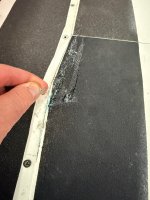
IMG_9566.jpegFor a while now I've had a sticky blue substance near my pilot side wing walk tape. At first it seemed like adhesive from new tape, and I thought of a few other things I am embarrassed to mention...

So, at last today I opened things up and found where I assume it is coming from. Reference first photo here: https://www.vansaircraft.com/wp-content/uploads/2022/03/44_10.pdf

The blue stuff was exiting from under the fairing on top of the wing, near the fuel vent bend, I see no leaks.

I did see blue sticky stuff between one of the connections of the fuel supply line. Sorry, no pics and I mostly cleaned that up.

I tightened the fittings up a bit. I expect the problem is solved.

While this could get moved to maintenance issues, or something RV10 specific, what I really want is understanding! My left fuel tank has a very slow drip out the vent tube onto the ground only when tanks are full or nearly full. If the tanks are not full, no slow drip out the vent AND no apparent drip from this fitting. So why does something happen in flight? I've been told a full tank drip can be normal.

My guess and simple understanding is that the fuel pump only sucks fuel and I can't fathom why there would be any back pressure.

So, what created this condition where there can be fuel gel formation from an apparent leak, but not while at rest?

Thank you for learning me!
 
That's a fuel leak that is dissolving the glue holding down the wingwalk material - thus blue and sticky. Identifying the location of the leak is your first tank, stopping it is the second.
 
That's a fuel leak that is dissolving the glue holding down the wingwalk material - thus blue and sticky. Identifying the location of the leak is your first tank, stopping it is the second.
Yeah, got that. Found a fitting with same gunk, tightened the fitting.

I'm only trying to understand why no leak at rest but had a leak when operating.
 
I'm only trying to understand why no leak at rest but had a leak when operating.
How about this possibility…when in flight that fuel is sloshing around instead of sitting inert at the lower portion of the tank. In aerobatic airplanes it is considered “a ball of fuel” slamming around applying stress to the tank itself. Visualize that and it might help. Good luck finding the leak.
 
Yeah, got that. Found a fitting with same gunk, tightened the fitting.

I'm only trying to understand why no leak at rest but had a leak when operating.
Most fuel vents will slightly pressurize the tank in flight, changing a marginally leak to a real leak. Try hooking up some vinyl tubing to the vent, and blow on it (do not use a compressor!) while looking for a leak.
Sometime ago there were a number of QB tanks produced where the inside nuts on the pass thru fittings were never tightened. Owners used a wrench with a 90 deg bend to access the nuts thru the fuel level float gauge hole.
 
Yeah, got that. Found a fitting with same gunk, tightened the fitting.

I'm only trying to understand why no leak at rest but had a leak when operating.
Vent fitting Will only leak when liquid fuel is present. Liquid fuel only exits the vent line when tanks are at or near full, assuming the nut/tube on the other side of that fitting is sealing properly; otherwise liquid fuel will be present to about 1/2 full. At other times it is just vapor present at the fitting and therefore no staining. The dye does not evaporate and become a gas. While it is soluble in fuel it cannot convert to a gaseous state, at least not at normal temps.
 
Temperature increase and pressure decrease both cause fuel to expand. The reason they drip on the ground is that you fill the tanks, sun hits the wings, the fuel expands and some drips go overboard. This is exacerbated if you fill with relatively cool fuel from underground tanks.

I don't know where the fuel vent lines are in the 10, but on my 7 they're up against the tank skin right next to the fuel caps. If I top off completely and immediately launch into a steep climb, I can see some staining around the inner shaft of the fuel cap as well because the inside of the cap is below the level of the fuel at that high deck angle. I imagine a bit goes into the vent line as well before engine consumption causes the level to drop and it gets sucked back into the tank.
 
The blue stuff was exiting from under the fairing on top of the wing, near the fuel vent bend, I see no leaks.
It could be a very slight leak. Slight enough that you don’t notice any “wetness “ around the fitting (and definitely no dripping) but over time you will get the blue stain indicating that there is a leak.
 
It could be a very slight leak. Slight enough that you don’t notice any “wetness “ around the fitting (and definitely no dripping) but over time you will get the blue stain indicating that there is a leak.

I kind of agree except the fuel is escaping through the top the wing at the fairing, not the bottom. I picture some kind of superfine and super small stream.
 
Back
Top
